Verse 4x1816ilhai aa))inah
G3
1
the heart is a workshop of thought/imagination, and Asad is without the voice/wealth of the heart
2
here, the doorsill-stone of Bedil is a mirror
'Thought, consideration, reflection; deliberation, opinion, notion, idea, imagination, conceit; counsel, advice; care, concern, solicitude, anxiety, grief, sorrow'.
'Voice, sound; modulation; song; air; — a certain musical tone or mood; riches, opulence, wealth, plenty; subsistence'.
| References | |
|---|---|
| Arshi, Imtiyaz Ali | Ghazal# 128 |
| Raza, Kalidas Gupta | 223-24 |
| Nuskhah-e-Hamidiyah | 176 |
| Asi, Abdul Bari | 204 |
| Gyan Chand | 314-316 |
| Hamid Ali Khan | Open Image |
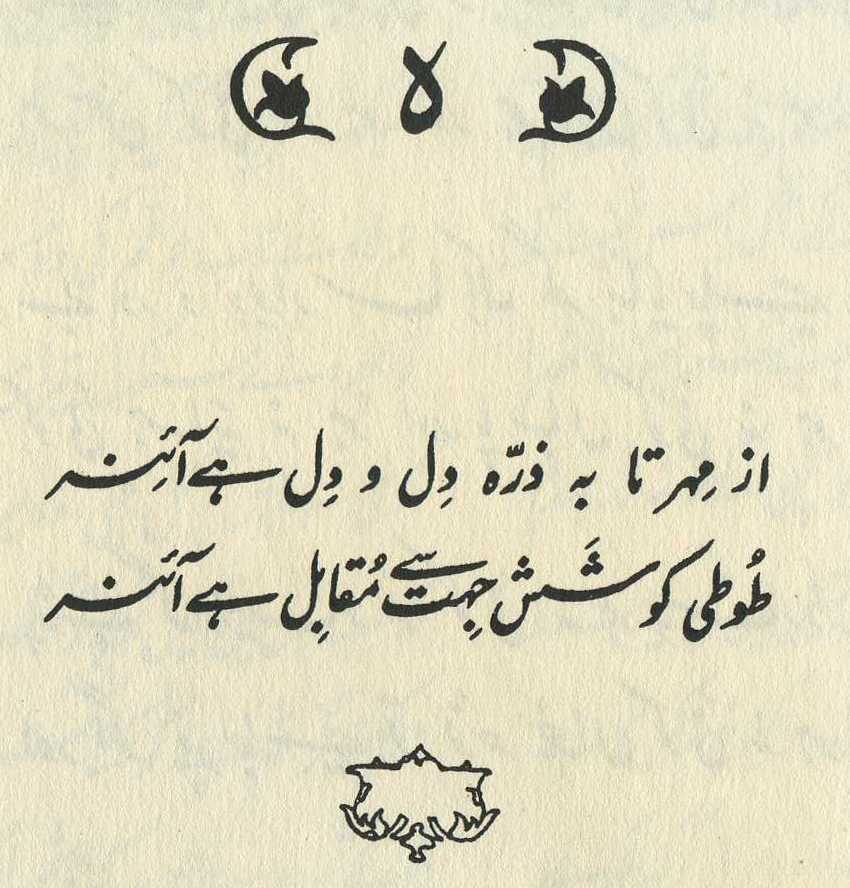
Asad has no heart, although the heart alone is always a workshop of thought/imagination. For us, the doorsill of Bedil has become a mirror-- and that very thing is our heart, the source of our thought/imagination. Only on the style of Bedil is our thought/imagination of poetry based, and that very doorsill-stone is Asad's mirror.
== Asi, p. 204
That is, the workshop of thought/imagination, where theme s of verses are molded, is the heart, and Asad doesn't have a heart at all. Helplessly, he sets out toward Bedil's doorsill-stone, which is the manifestation-place of lofty themes-- like a mirror, in which surrounding scenes are reflected.
== Zamin, p. 307
In the very verse before [ 128,3x ], Ghalib has called the mirror a 'knee of deliberation'; that is, the mirror too collects equipment for thought/imagination. Probably the doorsill-stone too offers this same advantage.... Here, is not the poet Bedil, but rather the 'heart-less' lover.
He says, 'The workshop of thought/imagination is the heart; Asad is devoid of a heart. For others, the heart is a bolster/cushion of thought/imagination (or a doorsill-stone)-- for heart-less me, the mirror is doing this work. I look in the mirror and begin to think about various aspects of my individuality, as if the mirror is my doorsill-stone.'
One other meaning of this verse is: The place of thought/imagination is the heart, and Asad has no heart. For this reason the doorsill-stone of Mirza Abd ul-Qadir Bedil is a mirror. Looking into a mirror, one can meditate and think/imagine. For Asad, Hazrat Bedil's poetry is a mirror of thought/imagination, or a workshop of thought/imagination. In the word there is an . The second interpretation is simpler and clearer.
== Gyan Chand, p. 316
For background see S. R. Faruqi's choices . This verse is NOT one of his choices; I thought it was interesting and have added it myself. For more on Ghalib's unpublished verses, see the discussion in 4,8x .
Asad is not 'without a heart', although all the commentators flatly say that he is. Rather, what he doesn't have is something more complex: the of the heart-- which can range from a 'voice' or 'song', to 'wealth' or 'opulence' (see the definition above). So it's possible that he might have a heart, but one that is somehow dysfunctional, or non-functional.
In any case, he might well see himself as a 'reflection' of an earlier poet named 'Heart-less'. And since we know that the young Ghalib had an extravagant admiration for Bedil (on this see 8,5x ), he might well imagine prostrating himself at the doorsill of Bedil's house, so that the polished marble doorsill-stone might almost act as a (metaphorical) mirror for him.
Note for translation fans: On the translation problem posed by , see 8,2 .
graphics/doorsill.jpg