Verse 6x1821aaz
G9
In this meter the next-to-last long syllable may be replaced by two shorts.
1
{see / having seen} the spectacle of the deceit/beguilement of the device/handiwork of invention/creation
2
the gaze, a reflection-{displayer/'seller'}; and the thought, a mirror-maker
'Deception, deceit, fraud, trick, duplicity, treachery, imposture, delusion, fallacy; allurement, beguilement, &c.''.
'Work, handiwork; art, craft, handicraft, trade, profession... ; a work of art; workmanship, skill (of a worker); make, work, manufacture, fabrication; a machine, engine; --a figure of speech; a mystery; miracle'.
'Creation, production; invention, contrivance'.
| References | |
|---|---|
| Arshi, Imtiyaz Ali | Ghazal# 68 |
| Raza, Kalidas Gupta | 332 |
| Nuskhah-e-Hamidiyah | 112-113 |
| Asi, Abdul Bari | 125-126 |
| Gyan Chand | 213-214 |
| Hamid Ali Khan | Open Image |
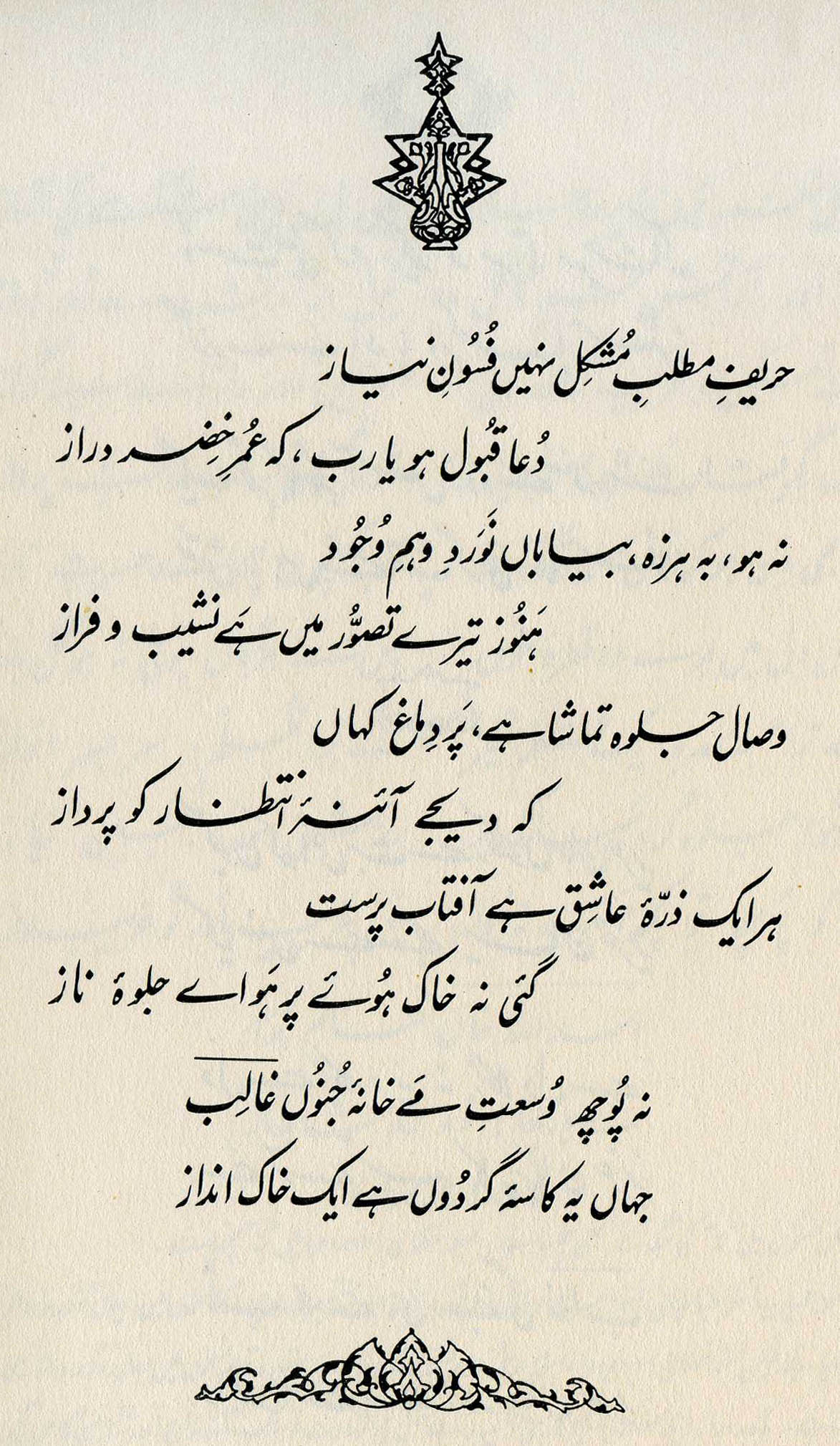
Please just look attentively at this deceit of the device of invention. The gaze is a reflection-displayer and the thought is a mirror-maker. It's obvious that the reflection that falls on the eye is what makes things manifest. Or else, the gaze is constantly showing a reflection of the beloved and the thought goes on preparing a mirror. That is, in order to deceive me both have come together.
== Asi, pp. 125-126
That is, look at Nature's device-invention! What a net of trickery it has spread. Otherwise, the eye is a reflection-displayer and the thought is a mirror-maker. That is, the world and what is not in the world are nothing at all; it is only our thought that makes pictures of things and keeps taking their reflection into its mirror, and the gaze sells those pictures. That is, people, thinking they exist, resolves to experience them.
The relationship of the reflection-selling gaze with the mirror and the vision is that when light from outside falls on the eyes, what is reflected is those various forms/shapes that we experience outside ourselves. And the mirror-making of the thought is [that it devises whatever we see].
== Zamin, pp. 186-187
In this verse is a philosophical illusion []-- [as in the second line of] 141,7 . This is not a world of [real] beings, it is a deceit/beguilement of our inventive temperament. Thought has made a mirror, and the gaze is creating reflections. Otherwise, in reality nothing exists in the world.
== Gyan Chand, p. 213
For background see S. R. Faruqi's choices . For more on Ghalib's unpublished verses, see the discussion in 4,8x .
On the meaning of as 'displayer', see Faruqi's commentary on 67,2 .
Here's an almost morbidly open-ended verse, with such wide meshes on all sides of its net that meanings are constantly slipping in and out. The first line offers us two readings for the verb: either an intimate imperative ('see!'), or a case of deletion ('having seen'); for more on this see 58,7 .
Then we have something that's either an out-and-out 'deceit, trick', or else a seductive, perhaps even participatory, 'allurement, beguilement'. (On the complexities of , see 71,3 .) Next we have a 'device, art, mystery, miracle, figure of speech'-- a huge spectrum of possibilities. And finally we have 'creation, invention, contrivance', with its own rich range of meaning. (See the definitions above.)
These three multivalent terms are joined by constructions, giving us the protean 'A of B of C'. The 'X of Y' can mean either the X that is Y, or the X that causes Y, or the X that is caused by Y, or the X that pertains to Y in some other, unspecified manner. And since constructions work on pairs of items, we also have a choice between 'the A of (B of C)' and '(the A of B) of C'. The possible permutations are staggering; and in a verse so abstract, how to choose?
Then the second line takes a classic 'list' tack: 'A B and C D'. On such lists see 4,4 . We might read the list as 'A is B and C is D', or 'A becomes B and C becomes D', or 'A would be B and C would be D'.
Depending on the multifarious choices we make about the first line, different ones of these possibilities would leap to the mind. For example, 'having seen' a certain kind of spectacle, perhaps as a result 'A becomes B and C becomes D'. Or else we're urged to 'see' a certain kind of spectacle-- 'A is B and C is D'! Or perhaps the whole 'spectacle' is a mere 'deceit'-- in reality, we can't take any of it seriously, and 'A, the B, and C, the D' are illusory shells that are shuffled in a shell-game. And so on and so on, as long as you care to play the game.
graphics/mirrorshop.jpg
