Verse 11816anpar
G2
1
from what would madness receive help/'hand-grip', if it would not be [from] nakedness?
2 a
the right/duty of collar-ripping has come to be upon my neck
2 b
oh Collar, the right/duty of ripping has come to be upon my neck
'Assistance, aid, help; defence, support, protection, patronage'.
'Right, title, privilege, claim, due, lot, portionshare, proprietorship; --duty, obligation'.
| References | |
|---|---|
| Arshi, Imtiyaz Ali | Ghazal# 62 |
| Raza, Kalidas Gupta | 181-82 |
| Nuskhah-e-Hamidiyah | 108-109 |
| Asi, Abdul Bari | 119 |
| Gyan Chand | 208-209 |
| Hamid Ali Khan | Open Image |
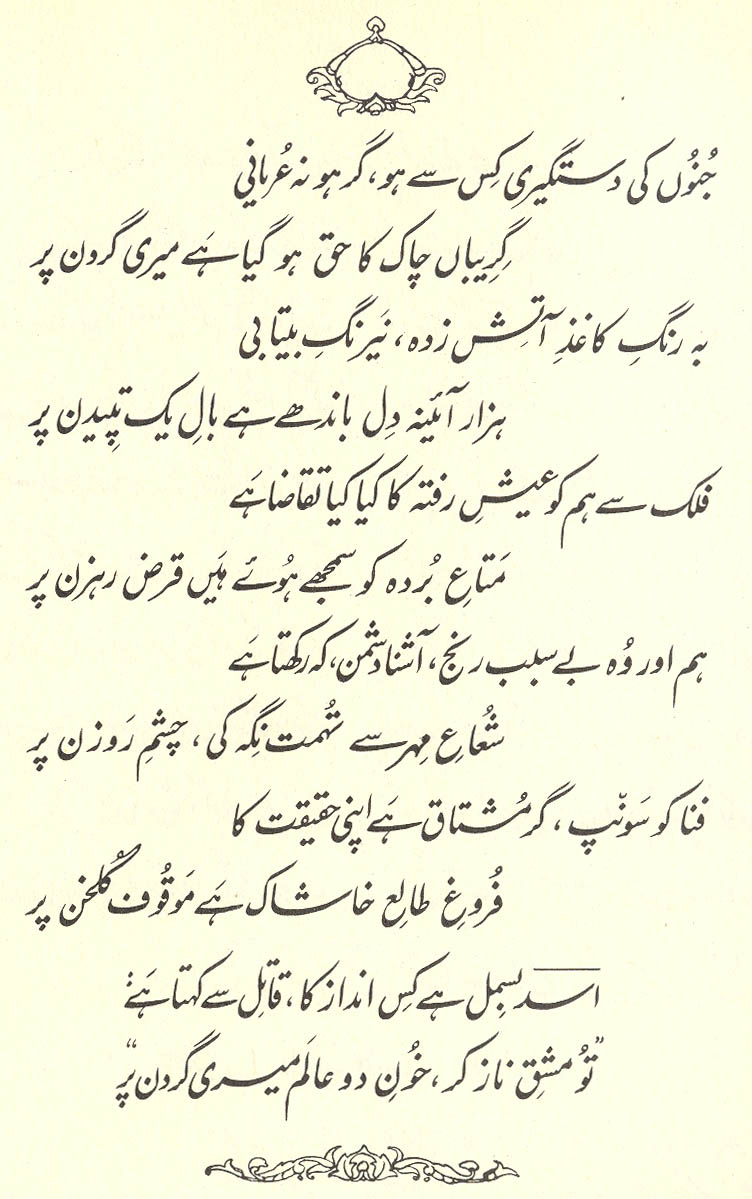
Oh Collar, the right/duty of this ripping has fallen upon my neck, since it has made me naked. Otherwise, I could not have given help to madness. That is, if I were not naked, then what kind of madness could it be? (64)
== Nazm page 64

The result of ripping of the collar is nakedness, and madness has power over nakedness. Thus, addressing the collar he says, Oh collar, because I am a friend of madness, I have acquired the right/duty over my collar of ripping, because by making me naked, it's as if it has seized upon my madness. (63)
He says, I am indebted to my nakedness, for it has aided my madness; for this reason the right/duty to rip the collar-- that is, kindness-- has devolved upon my neck. If the collar were not ripped, then I could have done nothing to help madness. The meaning is that the effects of madness are never established without the ripping of the collar. (112)
That is, divine love is not possible without cutting off relationships with the world. Accordingly, as I keep abandoning relationships, I become indebted to nakedness. (144)
Here, has the meaning of 'kindness'. He says, If there would be no nakedness, then madness remains without status. I ripped the collar and became naked. Thus this nakedness came from the tearing of the collar. Thus the kindness of ripping the collar is on my neck. Because of this kindness, I was able to be of help to madness. (148)
, that is, .
, that is, I am indebted to his/its kindness [].
Meaning: If the lover is not naked, then his madness cannot be established. Since the ripping of the collar has made me naked and thus assisted my madness, for this reason I am indebted to it. (442)
This is one of a number of verses about the ripping of the collar. And it's a particularly multivalent, self-consciously 'difficult' one. But what lovely wordplay!
The first line opens up a range of possibilities. 'Nakedness' is obviously in some sort of helpful relationship to madness-- but what kind? For a discussion of the uses-- and positioning-- of the word 'nakedness' [], see 6,1 .
In the second line, we first have to decide what to do with the awkward juxtaposition of two nouns 'collar ripping' []. Nazm and Hasrat take the former as a vocative (2b), even without any of the usual vocative markers, so that the lover is addressing his own collar. To others (including me), the two nouns look better as a sort of implicitly hyphenated noun compound (2a), of the kind very common in English but rare in Urdu. This usage can also be called a reversed izafat []; for discussion, see 129,6x . On the general practice of collar-ripping, see 17,9 .
The ambiguity of , which can mean both 'right' and 'duty', also makes it harder to decide what is going on. Does the mad lover eagerly claim the right to rip open his collar, or does he experience the collar-ripping as an unchosen duty that has 'fallen upon his shoulders' (or literally, one that is 'on his neck')? Perhaps it doesn't much matter, since the mad lover's fate in general is both self-chosen and helplessly imposed. Why should his collar-ripping be any different from the rest of his destiny? For another play on the ambiguities of , see 26,7 .
In any case, surely the reason people would say ' when they heard this verse is its spectacular witty and amusing wordplay. Both the 'hand-grip' [] for 'help', and 'on my neck' [] for 'upon me' work excellently to bring together the ideas of ripping the collar, madness, and nakedness. The 'hand-grip' is for grabbing the collar in order to rip it; and for seizing the madman in order to restrain him. The 'on my neck' is for the collar, the ripping of the collar, and the right/duty (of whichever kind) that is upon the lover (moral burdens are 'on my neck' in Urdu the way they are 'on my head' in English). As they interact with the complex meaning-play, don't these extra pleasures of related wordplay provide as much as any two-line verse needs to give us?
graphics/kurta.jpg