Verse 81833arga))ii
G3
1
the difference/separation between tomorrow and yesterday all at once became erased
2 a
yesterday you went-- for/since/while Doomsday passed over me
2 b
yesterday did you go, or did Doomsday pass over me?
'Tomorrow; (met.) the day of resurrection.... -- , The resurrection morn.'
'Yesterday (see and ). (Steingass, p. 550)
'Difference, distinction, separation, division; variance, discord, disunion'.
| References | |
|---|---|
| Arshi, Imtiyaz Ali | Ghazal# 205 |
| Raza, Kalidas Gupta | 382-83 |
| Hamid Ali Khan | Open Image |
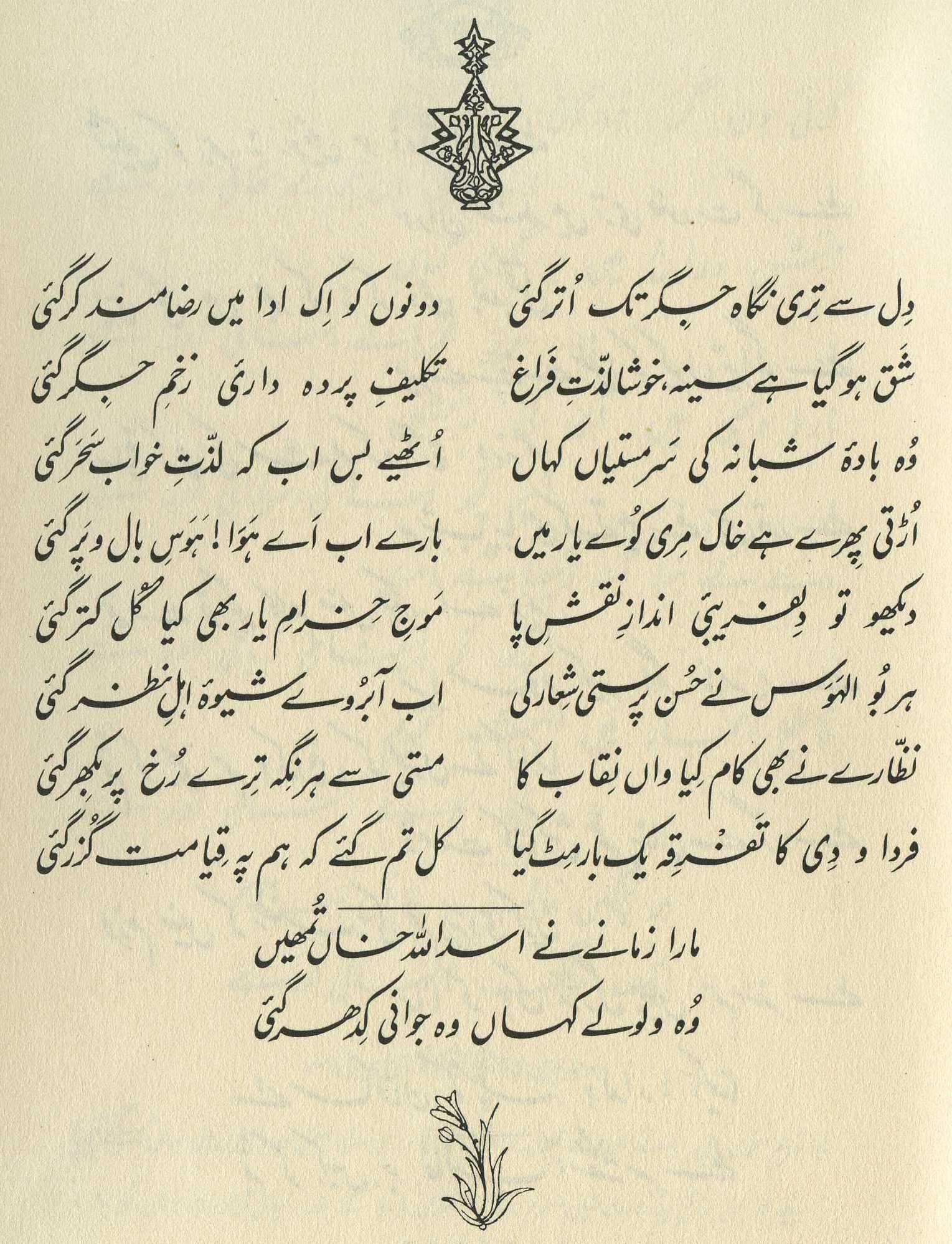
He says that the moment you left, by reason of self-unawareness and self-forgetfulness such a state came about that between today and tomorrow/yesterday there remained no distinction at all. And just such a thing is said about Doomsday too: that there, the past and the future will both turn into the present time. Thus it wasn’t that you went, it was as if Doomsday passed over me. For Doomsday to pass over has two meanings: for a time of extreme harshness to pass over, and for Doomsday itself to pass over.
==Urdu text: Yadgar-e Ghalib , pp. 156-57
Although yesterday was yesterday, the 'tomorrow of Doomsday' confronted me, and tomorrow and yesterday came together in one single day. No difference/separation of past and future remained. (170)
== Nazm page 170

Yesterday, the moment you left, such a self-lessness overtook us that we lost the power to distinguish between today and yesterday. The suffering of Doomsday passed over us.... That is, the moment you left, we departed from the world. (304-05)
SETS == KIH
DOOMSDAY: 10,11
The confusion is radical-- what happened yesterday when the beloved left? Was yesterday thus the metaphorical 'tomorrow' (see definition above) of Doomsday? And if so, was it literally so (could Doomsday actually have happened, and the lover have confused it with her leaving?), or simply metaphorically so (since her leaving was a Doomsday)? Or was he merely rendered so distraught by her leaving, that he can no longer tell night from day, or yesterday from tomorrow, in the most general sense? (As when someone might waks after a terrible concussion and ask, 'Where am I? What day is it? What happened?')
There are, in short, so many possible combinations of literal and metaphorical readings that the whole thing becomes hopelessly convoluted. We in the audience are as confused and bewildered as the lover-- which is, no doubt, part of the point. The various senses of exemplified in (2a) can each be readily invoked, and each creates its own cleverly appropriate relationship with the first line.
Then there's the ' fresh word ' effect of the rarely used ; in particular is so rare that it doesn't even appear in Platts. One could read and hear Urdu for years without encountering it. And in that position, would have fit perfectly (not to speak of many other more elegant ways to arrange the line). But by using the conspicuously exotic , Ghalib achieved the extra punch of novelty-- and also, once we hear the second line, the metaphorical resonance of with 'Doomsday' (see the definition above). There's also the 'difference' or 'variance' of nicely bumped up against the 'all at once' or 'completely' quality of .
This verse reminds me of the even simpler and more eloquent 35,2 .
Note for grammar fans: Ghalib often takes advantage of the multivalences of , but as best I can judge, rarely does he unquestionably use it in the modern colloquial sense of 'or' ( ); however, for one clear example, see 88,6x . In the case of this verse, it seems to me that he does use it as 'or', because the second line reads so well that way (2b). But I can't prove it, because there's also the excellent and quite sufficient reading of (2a), which is along the lines of his normal usage.
graphics/timebreakdown.jpg