Verse 31833arga))ii
G3
1
those intoxications of nocturnal wine-- where?!
2
please get up, enough now!-- for the relish/taste of the dream/sleep of dawn has gone
'Pleasure, delight, enjoyment; sweetness, deliciousness; taste, flavour, relish, savour; —an aphrodisiac; an amorous philter'.
| References | |
|---|---|
| Arshi, Imtiyaz Ali | Ghazal# 205 |
| Raza, Kalidas Gupta | 382-83 |
| Hamid Ali Khan | Open Image |
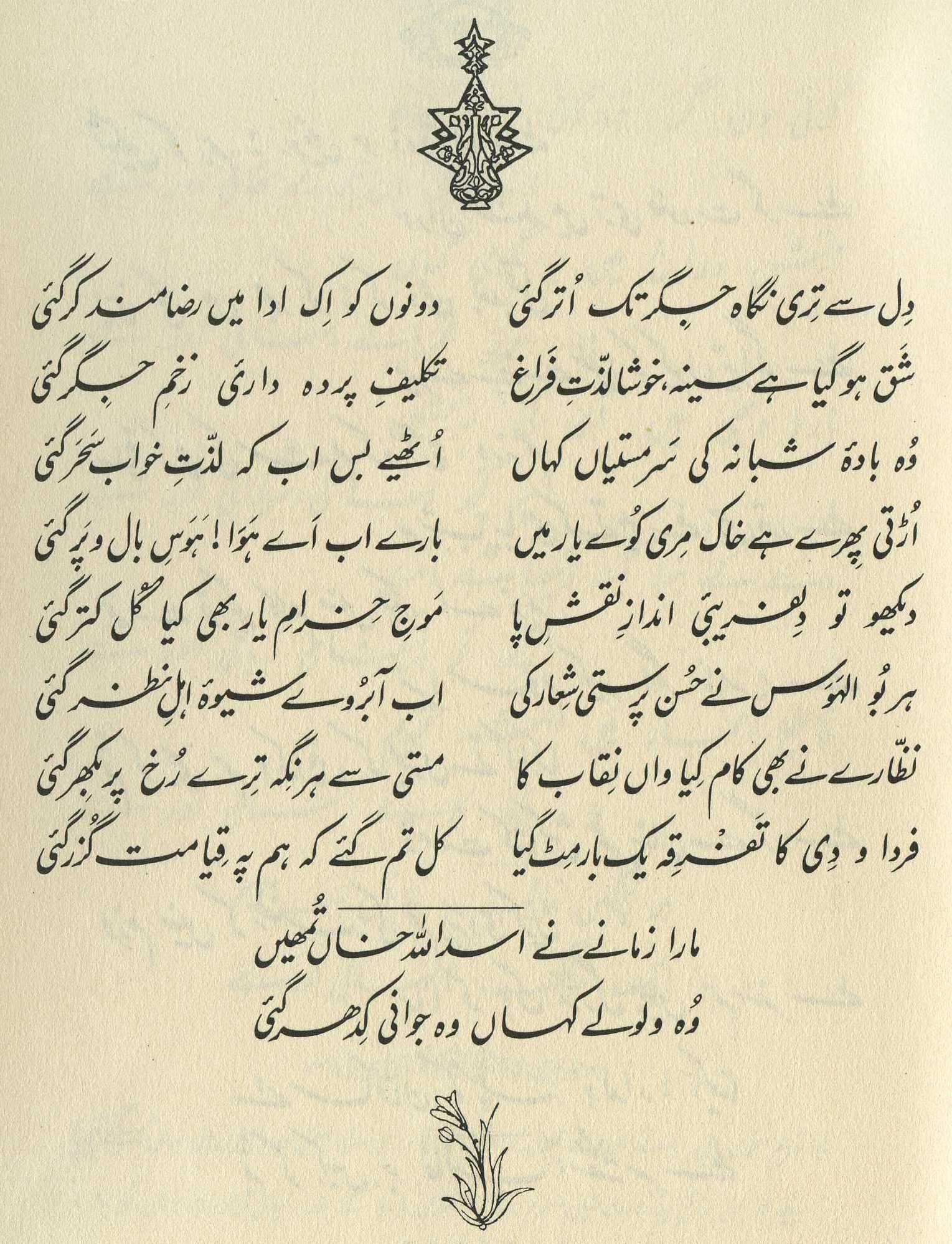
If the words of this verse would bear a literal meaning, then there's no pleasure. Probably [] the author intends a metaphor . That is, by 'wine of the evening' he means the intoxication of youth, and dawn is a metaphor for old age, and the address to get up is to his heedless spirit. (169-70)
== Nazm page 169 ; Nazm page 170


He says, 'Now where have those intoxications of the wine that was drunk at night remained?!' That is, the time of youth has passed; the time for waking up has come. The pleasure of the dream of dawn did not remain; that is, the beginning of old age has come, the time for sleeping the sleep of youth has gone. No occasion for heedlessness remains to the spirit. (226)
The pleasure of the wine that was drunk at night has departed, and in the morning, sleeping is only pleasurable as long as intoxication remains. And when the eyes begin to open from drunkenness, they are dulled, and there's a throbbing in the head. (303)
SETS == A,B; FILL-IN; IZAFAT; KAHAN; STRESS-SHIFTING
DREAMS: 3,3
NIGHT/DAY: 1,2
WINE: 49,1
The commentators generally follow Nazm's lead in making the simplest and most didactic reading of the verse. Certainly their case is plausible: they can cite in their support the famous verse-set in 169 , with its classic contrast of the nighttime party versus the morning after.
But of course, such a prosy, cut-and-dried reading is achieved only by ignoring all the subtleties of which Ghalib is such a master.
In the first line, what kind of 'night-wine' intoxications are we talking about? Considering the subtleties of the , they might be ones caused by wine that is drunk at night; or they might be ones caused by 'night-like' wine-- wine that has night-like qualities. Moreover, the first line ends in a well-placed that yields three very available readings:
=Those 'nocturnal' intoxications used to exist, but now it's dawn and they're over.
=Those 'intoxications' were never more than a dream, and never did have any real existence.
=Where are those night-time intoxications now, the speaker wonders-- now that it's dawn?
Then if we look to the second line for some interpretive help, we find that something has gone. And what might that something be? Allowing for all the readings, here are some haunting possibilities:
=the enjoyable dream/sleep that takes place toward dawn
=the enjoyableness of the dream/sleep that takes place toward dawn
=an enjoyable dream about (an idealized?) dawn
=the enjoyableness of a dream about (an idealized?) dawn
Then when we actually try to put it all together, we realize that we don't know what relationship exists between the 'intoxications of nocturnal wine' and the 'relish/taste of the dream/sleep of dawn'. How are we ever going to come to an end of the permutations? Does the second line describe the same state as the first (X is gone, get up because X is now over), or another state (where is X?, and furthermore Y is gone, so get up)? Are 'intoxications' to be identified with the 'taste/relish', the 'dream/sleep', or neither? Is the 'wine' to be identified with the 'taste/relish', or the 'dream/sleep', or neither? Moreover, whether we interpret as 'dream' or 'sleep' will make a big difference in how we imagine the connections.
In short, this deceptively 'simple' verse is astonishingly tricky; its fault is not simplicity, but undecideability (if in fact that's a fault). Is the speaker being painfully ejected from a lovely lost paradise, or being rescued from some delusional non-world, or being briskly welcomed into a new, brightly sunlit day? As so often, we're left to fill in the possibilities for ourselves.
Yet with all this, the verse remains a most powerful and haunting evocation of ' mood '.
On the translation of as 'has gone', see 158,2 .
graphics/nightwine.jpg