Verse 61833arga))ii
G3
1
every lecher has made a method/habit of the worship of beauty
2
now the honor of the profession/habit of the people of vision/sight has gone
'Desirous; whimsical, capricious, fickle; — a wavering, or fickle person; blockhead'.
'Mark, signal, sign, countersign, password, parole; habit, custom, practice; method, manner'.
'Business, trade, profession; manner, habit, custom, practice; amorous ways and looks'.
zar>> : 'Sight, vision, view; look, regard, glance; observation, inspection; supervision; —favourable regard, favour, countenance; —view, opinion, estimation; —intent, design; —regard, relation, reference'.
| References | |
|---|---|
| Arshi, Imtiyaz Ali | Ghazal# 205 |
| Raza, Kalidas Gupta | 382-83 |
| Hamid Ali Khan | Open Image |
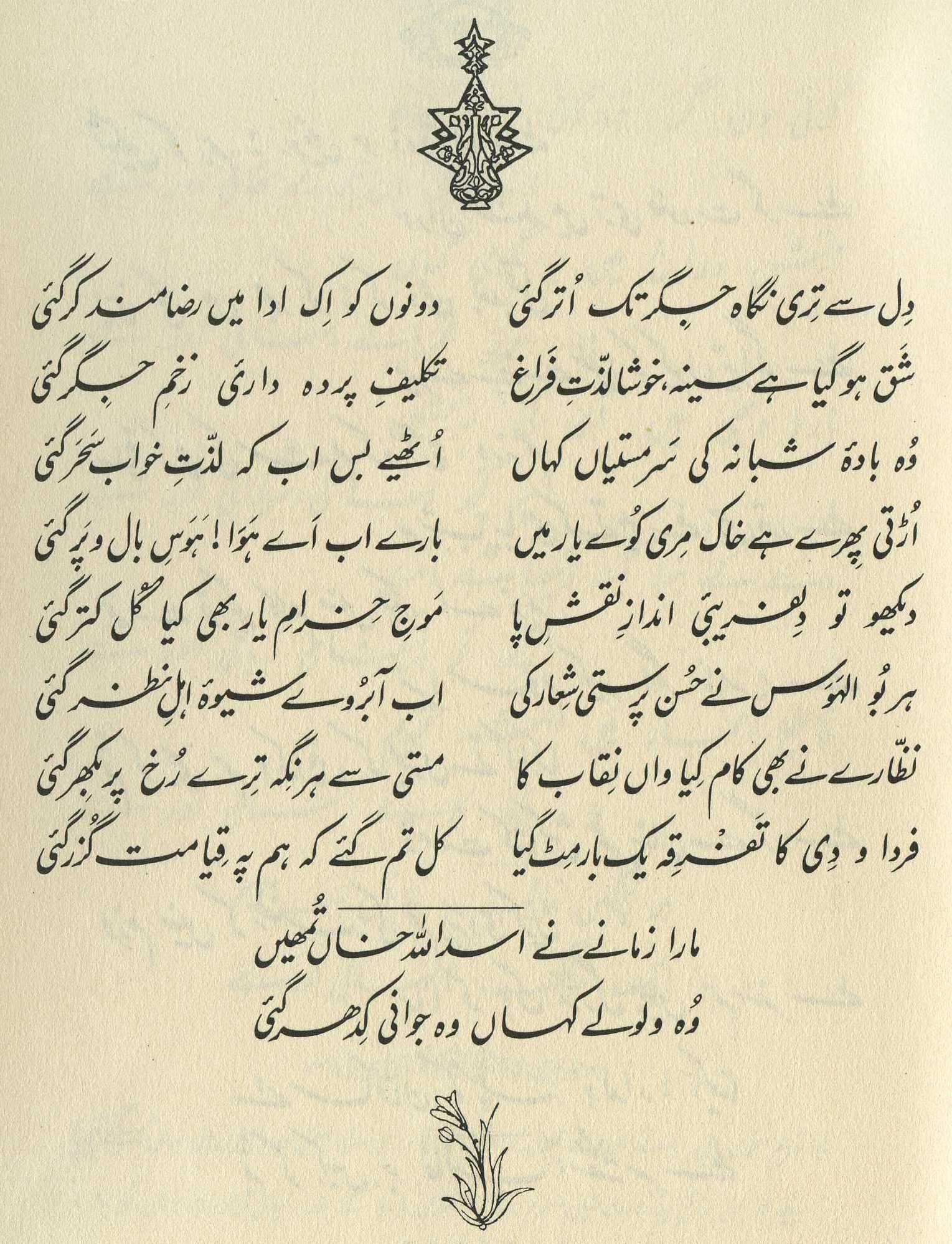
That is, the worship of beauty was the practice of people of vision: they recognized the affinity of the elements and pursued sincere passion. When all sorts of people also began to practice the worship of beauty, then the practice of people of vision was left with no honor at all. (170)
== Nazm page 170

He says, the habit of the lustful was not the worship of beauty. But now they too, without thought or understanding, have adopted this habit. The value of the sincere passion of people of vision has been vanishing. (226)
By the 'worship of beauty' only poetry can be intended. Now every lecher has become a 'worshipper of beauty'-- now the honor of that noble art/craft can no longer remain.
[Or:] Now every illiterate, every fool, has begun to compose poetry, and the distinction that used to belong to this noble art/craft-- that it was reserved only for people of vision-- has been vanishing. (304)
Alas, this one leaves me at a loss. It's quite simple in appearance, and the commentators explain it sensibly. But surely there's something more going on? Some bit of wordplay that we're missing? Where's the punch, where's the sudden burst of pleasure, where's the complexity, where's the central focus of the verse? It doesn't seem to lose much if paraphrased into prose-- which is always a bad sign. I don't know why Faruqi marks it as a notably good verse.
The sequence of is of course an enjoyable sound effect.
Compare 115,6 , for an example of how much more can be done with the 'lecher'.
On the translation of as 'has made' and as 'has gone', see 158,2 .
Note for meter fans: The Arabic phrase is actually pronounced, and scanned, bul-ha-vas, = - = .
graphics/rivals.jpg