Verse 11826arme;N ;xaak nahii;N
G9
In this meter the next-to-last long syllable may be replaced by two shorts.
1
the pleasures/relishes of the world, in my own view, are {nothing at all / not 'dust'}
2
except for '[drinking] the blood of the liver'-- and then, in the liver there’s {nothing at all / not 'dust'}
'Taste savour, smack, relish; delight, pleasure, enjoyment; anything agreeable to the palate or to the mind, &c.; a delicacy, a tidbit; a bon-mot; jest, joke, fun, sport, amusement'.
'Dust, earth; ashes; --little, precious little, none at all, nothing whatever'.
(postposition) 'Except, save, but, besides, other than, over and above, further than'.
'To suppress (one's) feelings, restrain (one's) emotion, or anger, or grief, &c.; --to consume (one's own) life-blood; to vex or worry (oneself) to death'.
| References | |
|---|---|
| Arshi, Imtiyaz Ali | Ghazal# 101 |
| Raza, Kalidas Gupta | 365 |
| Hamid Ali Khan | Open Image |
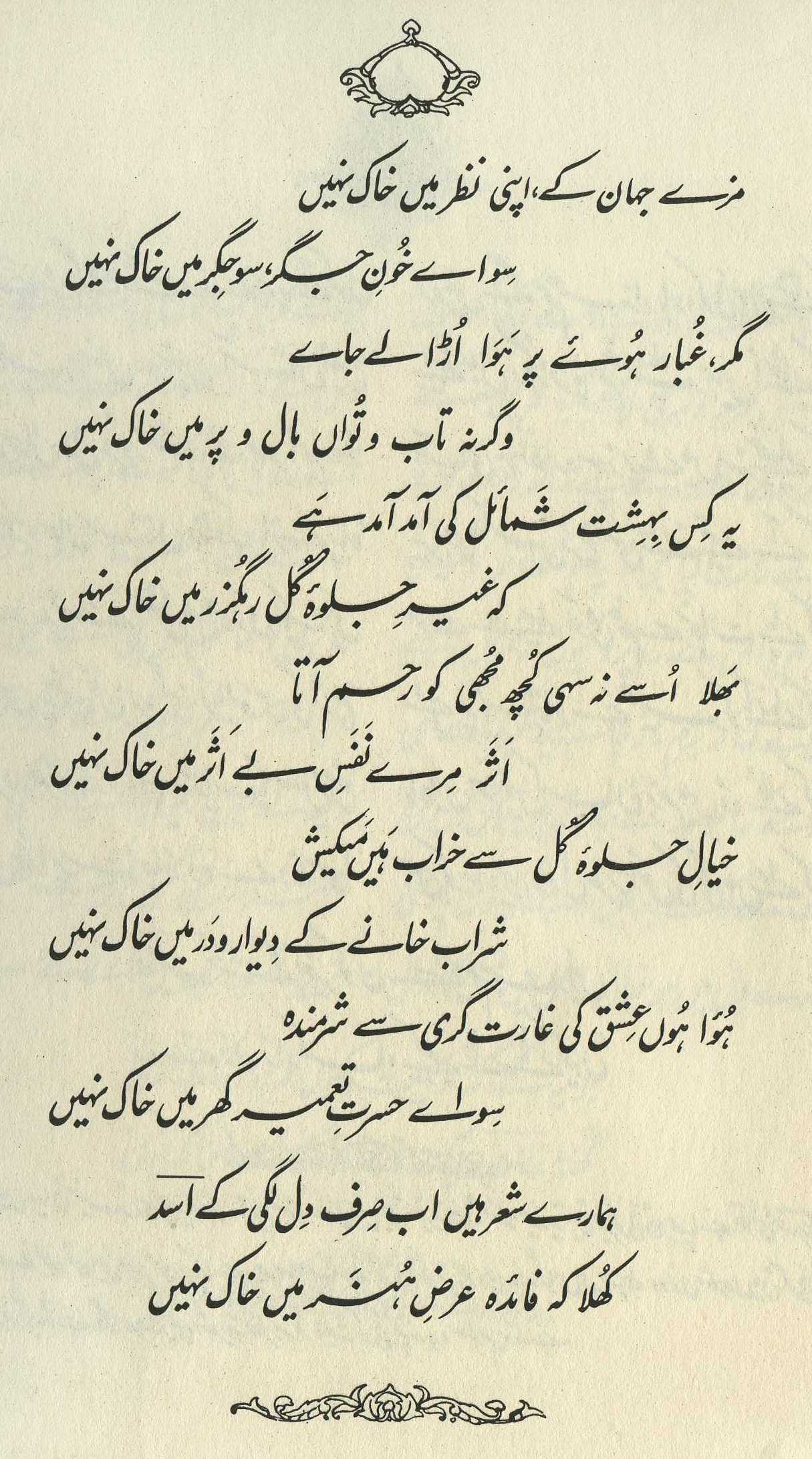
There's no pleasure at all [] in the world's eating and drinking. Indeed, although there's relish in drinking the blood of the liver [], there's no blood at all in the liver. The use of 'thus' [] is now being abandoned. (122)
== Nazm page 122

He says, the enjoyment of the world's eating and drinking is, in my eyes, nothing []. That is, I don't get any pleasure [] at all. Although in drinking the blood of the liver, there was always pleasure; but now there's nothing at all [] in the liver. That is, in the liver there's no blood left. I've devoured it all. (173)
Besides drinking the blood of the liver, all the world's pleasures are trifling, in my eyes. But it's a pity that now in the liver there's not even a trace of blood. That is, in our view only experiencing disasters and tests, and enduring them, was an enjoyable task. But now there's no strength left for enduring cruelty. Now our life is useless. (230)
Compare 166,5 . (226)
This ghazal uses one of the longest, most demanding sets of rhyming elements that Ghalib ever adopted: it has a rhyme of , followed by a refrain of ; the two together take up, most unusually for Ghalib, almost half of the metrical line (7 syllables out of 15).
And surely much of the real enjoyment of the ghazal is in its idiom-play. The idiom (see the definition above), or (as in 87,1 ), or (as in 67,3 ), is also evocative on a literal level-- something is as useless as dust (a vivid reminder of mortality), or somewhere there's 'not even dust' (meaning, with melancholy overtones, that it's entirely empty). The different spins given to in the course of the ghazal are a study in themselves: most of the verses relieve their bleakness only by using it as a touch of idiomatic black humor (or black wordplay?). But then-- 114,3 is eager for the coming of someone or something magnificent, and 114,5 depicts a kind of mystical rapture of intoxication.
The commentators read the present verse with enjambment: as a statement one and a half lines long, followed by a statement half a line long: the speaker despises all the world's pleasures except 'the blood of the liver'; and he has no 'blood of the liver'. This is a fine reading, and very Ghalibian. There are also the usual Ghalibian subtleties: is producing and consuming the 'blood of the liver' to be ranked among the pleasures of the world (as the only one of them with any value)? Or is it to be contrasted to them (it has value, they do not)?
In addition there are the subtleties of -- worldly pleasures are as useless as dust (a vivid reminder of mortality); the blood of the liver is dust, or as worthless as dust; or the liver is so empty and incapable of fortitude by now, or so generally worthless to a world-despiser like the lover, that there's nothing to it except a doomed little clot of blood.
Then there's the second, latent idiom: 'to drink the blood of the liver' [] (or sometimes ), with the range of meanings given in the definition above, including both the suffering of intense vexation, anger, frustration-- and the extra suffering of suppressing such emotions. Rather than enjoying worldly food and drink, the lover 'drinks the blood of the liver'-- or rather, did when he could get it, since now he apparently can't.
As we in the ghazal world know, the manufacture of the 'blood of the liver' is all that keeps the heart in business; on this see 30,2 . The speaker's liver is a nonstop blood-producer, bringing him the only joy he knows: the joy of suffering, and of morbidly suppressing that suffering. Is this a worldly, or an anti-worldly, joy? Is it part of his living, or part of his dying? His liver contains and provides absolutely nothing else except blood. As a rule, 'possession of a liver' [] is a measure of dignity, control, self-command (for an example, see 21,11 )-- but not, of course, in this case, since the liver in question is, if not solely devoted to blood-production, either full of blood/'dust', or full of nothing at all. ('Oh, the liver? There's nothing in that.')
Not a bad range of possibilities for this opening-verse to invoke! Once room has been made for two such restrictive, challenging sets of rhyming elements, a mere sixteen syllables remain for actual use.
On the use of to mean , see 15,12 .
graphics/liver.jpg