Verse 4x1816uud-echiraa;G-e kushtah hai
G1
1
they are wounded/scarred by mutual/shared connection , the people of the garden, if the rose would be a martyr/'witness'
2
the tulip is the {longing/sorrow}-{stained/overwhelmed} eye of an extinguished/'killed' lamp
'(adjectively) Branded, cauterized, scarred, wounded, &c.:'.
'Also, even, likewise, as well, as, same, similar, equal; in the same manner, equally; —together, with; both; one another, other, mutual, mutually'.
'A witness; ... a martyr'.
'Defiled, polluted, sullied, soiled, stained, spoiled; smeared, immersed, covered; loaded (with), overwhelmed'.
| References | |
|---|---|
| Arshi, Imtiyaz Ali | Ghazal# 151 |
| Raza, Kalidas Gupta | 265-66 |
| Nuskhah-e-Hamidiyah | 218 |
| Asi, Abdul Bari | 228-230 |
| Gyan Chand | 351-353 |
| Hamid Ali Khan | Open Image |
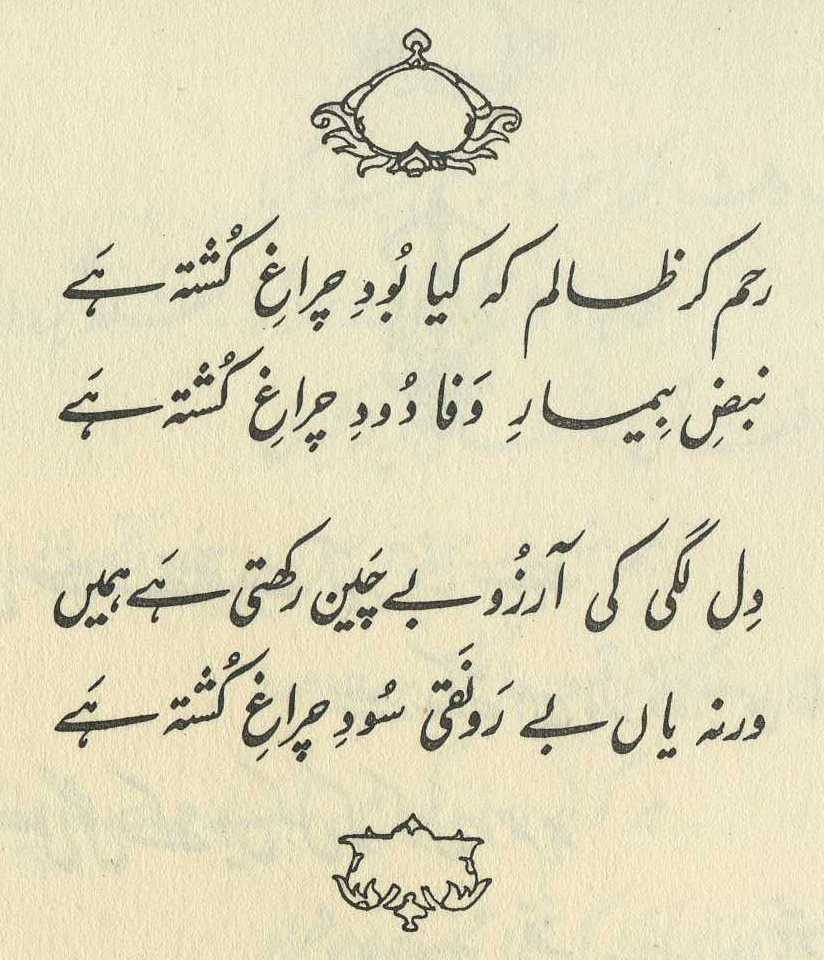
The people of the garden feel envy/jealousy toward one another, and the situation is such that if the blood-shrouded rose would be a martyr, then for this extinguished lamp the tulip would seem to be an amazement-overwhelmed eye.
== Asi, p. 229
The tulip has been given the simile of an eye with regard to its revolving [on its stem]; another cause for similitude is the tulip's black scar and the eye's black pupil. And the tulip's being overwhelmed with sorrow is apparent from its being bloodstained. And the eye of the extinguished lamp is certainly overwhelmed with sorrow, since it has already died and the radiance and brightness of its eye have already gone.
== Zamin, p. 345
The people of the garden, because of their connection with each other, have the wound/scar of longing/sorrow and despair. For example, if the rose would be a martyr, then the tulip, in sympathy with it, will display itself like the sorrow-overwhelmed eye of an extinguished lamp. The eye of a lamp is itself the lamp's openness/cheerfulness. Asi has writen about the meaning of the first line that the people of the garden feel envy/jealousy of each other. In my opinion, they are sympathizers with each other.
== Gyan Chand, p. 352
For background see S. R. Faruqi's choices . For more on Ghalib's unpublished verses, see the discussion in 4,8x .
For discussion of the tulip and its 'wound' or 'scar', see 33,1 .
The grammar of the verse offers two possibilities. If we read the 'midpoint' phrase as part of an end-stopped first line, then the first line becomes 'if the rose would be a martyr, then the people of the garden are wounded/scarred by mutual connection'-- that is, the rose's martyrdom is a special case, it's what causes the other garden-dwellers to feel sympathetic pain. On this reading, the second line offers the tulip as a case in point, illustrating such a feeling of empathy.
But if we read the two lines with enjambment, then the verse offers first a general truth: 'the people of the garden are wounded/scarred by mutual connection'-- in other words, they all share each other's pain in a general way, not just the pain of the rose. We then see an example of such sympathy: 'if the rose would be a martyr, then the tulip suffers as well'.
In this verse, it doesn't seem to make much poetic difference, but still the two possibilities are grammatically and logically quite distinct. And we need to keep our analytical powers attuned, for other verses make more fundamental use of such multivalence.
At the heart of the verse is a network of wordplay. To be a martyr involves literally being a 'witness' to one's faith, and a 'witness', by definition, sees something and testifies to what he or she has seen. The rose is a martyr or 'witness', and the tulip is an overwhelmed, or stained, or suffering, 'eye'. Why is the tulip like an eye? Because it's round and cupped like an eyeball, and has in it the dark (blinded by grief?) 'pupil' of a wound or scar. Why is the tulip like an extinguished oil lamp? Because it's round in shape, and its dark central wound/scar resembles the burnt and blackened wick of the lamp.
graphics/burntlamps.jpg