Verse 21816uud-echiraa;G-e kushtah hai
G1
1
the longing of/for heart-attachment keeps us restless/uneasy
2
otherwise, here, non-radiance {is / would be} the advantage/profit of an extinguished/'killed' lamp
'Lustre, water (of a sword, &c.); brightness, splendour, beauty, elegance, grace, ornament; freshness, prime; colour, complexion; flourishing state or condition'.
'Utility, advantage, benefit; profit, gain; interest, usury'.
| References | |
|---|---|
| Arshi, Imtiyaz Ali | Ghazal# 151 |
| Raza, Kalidas Gupta | 265-66 |
| Nuskhah-e-Hamidiyah | 218 |
| Asi, Abdul Bari | 228-230 |
| Gyan Chand | 351-353 |
| Hamid Ali Khan | Open Image |
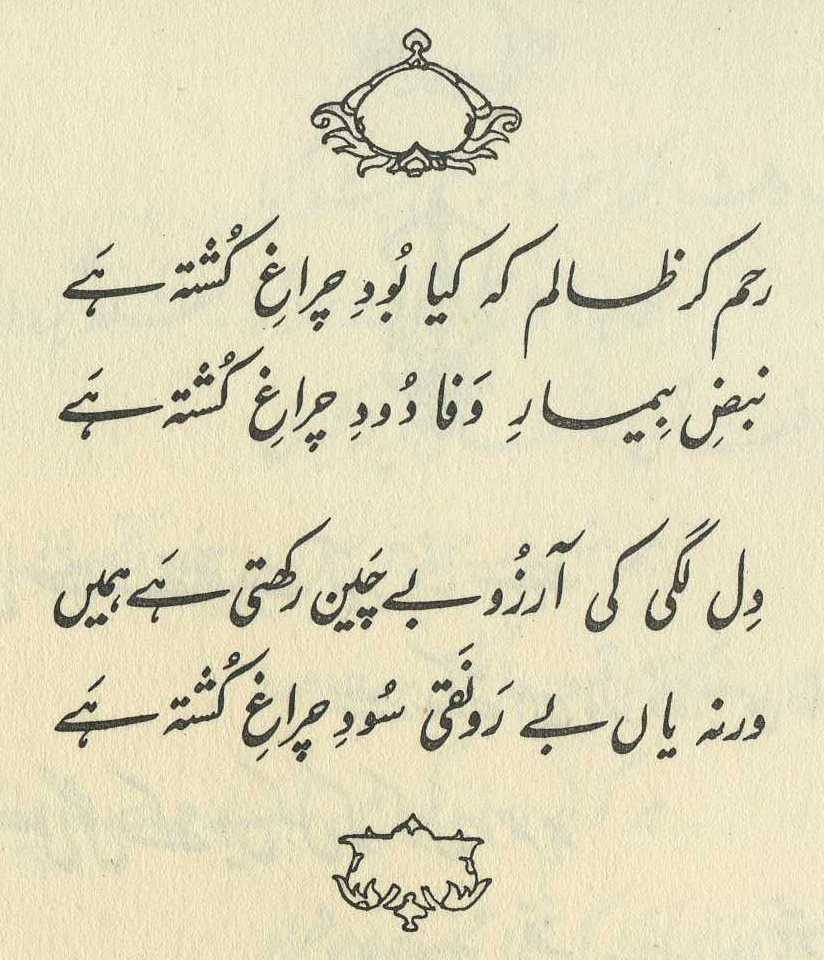
That is, the of the burning of passion is entirely a cause of loss [] for the heart. Look at the lamp, and heed the moral lesson: for it, burning is a cause of loss, and in 'silence'/extinguishedness [] and there is profit [].
== Nazm page 155

He says, the longing for heart-attachment keeps us restless, and as an illustration of this he presents the fact that the of a lamp is a cause of harm to it. That is, if a lamp keeps on burning, then its oil and wick both become finished, and the lamp is harmed. And if it is extinguished, then its is beneficial to the lamp. (213)
That is, the half-burnt candle that would be extinguished-- its profit [] is in the fact that it wouldn't be burned again. So that in this condition, it will enjoy the air of the world for a few more days. In the same way our heart, which is half-burnt-- its profit too is in the fact that now it wouldn't be consumed in the fire of love. But what's to be done-- the wretched heart itself won't agree.
For an extinguished lamp, alone is suitable. In the same way, when strengths and longings have come to an end, it's better to avoid the worship of beauty. But what's to be done? We're constrained by the heart. That is, now our age no longer remains capable of being a lover, but we're constrained by the heart. (284)
The speaker is, he implies, an 'extinguished lamp' (or, literally, a 'killed' one). In what sense would , with all its complexities of meaning, be a gain or 'profit' to him? There are surprisingly many possibilities:
=Because now he gets to live longer, instead of quickly burning himself out.
=Because now he no longer suffers the pain of burning, and could be cool and comfortable instead.
=Because it's proper: when his bright burning prime of life is over, he should withdraw from the 'heat' of the action and live quietly.
=Because now he's dead, and it's better to be dead than to be alive.
=Because now he's not really dead, since he can always be re-lit again.
=Because it's so unworthy and incomplete to remain half-burnt that only is a proper way to show his humiliation and regret.
=It's not really a profit to him at all, but it would be, if only his heart would cooperate (using the other, contrafactual sense of ).
The interactions and oppositions among these meanings quickly take us into the domain of the central paradox: it's the fiery, self-consuming process of (passionate) living that kills the lover, just as the very process of burning gradually 'kills' the lamp as it burns itself out. Is the lover better off half-burnt (like a lamp or candle that's been extinguished), with the resulting overtones of frustration and incompleteness? And if he's half-burnt, is he then alive, or dead, or half-alive, or half-dead? Or is he better off fully burnt (like a lamp or candle that has burnt itself out and can never be relit)?
These questions are emphasized by the vocabulary of profit and loss brought in by the word 'profit' []; this choice of word readily brings to mind both 'loss' [] and the word , which also means 'profit', as can be seen in Nazm's and other commentaries. The commercial overtones of 'profit' and 'loss' can be seen very clearly in 3,3 . This evocation of a balance sheet works well with the questions about consumption and consumedness that the verse raises: an oil lamp, after all, is a perfect illustration of the process.
And of course, the tone of the verse can be melancholy, rueful, sarcastic, bitter, or neutrally descriptive-- other than the reader, who's to decide?
graphics/burntlamp.jpg