Verse 5x1816uud-echiraa;G-e kushtah hai
G1
1
the tumult/brackishness, is of the presentation of the wounds-chamber of which gathering?
2 a
at dawn, a 'whole-gathering' of salt is the profit of an extinguished/'killed' lamp
2 b
at dawn, the profit of an extinguished/'killed' lamp is a 'whole-gathering' of salt
'Cry, noise, outcry, exclamation, din, clamour, uproar, tumult, disturbance; renown; —adj. Disturbed (in mind), mad (= ); —salt, brackish (cf. S. ); very bitter'.
'Assembly, company, party, entertainment, feast, banquet'.
'Presenting or representing; representation, petition, request, address; ... s.m. Breadth, width'.
'Salt; —savour, flavour; —bread, subsistence; —(met.) piquancy; spirit, animation; —grace, beauty'.
| References | |
|---|---|
| Arshi, Imtiyaz Ali | Ghazal# 151 |
| Raza, Kalidas Gupta | 265-66 |
| Nuskhah-e-Hamidiyah | 218 |
| Asi, Abdul Bari | 228-230 |
| Gyan Chand | 351-353 |
| Hamid Ali Khan | Open Image |
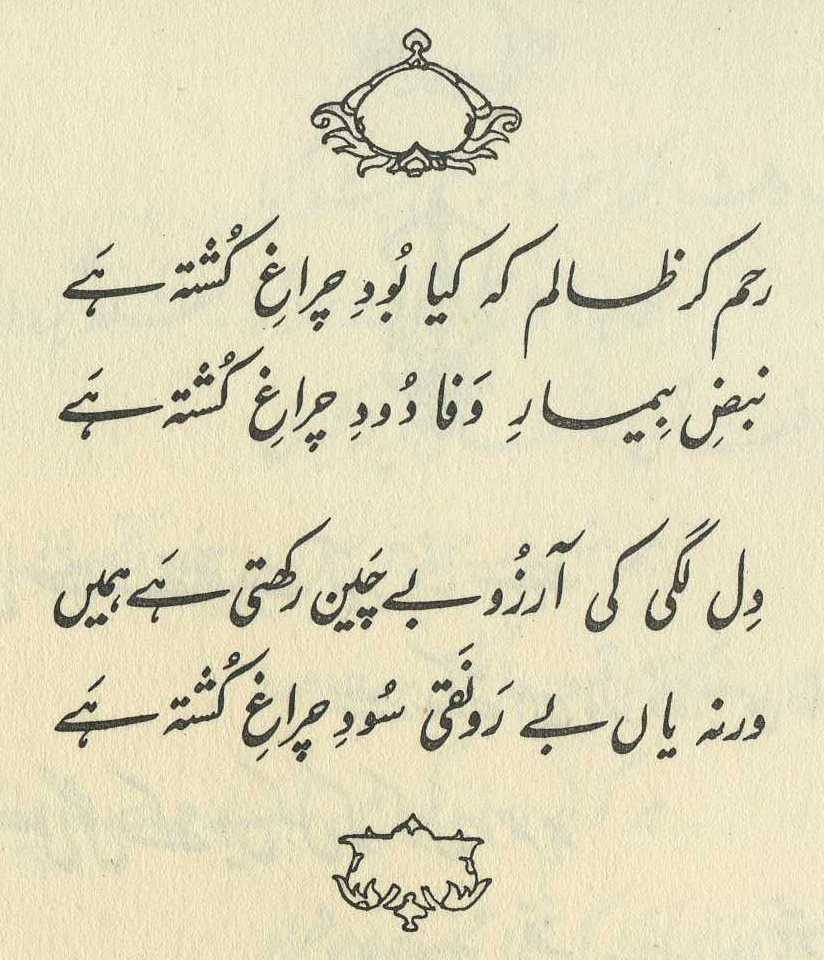
There's no telling, about the wounds-chamber of the manifestation and presentation of which gathering, clamor is being raised in the world. For the dawn too seems to be a salt-profiting wound; and this wound is of that lamp that has been extinguished. This is with regard to the crack, that dawn is like a wound; and with regard to whiteness, the wound has been given the simile of salt-profiting.
== Asi, p. 229
For the 'crack of dawn' [] (its abrupt rising []) the known simile s are: the wound in the liver; the tearing of the collar; the tearing of the garment-hem; and the smile. Mirza has brought together the similes of the wound and the smile and called it a , because salt is a metaphor for existence. And then to add to this he has said 'the wound of the extinguished/killed lamp', and created a suitable freshness in the simile. The reason for calling the wound of the extinguished/killed lamp the 'wound of dawn' is clear: that there is the same single time for the dawn's being wounded and the lamp's being extinguished/killed-- dawn!
== Zamin, p. 346
In the beloved's gathering, in a single room many lovers have been wounded. Thus the dawn too is like a single wound, on which salt has been sprinkled. Because of the crack, he has given to dawn the similitude of a wound; and because of the whiteness, [the similitude] of salt. He has spoken of the wound of the extinguished/killed lamp because they call the extinguishing of a lamp its 'killing'.
When someone would be murdered, then there will also be a wound. The proof of the dawn's being wounded is the murder of the lamp. The extinguishing of the lamp is the proof of the dawn. By is meant the tumult of the beloved's slaughter-chamber. The meaning of is 'saltiness' as well, but here that is not intended; with regard to wordplay [] Ghalib often brings in the word together with the mention of salt.
== Gyan Chand, p. 352
For background see S. R. Faruqi's choices . For more on Ghalib's unpublished verses, see the discussion in 4,8x .
The first line has a favorite Ghalibian structure, in the form of a question (compare 1,1 ). Some festive gathering is attracting attention, for its tumult, its clamor, its liveliness-- which in turn is generated by the 'presentation (or depth) of wounds' in the gathering. We know all this; all we need to ask is which gathering is the center of the buzz, whose salon is the place to be.
As so often, the second line doesn't answer the question, but offers a flat assertion of its own. If we follow Gyan Chand and read as a noun, this gives the second line the structure 'A, B, C, is': the 'dawn', the 'gathering of salt', and the 'profit of an extinguished lamp' have to be placed in some kind of apposition ('A is B and C', or 'A is B, and this combination is C', or whatever). Gyan Chand maintains that the line is really about the killed lamp: what it gains is the 'dawn', which is 'a whole gathering of salt'. Another, and more convenient, reading would be to take as adverbial, 'at dawn', and say that that's the time when the 'killed lamp' reaps its profit of the whole gathering of salt.
Either way, the whiteness of the dawn light (on the 'crack of dawn' see 67,1 ) provides the 'killed lamp' with a whole horizon of salt; and of course, dawn is proverbially the time when the lamp that has burned throughout the night is 'killed' either by being extinguished (because its light is no longer needed for vision, and because the party is over) or by its own night-long burning (it uses up its oil and flickers out). The 'killed' lamp has died of its 'wounds', including grief at the breaking-up of the gathering (compare 169,12 ).
Is access to all this salt really a 'profit' to the dead lamp? The line might be read sarcastically (that's all it gets for its trouble and suffering!), but of course, the lamp may well burn, like a lover, with its own flame, and may thus delight in having ample supplies of salt to enhance the fiery wounds of passion (if, that is, the lamp can still use the salt after it has been 'killed'). The connection between wounds and salt is a well-established one; for discussion and examples, see 77,1 .
It's striking that occurs in both lines. Obviously this is deliberate, since it would have been easy to frame a second line that didn't include it; thus it can't be some kind of culpable 'padding' (see 17,9 for discussion of this concept). Instead, what we see in the second line is used as a kind of measuring-scoop, 'a whole gathering-ful' of salt. For discussion of this Persian idiomatic structure (of which the young Ghalib was very fond), see 11,1 . This double usage is enjoyable because of the various senses of as a gathering (a collection of many parts), a party (for pleasure), and a feast (involving food, and spices like salt). By pointedly using in each line, Ghalib has almost commanded us not only to read each occurrence differently, but also to reflect on the different senses of and the other images that the verse invokes.
For the verse offers several interrelated patterns of imagery. There's food: a can be a 'feast'; can mean 'bitter, salty'; while means 'salt'. There's also the connection of 'bitter, salty', 'salt', and 'wounds'. Then there's the link between the 'wounds' and the 'killed' lamp; and that between the whiteness of 'dawn' and the whiteness of 'salt'. And there's a kind of romantic set as well: can mean 'renown' (in the sense of public discussion), can mean a formal 'presentation', a is an elegant gathering, and can mean, metaphorically, 'piquancy, spiciness, beauty'.
graphics/saltgrains.jpg