Verse 61816aahai
G13
1
your temperament made cold/numb/downcast the wildness/madness/desolation of the heart
2
beloved-ness, and lack of spirit/enthusiasm-- it's a novel/rare disaster!
'Frozen, frigid, benumbed; withered, faded; dispirited, dejected, low-spirited, melancholy.' (Platts, p. 62)
'A desert, solitude, dreary place; --loneliness, solitariness, dreariness; --sadness, grief, care; --wildness, fierceness, ferocity, savageness; barbarity, barbarism; --timidity, fear, fright, dread, terror, horror; --distraction, madness'.
'Capacity; desire, ambition; resolution; spirit, courage'.
turfah>> : 'Novel, rare, strange, extraordinary, wonderful; --a pleasing rarity; a novelty, a strange thing, a wonder'.
| References | |
|---|---|
| Arshi, Imtiyaz Ali | Ghazal# 179 |
| Raza, Kalidas Gupta | 268-69 |
| Nuskhah-e-Hamidiyah | 275-276 |
| Gyan Chand | 395 |
| Hamid Ali Khan | Open Image |
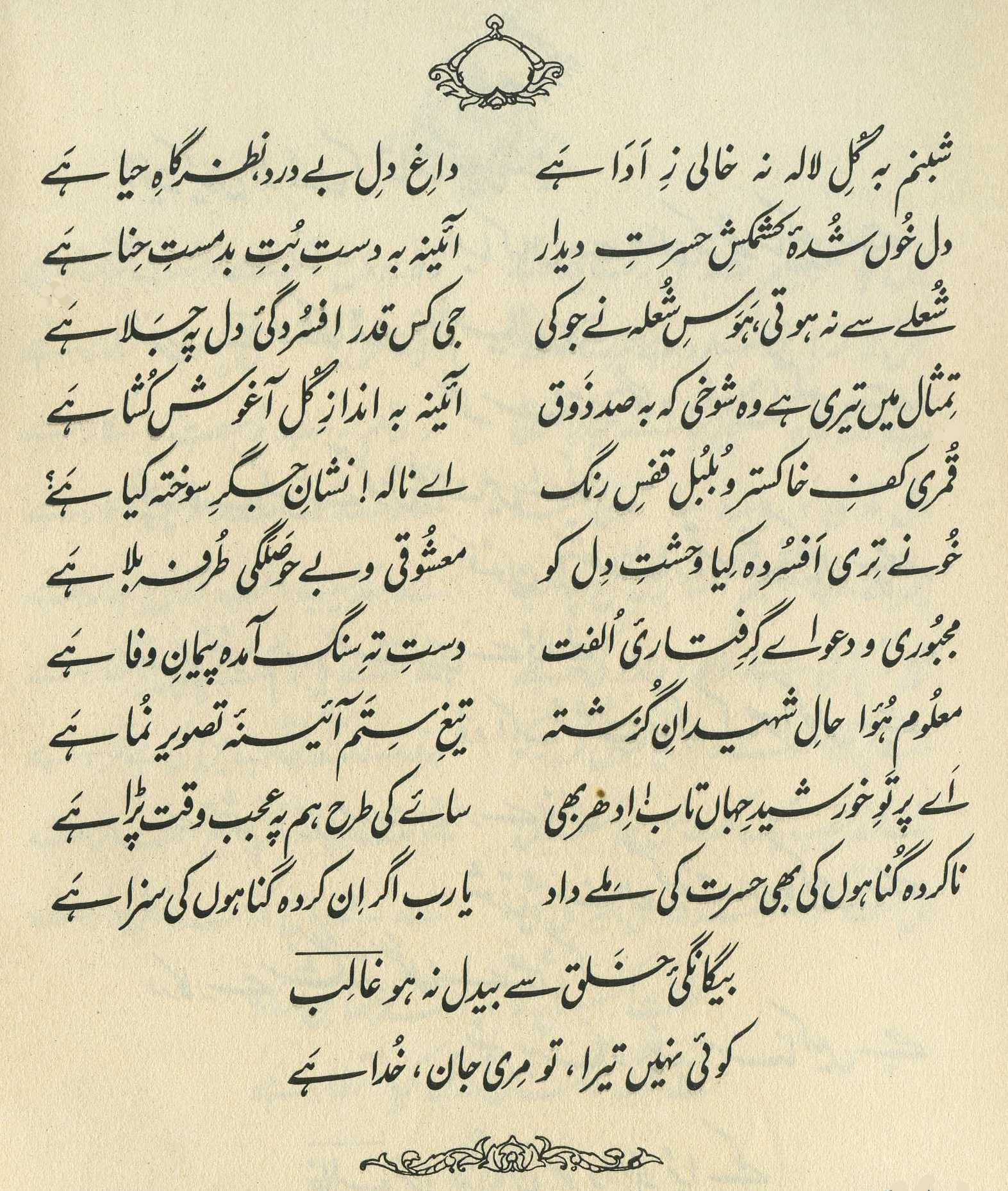
Having become a beloved, such insipidness, such a cool temperament-- neither airs and graces nor spirit, no pleasure of teasing repartee-- it's a wondrous disaster! That is, it's detestable. By 'temperament' is meant disaffectedness and ill-temper. In this verse the author has put the word 'wildness' in place of 'taste and ardor'; and in truth the meaning of 'wildness' and 'horror' are very close; here, it doesn't work, because the meaning is that from your ill-temper the heart has come to feel wildness and horror, not that the wildness of the heart has become frozen/melancholy. (260)
== Nazm page 260

He says, on the occasion of attachment, your habit of inattentiveness and backbiting lessened the turbulence of passion. Having become a beloved, to have so little spirit-- it's the confronting of a new difficulty. (316)
Here the meaning of 'wildness' is 'uproar' and 'longing', which the beloved in her language calls 'wildness'.... Mirza used only one word of the beloved's-- that is, 'wildness'-- to emphasize his wildness and to create a picture of the lover's and beloved's private meeting, the lover's teasing, and the beloved's response. The pleasure of which the 'people of taste' know. In support of my opinion, see one opening-verse by Mirza, and the commentary by Janab [Nazm] Tabataba'i: 148,1 . (483)
If the meaning of is taken as merely 'habit', 'innate temperament', then it's much more desirable. The meanings that [Nazm] Tabataba'i has written for are also correct. But there can also be the meaning that the beloved has no ardor for practicing tyranny and oppression. She has a cold nature. In modern terms we can call her 'sexually cold'. This cold-naturedness and disaffectedness made the longings of the heart cold. To be a beloved and be spiritless-- that is, to have no urge for tyranny-- is, for the lover, an extraordinary difficulty (a 'novel/rare disaster'). The beloved ought to be such that she'd do everything that would cause suffering to the lover. So much so that if she would see him to be equal to the cruelty, then she'd cease to practice it: 60,6 ....
Another meaning of can be that the beloved has no interest in adornment, she's absolutely bland and vapid. She doesn't have in her the quality that Ghalib has described in a letter as 'flirtatious wiles' []. That is, the beloved doesn't pay close attention to her 'sex appeal'. He's composed a fine verse.
== (1989: 368) 2006: 395-96
The claim in the first line that the beloved's temperament has caused (with a core meaning of 'wildness, desolateness') to become (with a core meaning of 'cold, numb') is a notably complex one (see the definitions above). For while these two terms do have within their range some opposite meanings ('fierceness' versus 'dejection', 'savageness' versus 'numbness'), they also have a considerable common ground in the middle ('sadness' and 'melancholy', 'dreariness' and 'dejection').
This common ground is based on overlapping metaphors for human misery, and since that's what the first line is about, we certainly can't ignore it. And yet the insistence on a change of state (in which one term takes on the qualities of the other) compels us to take note of the oppositions as well. There's almost uninterpretably much going on in the first line; we are made to wait (under mushairah performance conditions, as long as conveniently possible) and hope for the second line to provide clarification.
As so often, the second line instead starts out entirely afresh, with an exclamatory, verb-less phrase: 'beloved-ness-- and lack of spirit!' As a translation for 'beloved-ness' may not be ideal, but I want to bring out the way it almost looks like a job description, parallel to for the lover (as in 78,3 ). As Faruqi reminds us, in the ghazal world, a large part of that job description is tormenting the lover in every possible way. A beloved who lacks the 'spirit' or 'enthusiasm' to play her role is definitely falling down on the job; she's not fulfilling her part of the social contract.
And thus she makes it impossible for the lover properly to fulfill his. It's a two-person game. (This reminds me of all the times I've been most warmly, courteously, and ruthlessly forced to eat impossibly lavish meals in Indian homes, because the role of 'host' requires the participation of a 'guest'.) For the lover to be confronted with a non-bloodthirsty, non-cruel, non-tormenting beloved is indeed a 'novel disaster'. But maybe even a slightly, perversely, enjoyable one? For the nuances of can include the delight of sheer novelty-- the enjoyment of 'a pleasing rarity' or 'a wonder' (see the definition above).
In the light of the second line, we're able to make a wonderfully subtle sense out of the first line. It turns out that we need both senses of the two operative words, and . The lover's heart is full of 'wildness, desolateness' anyway, and by turning it 'cold, numb' the beloved's behavior has both reinforced its natural tendencies to misery and madness, and given them a particular twist toward 'coldness', 'numbness', passivity, and helplessness.
For another desperate cri de coeur from a lover in a similarly dire situation, compare 119,1 .
A small personal note: I once saw Faruqi get into a state of real ecstasy, real , over this verse. He recited the second line again and again, unable to stop because he so relished it. He recited it in different styles and rhythms, but especially in a kind of caressing way that was beautifully suited to its somewhat perverse mood. As it happens, the next verse, 230,7 , has the same effect-- extreme and incantatory delight-- on me.
graphics/chilledheart.jpg