Verse 81816aahai
G13
1
it became known, the situation/state of the passed-away martyrs
2
the sword of tyranny is a picture-showing mirror
'State, condition, circumstance, case, predicament, situation; existing or present state (as of revenue collections, &c.); a state of ecstasy, frenzy, or religious transport; --present time; (in Gram.) the present tense; --good condition, prosperous circumstances; --business, affair, matter, thing; statement, account, story, history'.
'Picture; drawing; sketch; painting; portrait; an image'.
'Showing, exhibiting, pointing out'.
| References | |
|---|---|
| Arshi, Imtiyaz Ali | Ghazal# 179 |
| Raza, Kalidas Gupta | 268-69 |
| Nuskhah-e-Hamidiyah | 275-276 |
| Gyan Chand | 395 |
| Hamid Ali Khan | Open Image |
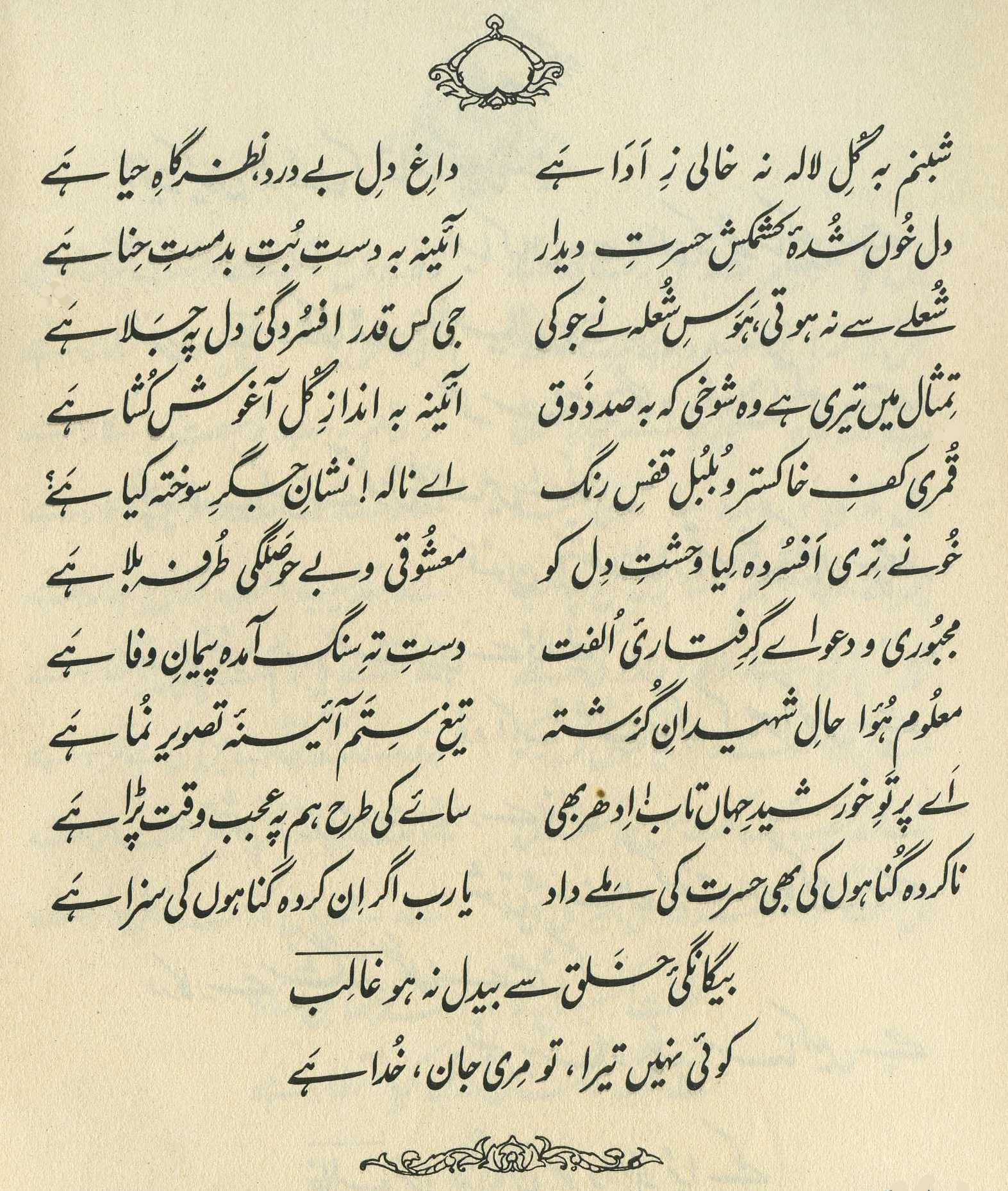
That is, having seen the style of my [endured] tyranny, a picture of the tyranny-endurers who have passed away, passes before the eyes. It wasn't a sword of tyranny, it was a picture-showing mirror. This verse is from the lips of one who has already tasted the relish of that sword, but the words are deficient in presenting the meaning. (260)
== Nazm page 260

He says, 'From your grasping the sword and preparing for murder, we learned the situation of the passed-away martyrs. Your sword of tyranny is a picture-showing mirror'. That is, the way you seek to murder us in our state of helplessness-- it seems that in the same way you must have cut the throats of more oppressed ones as well. (317)
About the meaning of this verse, I don't disagree with anybody. Indeed, I have to object that the verse is not deficient in presenting the meaning. I don't know what standard of 'presenting the meaning' Janab [Nazm] Tabataba'i has established for himself! (484)
The image in the verse is that of a highly polished steel sword-blade that acts as a mirror. But since it's so narrow, reflections in it can only be seen when the viewer is very close to it-- close enough, in other words, to be about to be slain. It's only at that point-- the point at which his situation would 'mirror' theirs-- that the lover would truly realize the 'situation' of the martyrs/lovers of the past who were his predecessors. This is an elegant, piquant, original thought in itself. (And let's not forget that the wide-ranging meanings of include a Sufistic stage of mystical ecstasy; see the definition above.)
But there's even more going on than this, because is a relatively unusual way to describe the work of a mirror in offering a reflection. The Urdu sounds about as odd as 'picture-showing mirror' does in English-- which is to say, not prohibitively odd (there's definitely some sort of scope for that meaning), but not entirely clear either. The normal word would be not 'picture' but 'image' or 'reflection' in English, and not but perhaps in Urdu; for an example of the latter, we need look no further than 230,4 .
The use of the word 'picture' opens up the possibility that what is visible in the shining depths of the sword-blade is not a reflection, but a picture of something else. A literal picture of previous martyrs/lovers, so that now their exact 'situation' can be seen? A picture of the world in general, obtained by some quasi-magical means, like the picture seen by Jamshid in the depths of his Cup? Or perhaps a vision of mystical truths of some kind? In these latter two cases, the connection to the 'situation' of the former martyrs would be that they saw such pictures too.
Of course such questions are unanswerable. But doesn't the verse become more compelling by inviting us to raise them?
For another pairing of a sword and a mirror, see 430x,1 .
graphics/sword.jpg