Verse 31816aahai
G13
1
it would not have occurred through flame, what the desire/lust for flame did--
2
to what an extent has the inner-self 'burned', at the coldness/sadness of the heart!
'Frozenness; frigidity, coldness; numbness; dejection, melancholy, lowness or depression of spirits.' (Platts, p. 62)
'To burn; to be burnt; to be on fire; to be kindled, be lighted; to be scorched, be singed; to be inflamed, to be consumed; to be touched, moved, or affected (with pity, &c.); to feel pain, sorrow, anguish, &c.; to burn or be consumed with love, or jealousy, or envy, &c.; to take amiss, be offended, be indignant; to get into a passion, be enraged, to rage'.
'To be vexed or troubled in mind, to have the heart inflamed, or wounded or grieved'.
| References | |
|---|---|
| Arshi, Imtiyaz Ali | Ghazal# 179 |
| Raza, Kalidas Gupta | 268-69 |
| Nuskhah-e-Hamidiyah | 275-276 |
| Gyan Chand | 395 |
| Hamid Ali Khan | Open Image |
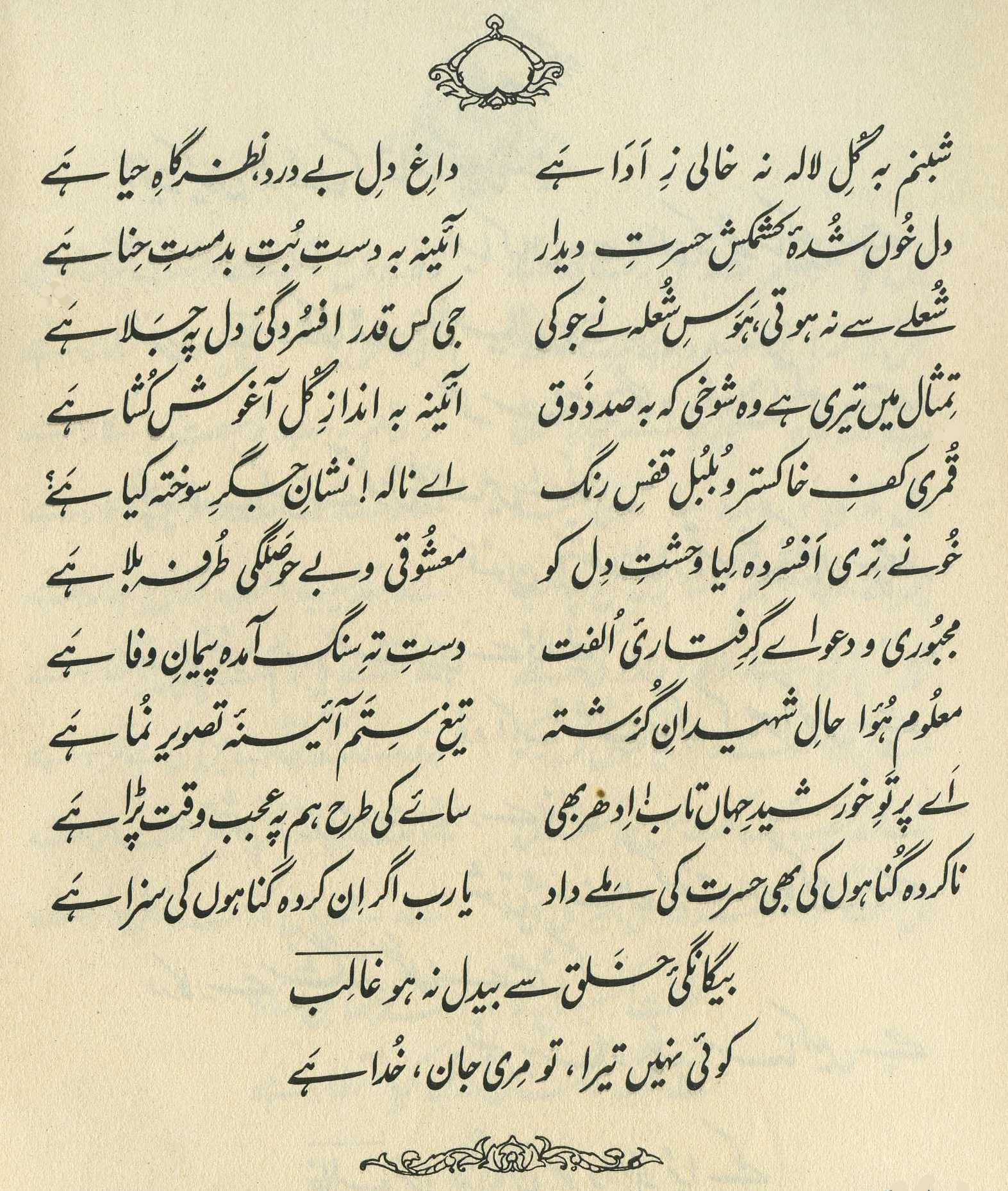
What the desire for flame did, would not have existed even through flame: that it burned up the inner self. And in Urdu idiom has the meaning of 'to feel distaste'. Here, that meaning is not intended; rather, by the meaning of 'to torment oneself', and the author, according to his habit, has translated [from the Persian] . (259)
== Nazm page 259

He says, it cannot be done even by a flame of fire-- what the desire for fire has done to the heart. Here, by 'flame' is meant the flame of passion. The meaning is that when in the heart the flame of passion was not able to flare up to the extent that the heart would have burned to ashes, then the temperament 'burned' at its own unsuccessfulness. (316)
[Disagreeing with Nazm:] Janab the Commentator didn't reflect carefully. has the meaning of 'to become angry' and 'to feel distaste'. The answer to the third objection is that indeed, Mirza, like other innovators in the art such as Mir Taqi Mir , Mirza Rafi Sauda , Shaikh Mus'hafi , etc., considers translating idioms from Persian to be synonymous with broadening the scope of Urdu.
By is meant not only being devoid of the flame of passion; rather, low-spiritedness and lack of courage are intended as well. (477)
It's a striking first line-- piquant and almost riddle-like. Although we have no idea where it's going, when we're allowed (after the requisite mushairah -performance delay) to hear the second line, we can see the angular, unexpected relevance.
The second line pivots entirely on the wordplay-- which of course, as Faruqi would remind us, is also meaning-play-- of and . Both have the dual aspect of a basic physical meaning (coldness vs. fire) and various metaphorical meanings generated by extension (see the definitions above). If the heart feels 'coldness, numbness, melancholy', the reaction of the inner self, the temperament, is to 'burn up'. But in what sense? Does it feel 'pity', 'sorrow', 'love', 'jealousy', 'envy', 'indignation', or 'rage'? Or some combination of these emotions? Or even all of them together? No matter which emotion(s) we choose, meaningful connection s with 'coldness, numbness, melancholy' can easily and unforcedly be made.
In commenting on M 386,2 , Faruqi has called the present verse 'worthy to be counted among the best not only of Ghalib's verses, but of verses in the Urdu language'.
There's also, as the commentators note, the idiom , which in typical Ghalibian style can be read in both its colloquial and its literal sense.
Compare 5,6 , which similarly deploys the same wordplay.
graphics/fireice.jpg