Verse 71821arhote tak
G5
In this meter the first long syllable may be replaced by a short; and the next-to-last long syllable may be replaced by two shorts.
1
for the grief of life, Asad , from what/whom would be the cure, except death?
2
the candle, in every condition/'color', burns until the coming of dawn
'Colour, colouring matter, pigment, paint, dye; colour, tint, hue, complexion; beauty, bloom; expression, countenance, appearance, aspect; fashion, style; character, nature; mood, mode, manner, method; kind, sort; state, condition'.
'To burn; to be burnt; to be on fire; to be kindled, be lighted; to be scorched, be singed; to be inflamed, to be consumed; to be touched, moved, or affected (with pity, &c.); to feel pain, sorrow, anguish, &c.; to burn or be consumed with love, or jealousy, or envy, &c.; to take amiss, be offended, be indignant; to get into a passion, be enraged, to rage'.
| References | |
|---|---|
| Arshi, Imtiyaz Ali | Ghazal# 78 |
| Raza, Kalidas Gupta | 334 |
| Nuskhah-e-Hamidiyah | 128-129 |
| Asi, Abdul Bari | 145 |
| Gyan Chand | 238 |
| Hamid Ali Khan | Open Image |
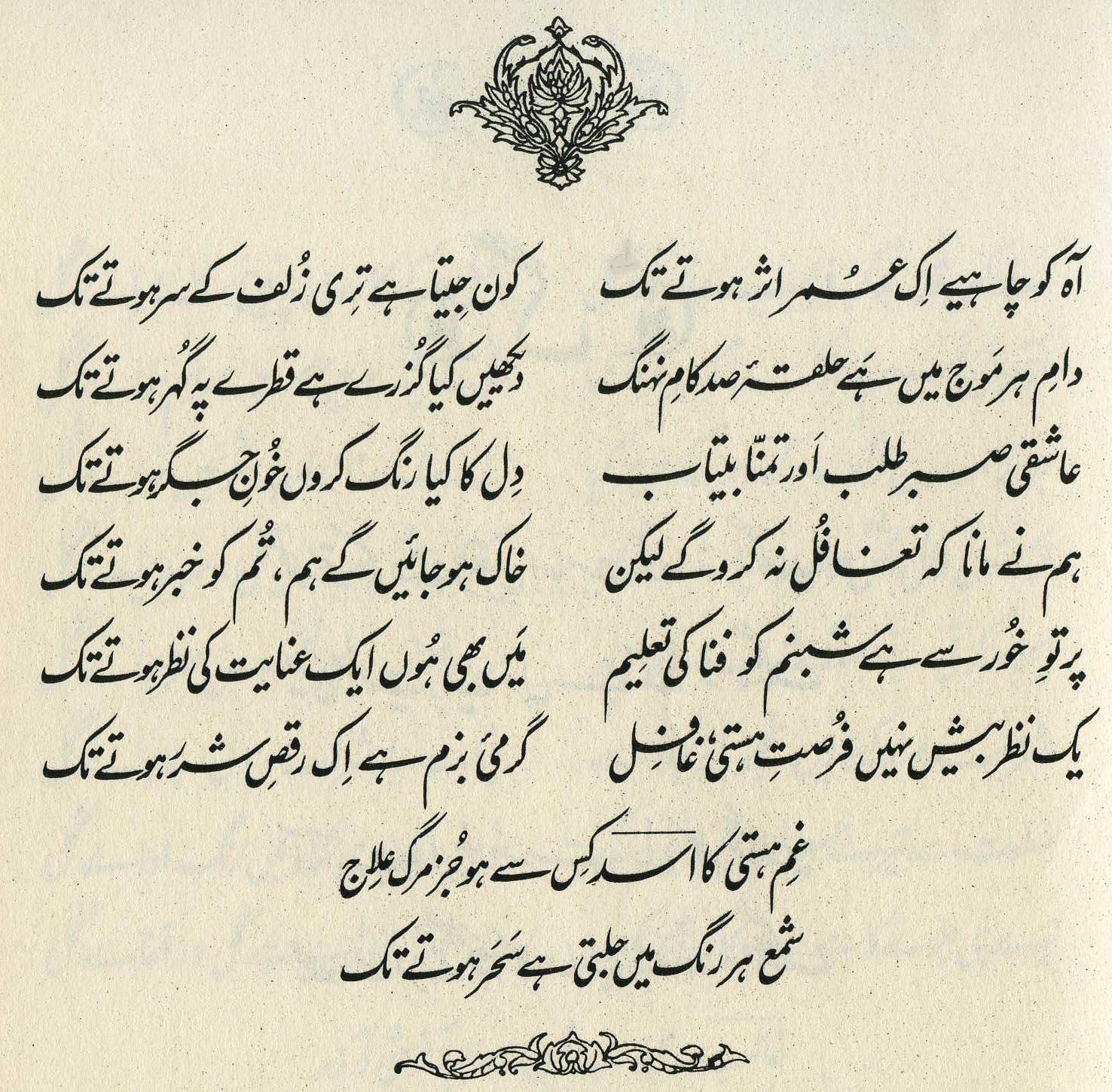
Both of Mirza’s divan s, Urdu and Persian, are filled with this kind of novel and peerless simile s.
==Urdu text: Yadgar-e Ghalib , p. 127
That is, no matter what kind of 'color' and joy there might be in the gathering, there can be no cure in it for the candle's burning. Only its extinguishing (death) is the cure for its burning. (80)
== Nazm page 80

In this verse Mirza Sahib has given for human life, in which until death comes there's no salvation from grief, the simile of the candle, which keeps on burning no matter what until morning comes. Such eloquent [] and supreme similes don't even occur to anyone except Mirza Sahib. (127)
Only death can cure the grief of life. Look, the candle is compelled to burn, no matter what, until morning. That is, life and grief are contemporaneous: 115,5 . (165-55)
As the commentators say, this is a chillingly beautiful and grim verse, a classic formulation of the dilemma of human suffering. The first line poses the rhetorical question, who or what could cure the grief of life, except death? The way the line is phrased makes it impossible to decide whether death is the curer (who can cure life, except Death?) or the cure (what can cure life, except death?). Then the second line illustrates the ineluctability of the situation with a perfect example.
The example is the candle, which 'burns', or suffers (see the definition above), for as long as it is 'alive', or lit. No matter what, it goes on 'burning' (both literally and metaphorically) 'in every ' until morning. The versatility of here does excellent service: it literally means 'color', but thus by extension means 'mood', 'style', 'manner', etc. (see the definition above). Even as a its color and shape change, the flame continues helplessly to burn.
The candle burns until dawn. The white light of dawn is the signal for the colorful gathering to break up; it's the time when candles gutter to extinction. Finally the candle, now a small puddle of cold wax, is free from its 'burning', just as the human being can expect death to bring an end to suffering. Is this an image of despair? In a sense it is, but not entirely. The image of the lively 'warm' candle-lit intoxicated party that terminates in the cold deadness of dawn is one side of the coin (as in 169,12 ). But the welcome arrival of the light of dawn to terminate a dark night of pain is the other side of the coin.
For an illustration of dawn as light and hope, consider the second verse in the whole divan : in 1,2 , making it through a black night of solitude and suffering until the hopeful white light of dawn is as difficult as Farhad's task of carving a channel through black stone to bring white milk. Or consider 169,1 : in the speaker's dark chamber, in the night of grief and oppression, the only proof of the coming of dawn [] is a single candle-- and that candle is, as it must then be, an extinguished, literally 'silent' [], one. (Mystically speaking, death can of course be seen as the dawn of a new day-- even a 'wedding day' [].)
For another superbly deployed case study of these back-and-forth hope-and-despair metaphorical possibilities, see Mir : M 7,2 .
For life as a night of travel, with arrival at dawn, see 54,5x .
On the possibilities of , see 101,1 .
graphics/latecandle.jpg