Verse 8x1821arhote tak
G5
In this meter the first long syllable may be replaced by a short; and the next-to-last long syllable may be replaced by two shorts.
1
until Doomsday, the lifetime will pass in the night of separation
2
'seven days' are burdensome/dark/'heavy' upon even/also us, until the coming of dawn
'Heavy, weighty, ponderous, massive, unwieldy; ... difficult, hard, laborious, burdensome, troublesome, grievous, oppressive, unsupportable, insufferable, distressing; dull, dun, dark (as colour)'.
| References | |
|---|---|
| Arshi, Imtiyaz Ali | Ghazal# 78 |
| Raza, Kalidas Gupta | 334 |
| Nuskhah-e-Hamidiyah | 128-129 |
| Asi, Abdul Bari | 145 |
| Gyan Chand | 238 |
| Hamid Ali Khan | Open Image |
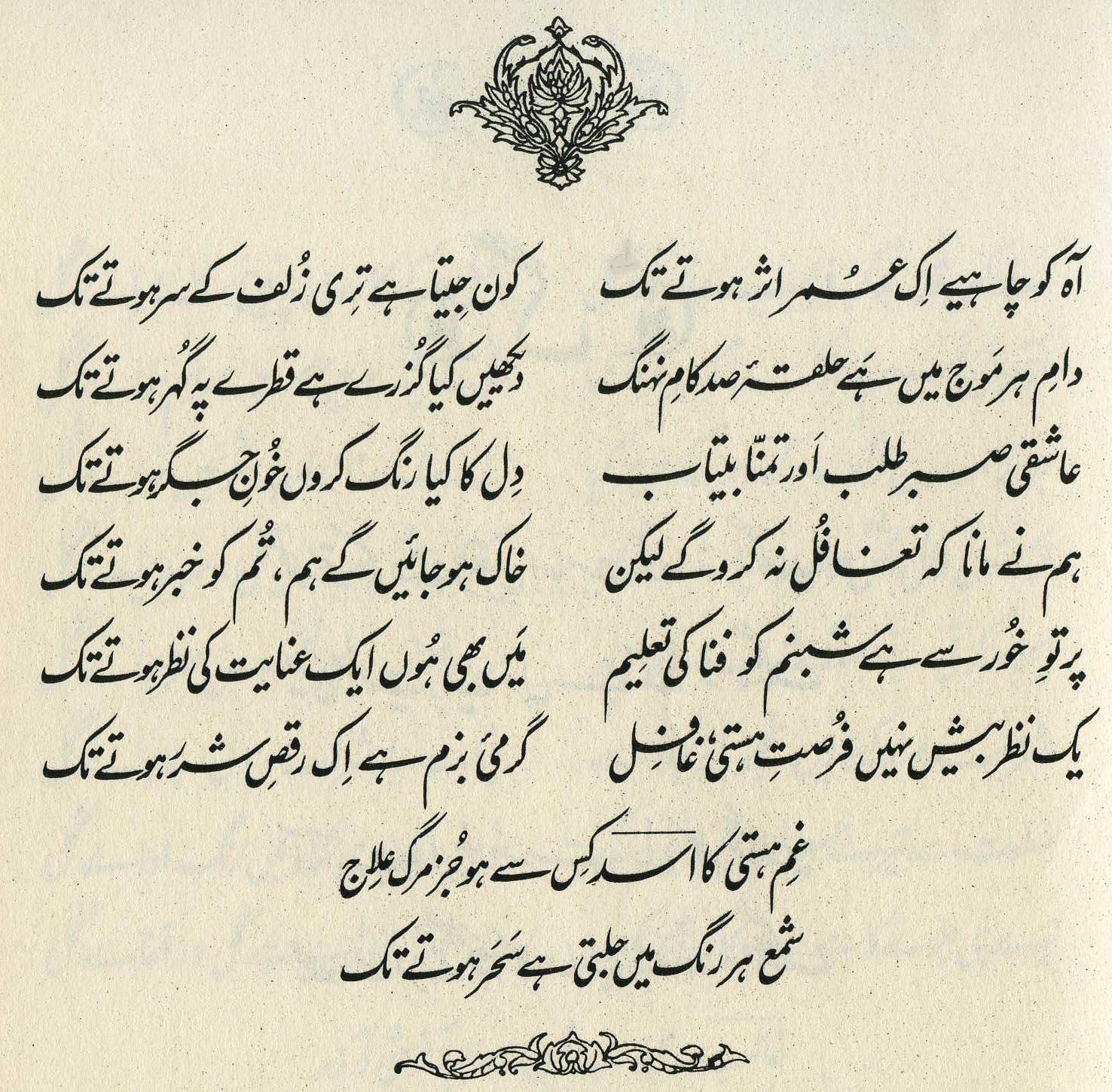
The night of separation is so long that in it our whole lifetime will pass, and it will end when Doomsday will come. Thus it's clear that a mere seven days are heavy upon us-- that is, the days of a full week. It's clear that the lifetime ends within the space of those seven days.
== Asi, p. 145
A lifetime is seven days long; the world is seven days long. All 'sevens' are ill-omened []. All the seven days (of the seven days from now till Doomsday) are 'heavy' (ill-omened). That is, they are days of difficulties and disasters, they are black days, they are not days but nights-- and those too, nights of separation. It will be vouchsafed to me to see the face of dawn only on Doomsday.
== Zamin, p. 210
In a week there are seven days; so to speak, the lifetime is composed of seven days (Sunday, Monday, Tuesday, etc.). Until Doomsday there will be no sight of the beloved, so that the state of the 'night of separation' will remain. When Doomsday comes then the night of separation will be finished, and for us it will be dawn. Until that dawn the 'seven days' of life are burdensome/heavy upon us.
== Gyan Chand, p. 238
For background see S. R. Faruqi's choices . This verse is NOT one of his choices; mostly for the sake of completeness, I have added it myself. For more on Ghalib's unpublished verses, see the discussion in 4,8x .
Obviously the verse plays with the contrast between the lifetime as a (brief, single) week, and the lifetime (and time in the tomb) as a heavy, dark, endless night that will be relieved only by the dawn of Doomsday. Zamin adds the idea that 'sevens' are ill-omened; if we think of the week as ending with Saturday, then its culmination is governed by Shani-dev , a highly inauspicious deity. Even if Ghalib had no personal belief in such astrological notions, he might well have taken advantage of them to give an extra punch to the verse.
Note for grammar fans: The thing that niggles at my mind is the positioning of the , which suggests that such afflictions come upon one or more others, and upon 'us too', or 'even upon us'. I can't find a way to make this positioning meaningful in the context of the verse, so perhaps it should just be considered a metrically convenient permutation of .
graphics/week.jpg