Verse 11816aama((luum
G9
In this meter the next-to-last long syllable may be replaced by two shorts.
1
with/through lamentation/groaning, gather the harvest of attachment/'heart-boundness'
2
the merchandise/wealth of a house of chains, except for sound, is-- 'known' [to be nothing]!
'Complaint, plaint, lamentation, moan, groan; weeping'.
'Affliction or anguish of mind; attachment, friendship, love'.
'To collect, gather together, accumulate, amass'.
'Merchandise; goods, chattels, furniture; clothes, effects; utensils; valuables'.
'Echo; sound, noise; voice, tone, cry, call'.
'Known; distinguished; celebrated, famous, notorious; clear, evident, certain, obvious, apparent'.
| References | |
|---|---|
| Arshi, Imtiyaz Ali | Ghazal# 81 |
| Raza, Kalidas Gupta | 198-99 |
| Nuskhah-e-Hamidiyah | 136-137 |
| Asi, Abdul Bari | 156 |
| Gyan Chand | 250-252 |
| Hamid Ali Khan | Open Image |
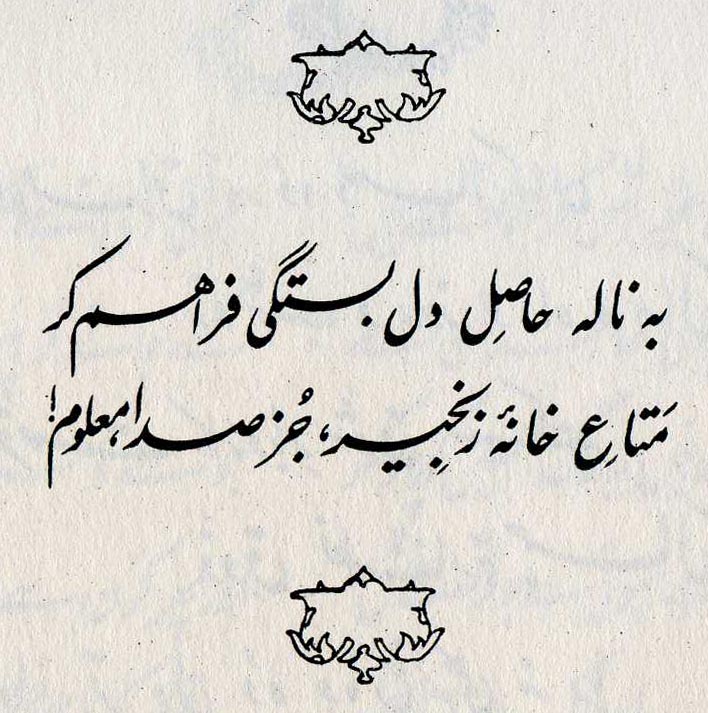
He has constructed heart-boundness and relationship of temperament as chains. He says, 'If you engage in heart-binding, then adopt the practice of lament as well, for in a house of chains, the only wealth and property is the sound of mourning. His intention is the scorn of the world. (83)
== Nazm page 83

A 'house of chains' is a prison-house; he has called the world a prison-house. If you are interested in the world (which in respect to its difficulties is a prison-house), then cultivate an interest in lament and complaint as well. That is, if you are ensnared in the world, you'll spend the rest of your life weeping. (171)
-- to speak like this is an idiom of the language used by eloquent ones. The meaning is that except for sound there's nothing else; it's written in one's destiny that -- that is, gold cannot be obtained. The meaning of the verse is, 'Collect the property of your heart-boundness through complaint. The heart-binding of the madman of love is in this fashion. The wealth of a house of chains is nothing else except complaint.' The sound of chains is called the 'lament of chains'. The mention of chains is because of the madman of love. (168-69)
Here the address is to 'you' in the intimate , and the bitter, cynical tone suggests that the lover is either counseling himself, or giving heartfelt, candid advice to some younger friend. The colloquial use of , as Josh observes, gives an extra punch; for more on this idiomatic usage see 4,3 .
The first line plays with images of the harvest. The word itself, though it often means merely the abstract 'result', can refer literally to the 'harvest'; for an example of wordplay involving both meanings, see 12,1 . When we also see that it is to be 'gathered' [], we have a sense of grain being brought in. Brought in 'with lament' [], of course, since it's the harvest of heart-boundness, and we know it will somehow be lost or blighted.
But not until we are vouchsafed the second line-- and under mushairah performance conditions, there would certainly be some delay-- do we realize that the lament isn't just a reaction to the harvest, but itself constitutes the harvest. The 'lament' is placed at the beginning of the first line, and the 'sound' as late as possible in the second line, so that (in the best mushairah style) the full realization is delayed as long as can be managed.
And in between we have-- the chains. As with the laments, we're taken by surprise. In the first line, registers only as a common expression for the state of being in love. Only when we see the do we recall its literal meaning of 'heart- boundness', a form of bondage. And then we realize that the elegant wordplay of the 'house of chains' with 'heart-boundness' is at the center of the verse. If the lover chains up his heart, the only 'harvest' that he 'gathers' will be laments, his only 'wealth' will be the sound of the chains themselves as they screech and groan with his every movement. The chains on his heart are thus both themselves a lament, and a cause for lament to the lover. (Of course, as Josh notes, madmen were often chained up in any case.)
The verse is unusually full of conspicuously placed long sounds. Perhaps they help to provide the of the .
On the possibilities of , see 101,1 .
graphics/chains.jpg