Verse 7after 1826oshhai
G3
1
look at me, if there would be [in you] an admonition-watching eye
2
listen to my [words], if there is [in you] an advice-listening ear
'Look, glance, sight, view, regard; consideration; — look, aspect (of); — watching, observation, attention'.
'Listen; a listener; attention'. (Steingass p.1446)
| References | |
|---|---|
| Arshi, Imtiyaz Ali | Ghazal# 199 |
| Raza, Kalidas Gupta | 373-74 |
| Hamid Ali Khan | Open Image |
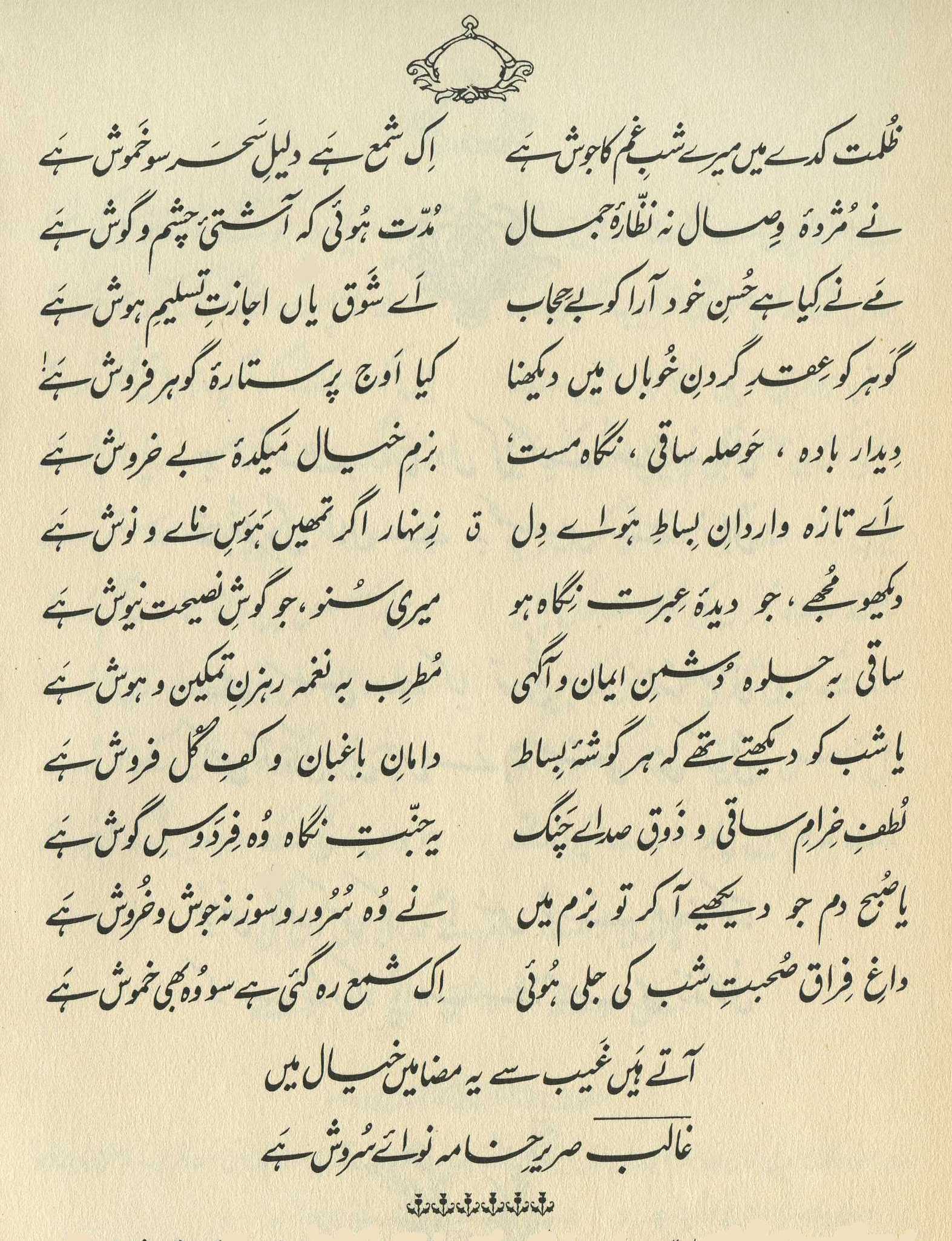
With regard to those two things, the flute and the 'spread' [], in the second verse he says, 'Why do you look toward wine-- look at my state, and take a lesson; and why do you listen to the flute-- incline your ear and listen to my words.' (190)
== Nazm page 190

Look at me, and look at my state, and receive a lesson; And in preference to the flute, listen with the ear of the heart to my advice. (245)
If Nature has bestowed on you an eye that would look at the wretched state of others and learn a lesson from it, then look at me; and if you are ready to listen to anyone's advice, then listen to mine-- that is, do what I say, because what I say is true. Because I've already done it all, and I'm now 'stretching/yawning' [ ; on this see 12,2 ]. (332)
This is the second verse of a seven-verse verse-set ; for discussion of the whole verse-set, see 169,6 .
The two lines present themselves as strongly parallel. They seem to be giving virtually the same message, and merely inviting attention through two different senses. Yet subtle differences also present themselves. 'Look at me' is an ambiguous remark. It can mean 'Pay attention and stop gazing at other things'. But of course it can also mean 'Take a look at me, my own situation is an illustration'. Similarly, 'listen to my words' may mean little more than 'Pay attention, I'm talking to you'; but it can also be read with an emphasis on 'my words'-- a claim that what the speaker says is authoritative and comes with the full weight of personal experience.
How does the speaker's appearance ('look at me!') compare with his advice ('listen to me!')? It might be a case of 'Do what I say, not what I do!'. Is the speaker a rake and a longtime party-goer who has spent his life pursuing wine, women, and song, and is he now trying to save the newcomer from falling into the same way of life? Has he seen the error of his ways, but found it too late to save himself? Or is he simply too burnt-out to pursue the 'desire of the heart' any more, and so finds it easy to warn others against his own former follies? Or is he by any chance someone who has escaped by the skin of his teeth, and lived a virtuous life far from wine and flute, and wants to offer other endangered young people the same way out?
We're still in the prefatory part of the verse-set; we haven't yet actually heard the speaker's advice. Two whole verses, in such linear sequence, each pointing forward to a coherent later message! How un-ghazal-like!
On the omitted that modifies, see 59,2 .
graphics/ghalib.jpg