Verse 1after 1838aaraanahii;N karte
G13
1
so that a place/occasion wouldn't remain to us for even/also complaint
2
she listens-- although she doesn't mention/remember us
'Remaining, lasting, enduring, permanent, existing, extant; eternal, everlasting; left in arrears, still due;—remaining portion, remainder, residue, remnant'.
'Remembering, remembrance; memory; commemoration; —mention, telling, relating, relation, recital, report, account; praise, eulogy, fame'.
| References | |
|---|---|
| Arshi, Imtiyaz Ali | Ghazal# 208 |
| Raza, Kalidas Gupta | 387 |
| Hamid Ali Khan | Open Image |
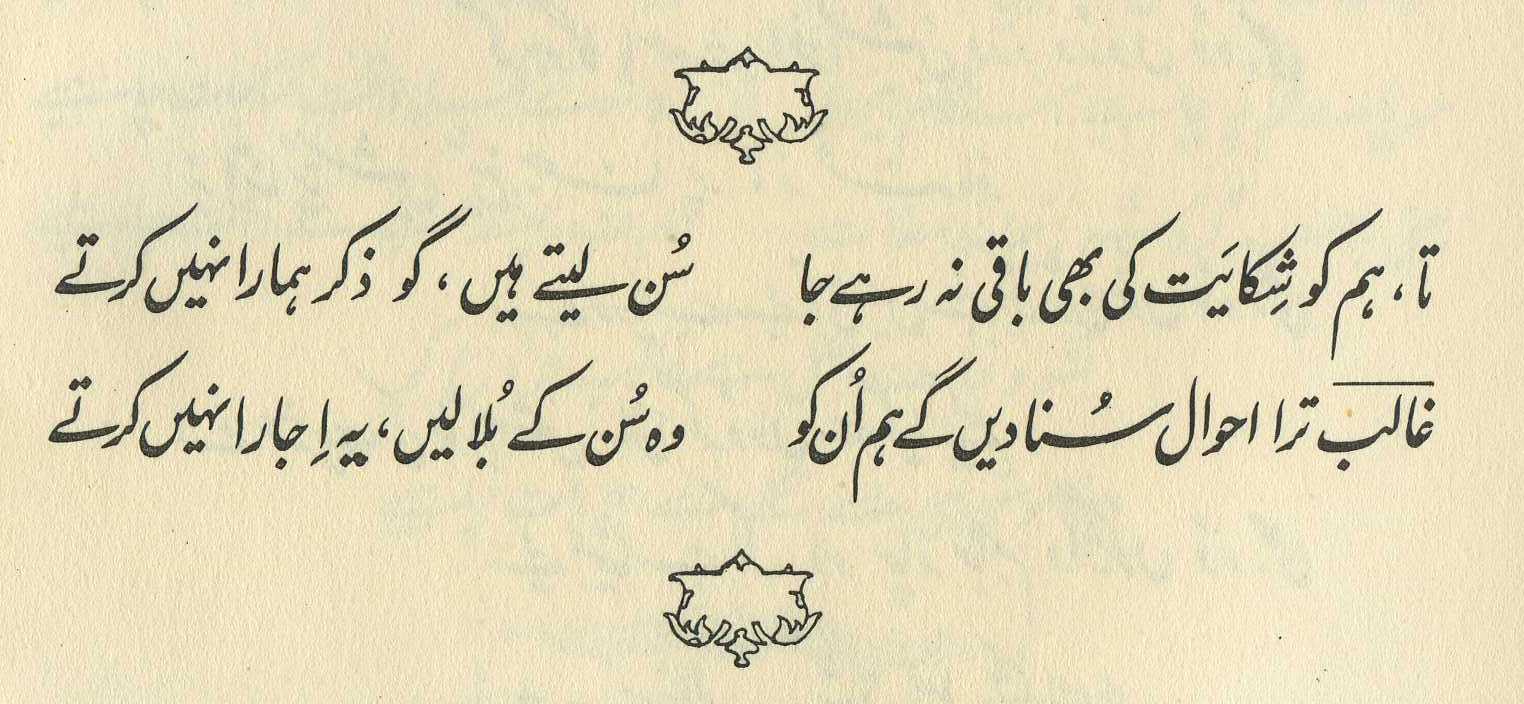
That is, if somebody spontaneously mentions me before her, then she doesn't even forbid him, so that I wouldn't have a clear cause for unkindness and quarreling and complaint. In this verse the author has versified the state of the beloved's temperament which is that of extreme hostility. That is, she doesn't even express anger, so that he could apologize; she doesn't express hatred, so that he could complain. She doesn't even express any grievance; it's as though she had never met him. To versify states like these is always a depiction of inner reality. And this is poetry of a high level, although in it there's no excellence of expression and rhetoric [].
[He quotes from a Persian work on poetics to show that poetic pleasure can come not only from 'metricality' but also from 'depiction':] that is, the proof that pleasure is obtained from depiction/description [] is that when some creature is disgusting to look at, people are happy to look at a picture of it; if they would see the creature itself, then they would avert their eyes. Thus it can be learned that pleasure is neither in its aspect, nor in the picture itself; but rather, the picture as an occasion of depiction is pleasing. The point is that the reason that the picture is pleasing, is the same reason that the verse is pleasing. That is, that poetry is good in which the glory of the depicting/painting would emerge. (144)
== Nazm page 144

And in both of these things her purpose is only that we wouldn't have even cause for complaint against her. (200)
In such a situation, to the lover death looks easier than such a life. In such a situation, the side of hope weighs lightly in the balance scales, and the side of hopelessness becomes heavy. (266)
This little two-verse ghazal, with no opening-verse , in fact feels like a small, informal verse-set in its own right. Just notice how elegantly its two verses dovetail. The present verse reports that the beloved listens with complete indifference and disdain to any reference to the lover. The next verse finds the lover, undeterred, recruiting an emissary to speak to her on his behalf-- an emissary who explicitly doubts the value of the mission.
Nazm makes a thoughtful observation: this is a verse of extreme simplicity and bareness: no wordplay, no charm, no wit, no clever idioms, no elaborate multiple meanings.
But the role of in the first line speaks volumes: not to speak of a 'place' or occasion for anything else, she intends that the speaker would be deprived of a place 'even' for complaint-- that's how systematically and unrelentingly cruel she is. Or else of a place 'also' for complaint-- along with all his other deprivations. And the grammar of 'would not remain remaining' [] makes it clear that what's at issue is the loss of something that would 'remain' in the sense of being a 'remaining portion' or 'remnant' or 'remainder' (see the definition of above) of something that once was larger and more ample.
Then there's the question of whom the beloved listens to. Nazm feels that it's some random person who just happens to mention the lover; but it could also be-- and this is almost a worse vision-- that the lover himself is allowed to speak and to plead his case before her. And she listens to it all-- and then says not a word in reply, but turns to her maid and asks for a shawl, or inquires whether any letters have come.
Nazm goes on to praise the verse, and to locate its power in its 'depiction' or 'description' []. What we enjoy, in his view, is not the beloved's coldly terrifying alienation itself, but the economy and masterfulness with which it is depicted. Nazm is inconsistent and quirky in his use of poetic principles, but here he makes a very plausible point. If we don't enjoy the subtlety of psychological evocation in this verse, what do we enjoy? There literally isn't anything else on offer. And yet the verse feels grim, chilling, powerfully bleak.
graphics/disdain.jpg