Verse 2after 1838aaraanahii;N karte
G13
1
Ghalib, we'll narrate/recite your situation to her
2
that she, having heard it, would summon you-- this we don't undertake
The spelling of has been changed to suit the rhyme .
'Lease, farm, contract, rent, hire; right, title, monopoly'.
| References | |
|---|---|
| Arshi, Imtiyaz Ali | Ghazal# 208 |
| Raza, Kalidas Gupta | 387 |
| Hamid Ali Khan | Open Image |
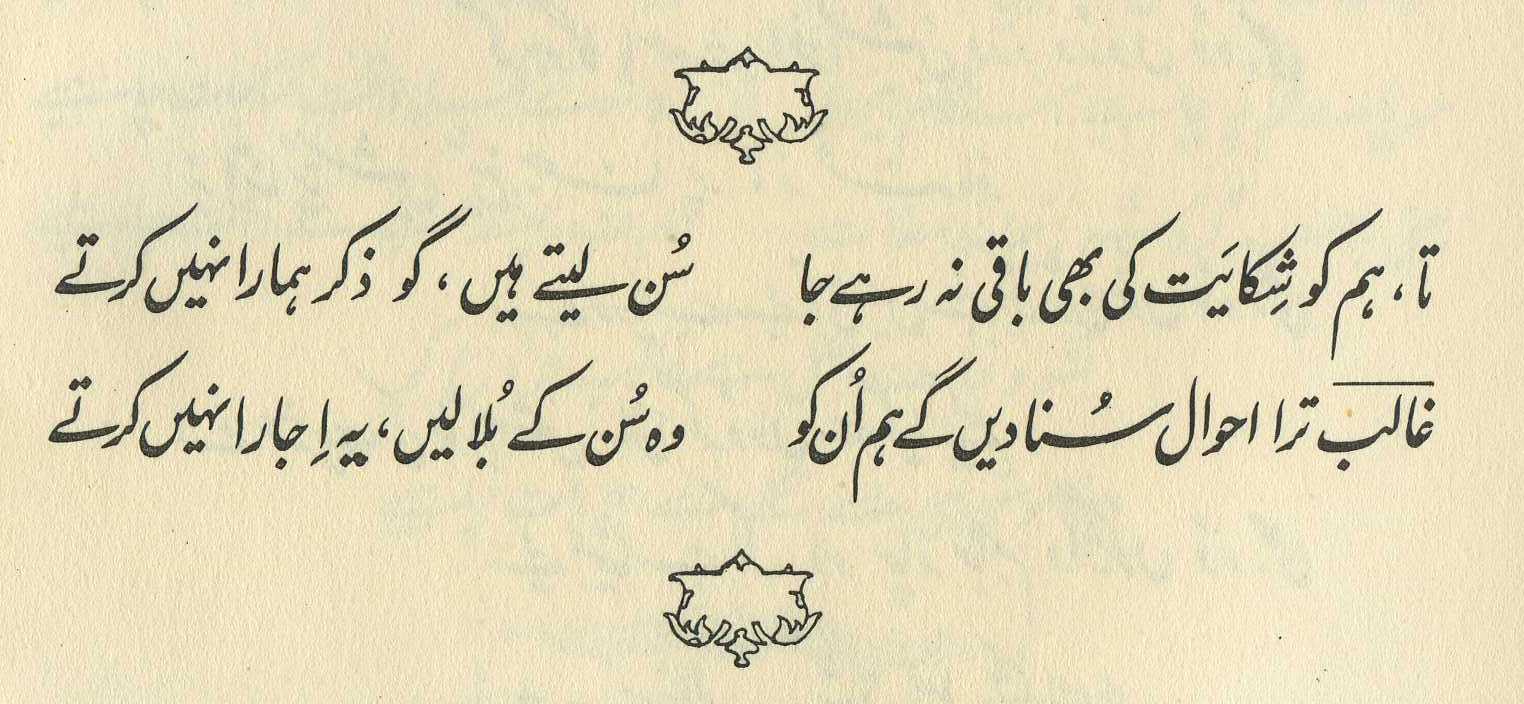
The verse is very clear, but the causes of its eloquence [] are very subtle. When non-responsibility-taking [] people say , its meaning is, as an idiom, that some time other, on one or another occasion, watching her mood, in the course of conversation or joke-telling, we'll convey your situation to her ear; that much responsibility we undertake. That is, we don't have the courage to say it straight out. The point is that all these meanings are comprised in that phrase. Because this is the occasion on which it's used, and necessarily the beloved's pride and loftiness and imposingness and quick-temperedness and self-regard and selfishness also become apparent. Suppose that the author had said -- then the multiplicity of meanings would have vanished.
And is said when someone would be extremely persevering and would say 'by any means, arrange a meeting between me and her-- otherwise, I will have a complaint against you'. In short, this phrase has captured a picture of the lover's impatient insistence. For one expression to be abundantly meaningful [] is a major one among the causes of eloquence. Then on top of that, the addition that on the one hand the beloved's dignity and coquetry, and on the other hand the lover's impatience and insistence-- glimpses of both these pictures can be seen in this verse. (145)
== Nazm page 144 ; Nazm page 145


What a fine closing-verse he has composed! And to what an extent the words have assumed the aspect of eloquence-- it's impossible to praise it enough. (200)
In this verse the poet has not said all these things openly, nor does it seem that he wants to say all this. But the words have emerged from the pen such that the beloved's quick-temperedness, loftiness, self-regard, pride, stubbornness, lack of sympathy, self-interest also drip from it. Along with that, the lover's restless, hopeless secrets too can be seen glittering here and there. The verse is peerless. (266)
Here the speaker is only one person, or one group of people, and the voice is entirely different from that of the lover; it doesn't occur to us for a moment that the verse could be, like so many closing-verse s, one of self-address. In analyzing its idiomatic overtones, Nazm has once again excelled himself.
Perhaps because of the legalistic senses of , we imagine the speaker as a practical person, a social engineer in effect, who can undertake to do this or that. The speaker has some sort of access to the beloved; probably as a casual acquaintance of some kind. The lover begs this potential ally to plead his case before the beloved. The speaker gives a sympathetic but measured reply: it will be possible to get the message across, but (with a shrug of the shoulders), one can't promise that it will work. He or she won't undertake, or contract, or guarantee, to achieve the desired outcome.
The colloquial plainness and idiomatic subtlety of his speech is the real delight of the verse. It's exactly how reluctant contractors talk to insistent clients-- 'Well, we can do it, if you really want it done; but (with a shrug of the shoulders) we don't guarantee that it will work'. (Meaning, of course, that we don't think it will work; but, hey, it's your money.)
It's clear that the speaker doesn't really believe in the project, or hold out any real hopes for it. But his (or her-- the speaker might be a female friend) words are strictly businesslike; they decline to judge the ultimate costs and benefits. It's the understated, unmovedly realistic, emotion-free practicality that's the charm. And it's the shrug of the shoulders in the last half of the second line, with its bleak and lingering finality, that packs the verse's real punch.
For discussion of the use of as singular, see 57,4 .
graphics/narration.jpg