Verse 31816aabthaa
G1
1
there, Self-adornment was thinking about stringing pearls
2
here, in the rush/crowd of tears, the thread of the glance/gaze was unfindable
'To pierce, transfix, thrust in, penetrate; to spit, fix on a spit or skewer; to string (pearls, &c.); to thread (a needle, &c.)'. (Platts p.257
'Assault, attack; effort; impetuosity; —crowd, throng, concourse, mob; a swarm'.
| References | |
|---|---|
| Arshi, Imtiyaz Ali | Ghazal# 9 |
| Raza, Kalidas Gupta | 158-160 |
| Nuskhah-e-Hamidiyah | 42-46 |
| Asi, Abdul Bari | 57-58 |
| Gyan Chand | 78-82 |
| Hamid Ali Khan | Open Image |
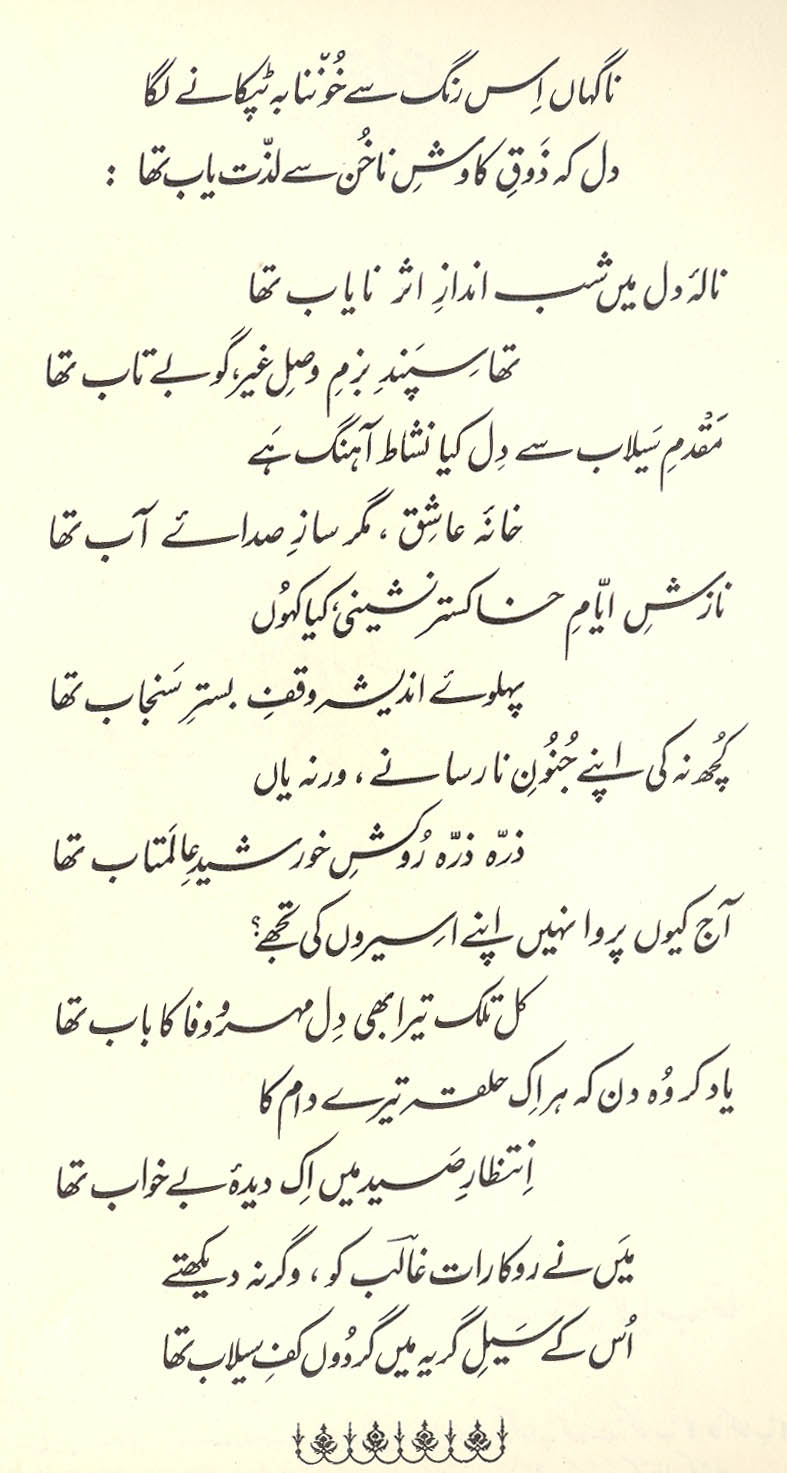
That is, on the thread of the glance so many tears had been threaded that that it itself became hidden and obscured, the way pearls hide the string. Look, the whole simile is found [in earlier poetry], but the freshness is in this, that he does not wish to give the simile. The poet mentions the similar elements, and then does not give the simile. (15)
== Nazm page 15

There, for her self-adornment and decoration she was string pearls, and in that occupation her promise was also forgotten. Here, I was in such a state that while waiting I had wept and wept to the degree that the profusion of tears had obscured even the thread of vision. The point is that the beloved wanted no lack or shortful in outward beauty to remain; and the lover's ardor demanded that the time of union should come quickly. A picture of self-adornment and the restlessness of passion cannot be drawn in better words than these. (32)
There, her adornment and decoration never came to an end; and here, so many tears have been strung on the thread of the glance that because of the abundance of tears the thread of the glance itself can't be seen. For the wordplay of tear-shedding, in the first line mention has been made of stringing pearls by way of adornment; and by way of comparison, although the desired simile is not present, the pleasure of the simile has been created. (69)
The present verse is part of something like a verse-set ; for discussion, see 15,2 .
The pleasure comes from the parallel and yet utterly contrasting situations of beloved and lover: 'there', the (implicit) 'thread' of her self-adorning gaze turns toward stringing pearls; 'here', the lover's gaze is 'threaded' with so many pearl-like tears that it becomes lost to sight in the 'rush'.
The verse can also be read as an example of that same 'mutual causality' on view in 15,2 . The beloved's indifference to the lover, her preoccupation with the details of self-adornment (possibly to show herself to Other s), causes the lover to weep floods of tears; his lavishly flowing pearl-like tears cause her to become more devoted to self-adornment and more interested in stringing pearls. As we know from 10,2 , her eyelashes can pierce blood-drops to make a set of coral prayer-beads; no doubt the process of piercing and stringing tear-pearls would be similar, and equally effortless.
Nazm's point is a good one: that the verse is built on the metaphorical equation of tears with pearls, but the equation is never made explicit. Here too we are obliged (or permitted) to do a good part of the interpretive work ourselves.
graphics/pearls.jpg