Verse 151816aabthaa
G1
1
I stopped Ghalib last night, otherwise you/we would have seen--
2
in his torrent of weeping, the sky {would have been / was} foam of the flood
is simply the full Persian form of ; GRAMMAR .
'A flowing; a flow of water, a torrent, a current'.
'Abounding with water, flooded; —s.m. A flood, torrent, stream, deluge, inundation'.
| References | |
|---|---|
| Arshi, Imtiyaz Ali | Ghazal# 9 |
| Raza, Kalidas Gupta | 158-160 |
| Nuskhah-e-Hamidiyah | 42-46 |
| Asi, Abdul Bari | 57-58 |
| Gyan Chand | 78-82 |
| Hamid Ali Khan | Open Image |
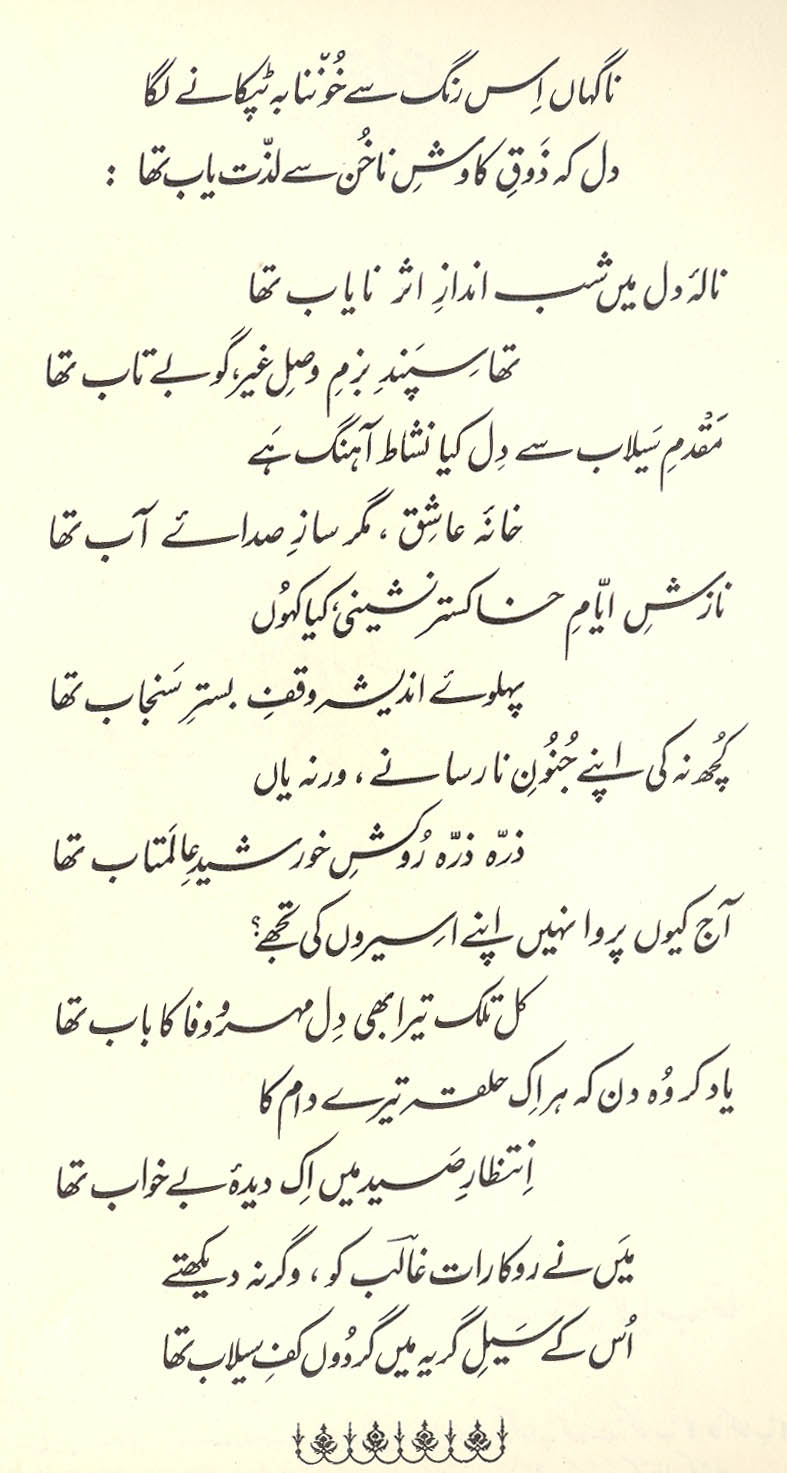
That is, the flood of tears would have reached up to the sky. (17)
== Nazm page 17

He says, last night I prevented Ghalib from weeping-- otherwise, you would have seen the spectacle that his flood of tears would have reached to the sky and become a torrent of water. (34)
That is, the sky would have swum in water the way foam does in a flood. The Ustad of the Age so decrees it. It's worth seeing, where he has put . (38)
On the twofold grammar of (of which is the full Persian form) see 3,14x .
The lover either did weep the sky into a mass of foam (clouds), or would have done so if he had not been stopped by a prudent bystander. This 'cosmic destruction' theme involves sometimes weeping, and sometimes fire. Usually these cataclysms seem to occur only in the lover's own world, but in other verses, like this one, they appear to be evident and dangerous to ordinary human beings as well.
The wordplay of and , with their similar but slightly different meanings (see the definitions above), also helps to energize the verse.
Compare this verse with its less fortunate unpublished cousin, 15,16x .
graphics/seafoam.jpg