Verse 101852ankii aazmaa))ish hai
G2
1
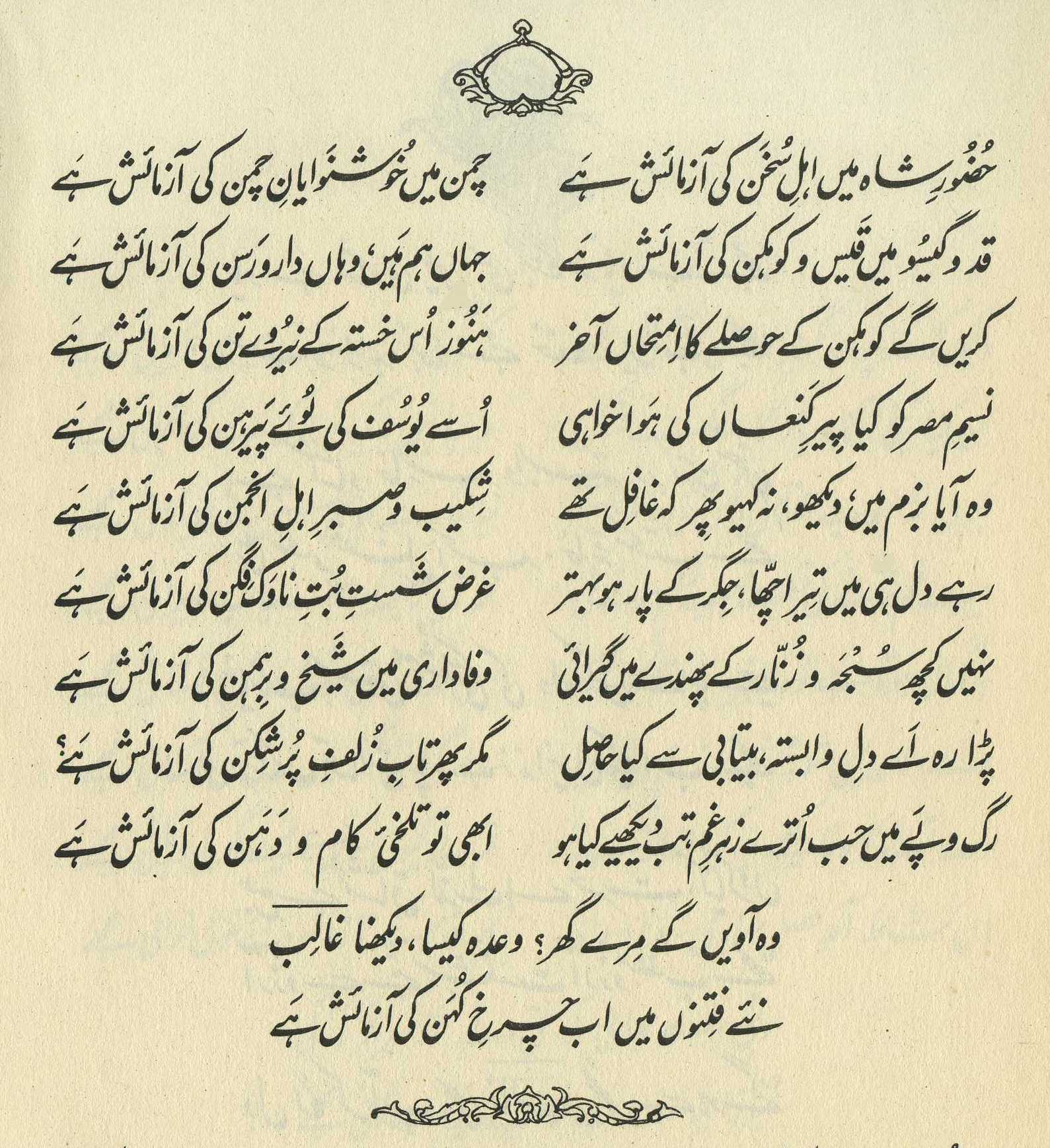
she will come to my house-- what kind of promise [is that]?-- let's see, Ghalib!
2
in new trials/mischiefs/seductions/crimes, now, is a test by/of the ancient sky/sphere
is an archaic form of ( GRAMMAR )
'Trial, affliction, calamity, mischief, evil, torment... ; --temptation, seduction; --discord, conflict, cabal, faction, civil war, sedition, revolt, mutiny; perfidy; sin, crime'.
'A wheel (as of a water-mill, or of a well, &c.); a potter's wheel; a lathe; the celestial globe or orb, the sphere of the heavens, the heavens, the sky; —circular motion; turn; —fortune, chance'.
| References | |
|---|---|
| Arshi, Imtiyaz Ali | Ghazal# 224 |
| Raza, Kalidas Gupta | 427-28 |
| Hamid Ali Khan | Open Image |
'She will come to my house'-- that is, the hell [] she'll come! 'What kind of promise [is that]?'-- that is, when does she give a thought to promises? Now we have to see in what kind of difficulties the sky engulfs us-- that is, from her not coming, and her going against her word, let's see what days the sky shows us. (231)
== Nazm page 231

He says, 'She won't come to my house. Until Judgment Day she won't come. Oh Ghalib, when does she think of her promises? She'll have forgotten it. Now we have to see in what kinds of new difficulties the sky engulfs us-- that is, from her going against her word, and not coming, we have to see what difficulty the sky inflicts on us, in separation from her.' (288)
She has never come to my house, nor will she ever come. What is a promise? Let her promise. As if she would promise and be faithful to it! Now wait and see what new mischiefs the sky raises. That is, what happens to us through her going against her word. (408-09)
This verse belongs to the set of those in which the beloved (perhaps) visits the lover; for a full list, see 106,2 . The commentators act as if her coming is completely out of the question; they read the first line as if it contained an indignantly negative rhetorical question or exclamation, like . But of course, it doesn't. It contains , 'what kind of promise?', a more subtle and open-ended question that might be rhetorical, or might not.
For after all, the second line at once presents us the idea of new kinds of that the sky is on its mettle to provide for us; the sky will thus 'test' us. But the sky will also undergo, in our eyes, a kind of 'test' of its ingenuity in -- in producing new kinds of 'trial, affliction, calamity, mischief, evil, torment; temptation, seduction; discord, conflict' (see the definition above). All of these are enjoyably appropriate to the beloved and her promise of a visit. Might she cruelly and deliberately snub us? Might she absent-mindedly forget? Might she even, for some obscure reason of her own, actually come? Might she come, but treat us in some cruel way? Might she come, laughingly, with another lover in tow, as in 116,3 ? Might she come in our dreams, as in 97,3 ?
The sky is a well-known source of disasters and calamities (see 14,8 as just one example), and can be blamed for almost anything; blaming the sky adds overtones of fate, destiny, dignity, and necessity to what might otherwise appear, in this case, to be mere human caprice on the beloved's part. In the grief-stricken 66,5 , the 'ancient sky' is directly addressed, and is reproached for its heedless cruelty.
graphics/ruinedhouse.jpg