Verse 31852ankii aazmaa))ish hai
G2
1
they/you/we will test Kohkan 's spirit/courage/'guts' at the end
2
right now it's the test of that wounded/broken one's strength/power of body
'Stomach...; capacity; desire, ambition; resolution; spirit, courage'.
'Wounded, hurt; broken; infirm; sick, sorrowful; --fragile, brittle'.
| References | |
|---|---|
| Arshi, Imtiyaz Ali | Ghazal# 224 |
| Raza, Kalidas Gupta | 427-28 |
| Hamid Ali Khan | Open Image |
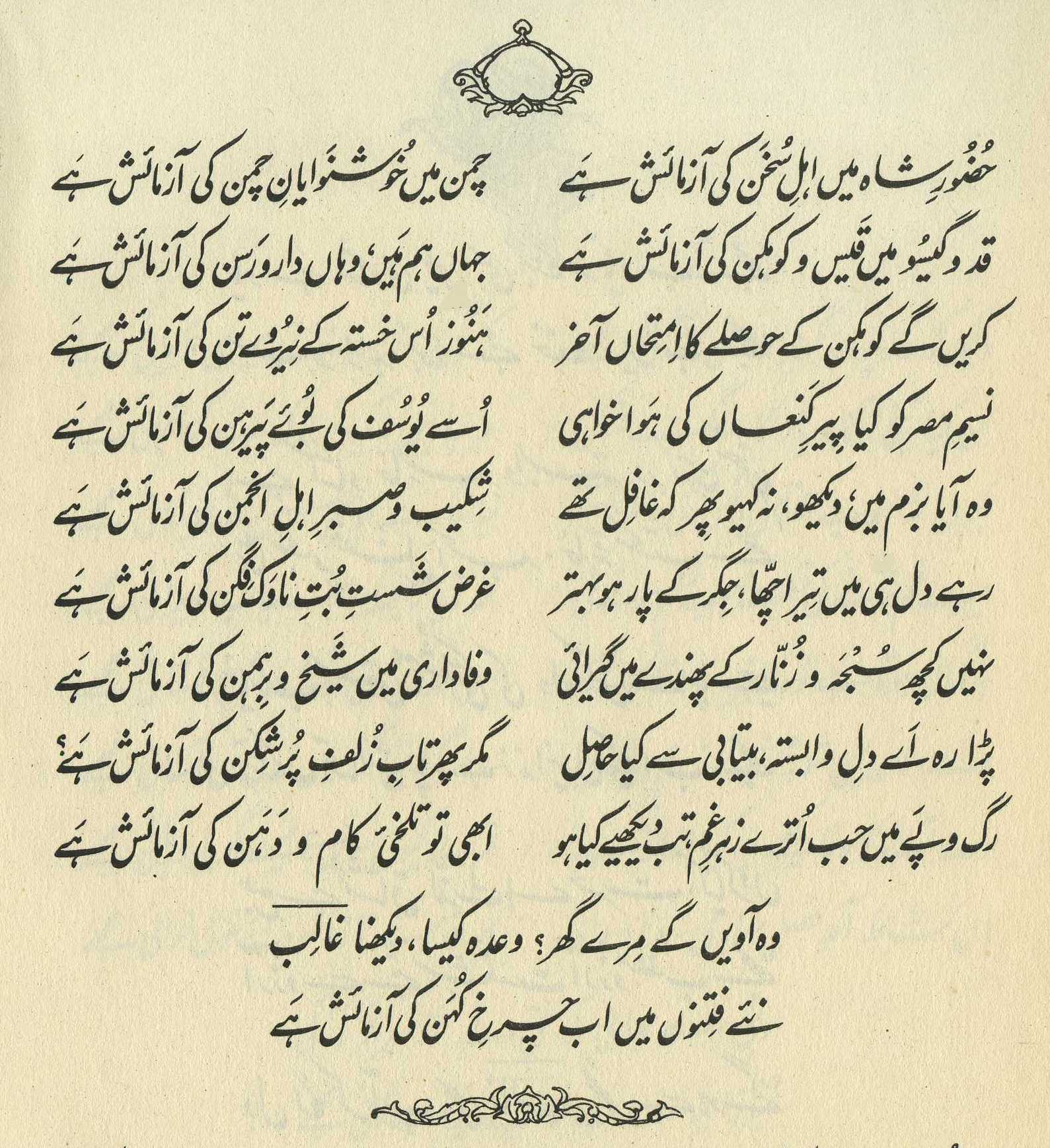
That is, now it is the test of his arm and shoulder: let's see whether he can make a canal of milk or not. The time for looking at his heart will come when the old woman comes and tells him news of Shirin's death: let's see whether he endures this grief, or splits open his head and dies. In this verse is a taunt against Kohkan: that he lacked spirit/courage and could not endure the shock, so that he gave up his life and fled from the battlefield of passion. (230)
== Nazm page 230

He says, right now a test simply of Kohkan's strength of arm and shoulder is being made, for he's been given the order to bring the canal of milk and cut through the Pillarless Mountain. The test to judge his strength of endurance and self-control will be at the time when an old woman comes to that unsuccessful lover bearing the heart-rending news of Shirin's death, and that one lacking in spirit/courage will split his head open with an axe and die. As if it's a taunt against Kohkan, that he lacked spirit/courage and thus gave up his life and fled from the battlefield of passion. (287)
This verse is not intended to taunt Kohkan. The word bears witness that whatever the poet has said, he has said in a sympathetic tone. Here the meaning of is 'poor, helpless, distracted, anxious', not limp or lacking in fortitude. Perhaps Janab the Commentator [Nazm] felt this suspicion because Mirza has often been cool toward Kohkan, as in 3,6 . (406)
Some editions and commentators have instead of ; as always, I follow Arshi.
Who is speaking? It could in principle be anyone, though of course we think first of the lover. More intriguingly, who will do the testing? 'They', or 'you', or 'we' could fit. But still-- who would that be? After all, not even Khusrau was seeking to 'test' Kohkan; he only wanted to exploit and mock him.
The comments of Nazm and Bekhud Mohani, if put together, excellently show the range, and the elegant ambiguity, of this verse. Is it meant to taunt Kohkan with his lack of 'guts' (the literal meaning of is 'stomach', after all), as Nazm asserts? It's quite possible to read it that way; and on that reading it would fit in with the whole set of 'snide remarks about famous lovers' verses (for a list, see 100,4 ).
But as Bekhud Mohani observes, a more sympathetic reading is also possible: the second line speaks of testing Kohkan's physical strength, and we know very well that he passed this text magnificently; his very success as a 'mountain-digger', which had seemed impossible, is what precipitated the ruse that led to his death. And his being called does indeed suggest some admiration: despite his being weak, sick, frail, worn-out, he performed impossible feats of digging, through his sheer passion (and surely his 'guts' too).
So perhaps, on this more sympathetic reading, the first line is to be read as analogous to the second one? Perhaps he might pass the test of his 'guts', just as he also passed the test of his physical prowess. For is it really so obvious that splitting one's head open with an axe when hearing of the beloved's death is an act of weakness and cowardice? It could surely also be seen as an act of properly mad, passionate, lover-like refusal of life without her. Even in the archetypally sneering verse, 3,6 , that Bekhud Mohani himself cites, the criticism of Kohkan doesn't seem to be that he died, but that he needed to use an axe to die, whereas a superior lover might, the verse suggests, have dropped dead out of sheer will-power.
There's a nice word-and-meaning connection between the physical, bodily strength in the second line, and the metaphorical quality of spirit/courage in the first line, since of course the word for the latter itself literally means 'stomach'. (It's so lucky that in English we have 'guts', with the same double valence.)
graphics/farhad.jpg
