Verse 41816ii;Nhai
G9
In this meter the next-to-last long syllable may be replaced by two shorts.
2
it's an occasion for the abandoning of concealment/veiling and the seeing-off of dignity
'The agonies of death; the last breath; expiration'.
'Adieu, farewell; parting; bidding farewell'.
| References | |
|---|---|
| Arshi, Imtiyaz Ali | Ghazal# 162 |
| Raza, Kalidas Gupta | 282-83 |
| Nuskhah-e-Hamidiyah | 236-237 |
| Asi, Abdul Bari | 297 |
| Gyan Chand | 437-438 |
| Hamid Ali Khan | Open Image |
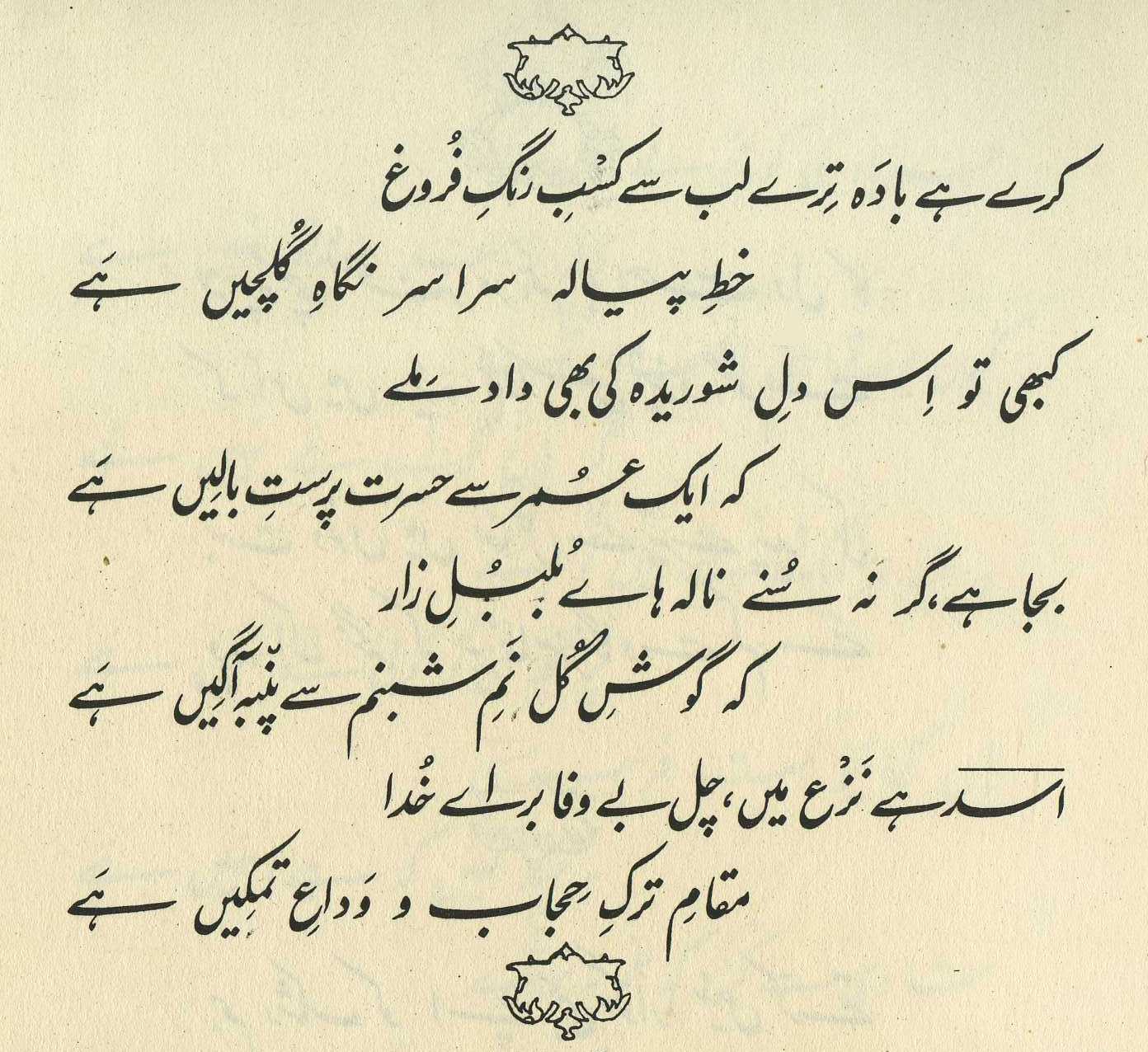
That is, if concealment appears, then at such a time, renounce it; and if dignity and self-respect forbids that, then at such a time, bid farewell to them too. (224)
== Nazm page 224

He says, 'Asad is absorbed in the pain of the death-agony. Oh faithless one, for the Lord's sake, go along to see him! This is a time to renounce shame and concealment, and bid farewell to dignity and self-respect.' (281)
The lover is dying, and the beloved's friends too are moved by his condition-- and moved in such a way that they adjure her for the Lord's sake. By calling her 'faithless one' they want to influence her toward mercy-- and they too are convinced of her faithlessness, because they go on to say that this is not a time to care about shame and dignity. The lover's state, and the extent of the beloved's modesty and dignity, are revealed through this verse. (392)
Ghalib composed two closing-verse s for this ghazal, both using 'Asad'. For discussion, see the non- divan one, 199,6x .
The beloved is urged to go and say farewell to the dying lover, because this is an occasion to 'abandon' concealment, and to 'see off' or 'take leave of' dignity. She would thus be doing three acts of farewell at once: to the lover, to concealment, and to dignity. But can one really 'see off' concealment and dignity the way one 'sees off' a person, and what does it mean to do so? Is this wordplay, or meaning-play? Surely it's both, and the complexity greatly enriches the verse.
The beloved would thus be doing three acts of farewell-- if she did them. But the verse gives us little cause for hope. Someone is exhorting her to show religious charity and fear of the Lord, if nothing else, and thus behave kindly toward her dying lover. But will she pay any attention? Is she even listening? After all, that someone is addressing her as 'faithless one', and the very definition of a faithless one suggests little concern for the claims of loyalty and devotion.
This is, in a sense, a verse about the beloved visiting the lover-- for the full set, see 106,2 -- but it's a very negative and hypothetical one. For a more optimistic-- in terms of the ghazal world, at least-- look at her deathbed visit, see 52,1 .
graphics/veiled.jpg