Verse 11816ii;Nhai
G9
In this meter the next-to-last long syllable may be replaced by two shorts.
1
wine makes, through your lip, the aquisition/gain of the color/aspect of radiance/splendor
2
the line on the glass is entirely/'head to head' the gaze of a Flower-picker
is an archaic form of (GRAMMAR)
'Acquirement, acquisition (by labour), earning, gain; industry, employment, occupation, trade, profession, handicraft; art, skill; prostitution, harlotry'.
'Illumination, light, brightness, splendour; flame; --glory, fame, honour'.
'From end to end, from beginning to end, all, the whole, wholly, entirely, throughout, out and out'.
| References | |
|---|---|
| Arshi, Imtiyaz Ali | Ghazal# 162 |
| Raza, Kalidas Gupta | 282-83 |
| Nuskhah-e-Hamidiyah | 236-237 |
| Asi, Abdul Bari | 297 |
| Gyan Chand | 437-438 |
| Hamid Ali Khan | Open Image |
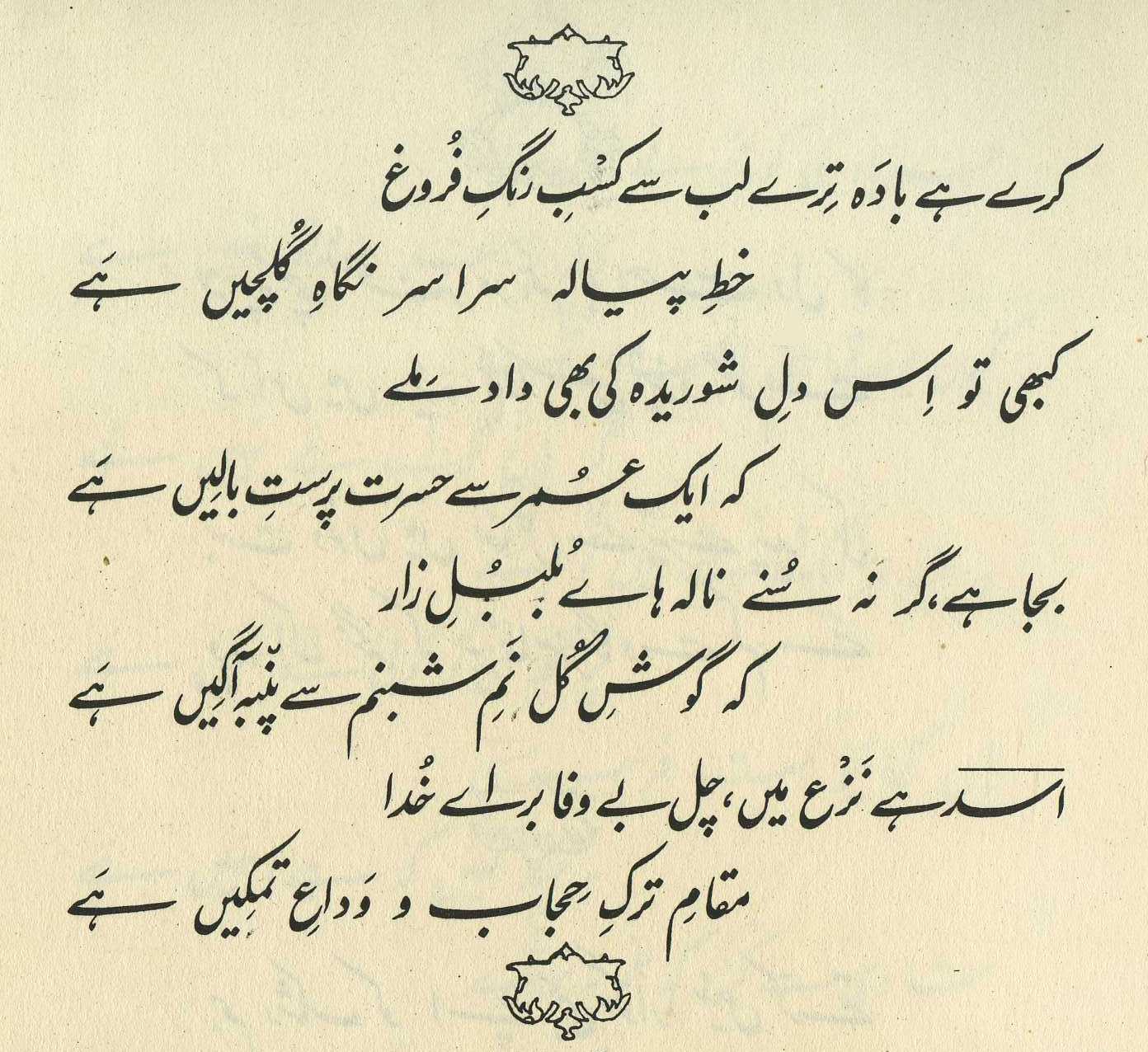
That is, your lip is the flower, and the wine is the Flower-picker, and the line on the glass is the gaze of the Flower-picker. And the word 'entirely' [] is put in to complete the verse [as padding]. (223)
== Nazm page 223

He says, 'Wine wants to obtain from your red lips a mischievousness of color. The line on the glass is the thread of the Flower-picker's gaze, that is gathering your flower-like lips.' (281)
Your lips, with regard to their colorfulness and moistness, are flowers, and the wine is the Flower-picker. He mentions as proof of this that the line on the glass is entirely the Flower-picker's desirous gaze.
[Disagreeing with Nazm:] 'Entirely' gives a sense of emphasis.... and another of its pleasures is that in the whole going-round of the flagon-- that is, in the shape of the circle-- there is a line. Momin says:
[now we write to him in a letter, 'oh entire enemy'
to whom we always used to write, 'oh wholly devoted friend'] (391)
has two meanings: (1) wine, and (2) a wineglass. has a number of meanings; among them the following are to our purpose: (1) portion, fate; (2) power and strength; (3) style, manner, aspect. Now let's take : in Arabic it means 'to be through with some task', and in Persian (1) splendor, glow, (2) glitteringness, (3) radiance, (4) flame.
If in the light of these meanings we reflect on the verse, then two meanings emerge. If we take 'wine' to mean 'wineglass', then the meaning becomes: when the wineglass reaches your lip, then it obtains the aspect of radiance or fire. That is, when the radiance of your lip is reflected in the wineglass, then it seems that it's not a wineglass, it's a flame. He gives the wineglass as a simile for the eye, and for the flower a simile of a flame or a lamp. Thus the meaning of the second line becomes that the wineglass, having reached your lip, became radiant, as if it became a lamp. That is, the eye of the wineglass became brightened. On this basis it is doing the work of a Flower-picker, because the Flower-picker too brightens his garment-hem with the lamp of the rose. And if the wineglass is a Flower-picker, then the line on the glass will certainly be called the gaze of the Flower-picker. And for this reason too: that the gaze too is considered to be a line; and for this reason too: that the line on the wineglass has become radiant from the radiance of the wine, the way a glance becomes radiant.
If we look at it from another angle, then it's also not necessary to suppose the wineglass to be a Flower-picker. It's sufficient to say merely that from the colorfulness of the lips, the wineglass has become radiant, and the line on the wineglass, like the gaze of the Flower-picker has become full of color.
If we take to mean 'wine', then the meaning becomes that when the wine reaches your lips, then on the basis of the redness of your lips it itself too obtains the style of radiance or flame. It's obvious that when the wine is radiant, then the line on the glass will also be radiant. And on the basis of this radiance the line on the glass is radiant the way that the gaze of the Flower-picker is illumined by the radiance of the rose. Here it's not a garden, but it's thanks to your lips that that the line on the glass is obtaining pleasure like that of the glance of the Flower-picker. To make the wine into flame, and the line on the glass illumined like a gaze, is the charisma of the beloved.
A reason for the affinity is also that the beloved's lips and the wine are both called flowers, and people use flame or a lamp as a simile for a flower. Another point is that where wine or the wineglass obtains access to the beloved's lip, the line on the glass is watching this from afar; thus the line on the glass has the quality of a gaze.
Thus in both lines is the connection not of 'this, therefore that', but rather of 'this also, and that also'.
== (1989: 327-28) 2006: 355-57
There may be something interesting going on in this verse, but if so it eludes me. I don't see that the two lines have much real connection -- the whole idea of wine as a Flower-picker is simply so physically ungrounded, so hard to put together visually in one's imagination (does the wine have red blobby 'hands' that reach out and pick the flowers, like a creature in a horror movie?). There would need to be some special care given to justify it and make it work. And no such care is apparent. On the contrary in fact: the idea of the line formed by wine in the glass as resembling a 'gaze' is equally uninviting (since when do gazes go round in circles?), and doesn't cohere well at all.
Faruqi does as much for the verse as is humanly possible, but I still can't make myself take it seriously. Once we've struggled to 'get' the complex connections that the verse manages to set up, what have we got? What's behind all the arbitrary and unmotivated-seeming imagery? I still don't buy it.
Of course, there's the wordplay of body parts: lip, down on the cheek [], head [], and perhaps the eyes through 'gaze'.
For more about lines on wine-containers, see 81,6x .
graphics/wineglasslines.jpg