Verse 21816ii;Nhai
G9
In this meter the next-to-last long syllable may be replaced by two shorts.
1
well, sometime even/also this tumultuous/faint heart should receive its due/justice!
2
since for a whole lifetime it has been a {longing/grief}-worshiper of the pillow
'Disturbed (in mind), distracted, mad, frantic; desperately in love; faint; dejected'.
'Statute, law; equity; justice; crying out for justice, complaint; revenge'.
'Grief, regret, intense grief or sorrow; --longing, desire'.
'Adoring, worshipping; devoted (to), attentive (to)'.
| References | |
|---|---|
| Arshi, Imtiyaz Ali | Ghazal# 162 |
| Raza, Kalidas Gupta | 282-83 |
| Nuskhah-e-Hamidiyah | 236-237 |
| Asi, Abdul Bari | 297 |
| Gyan Chand | 437-438 |
| Hamid Ali Khan | Open Image |
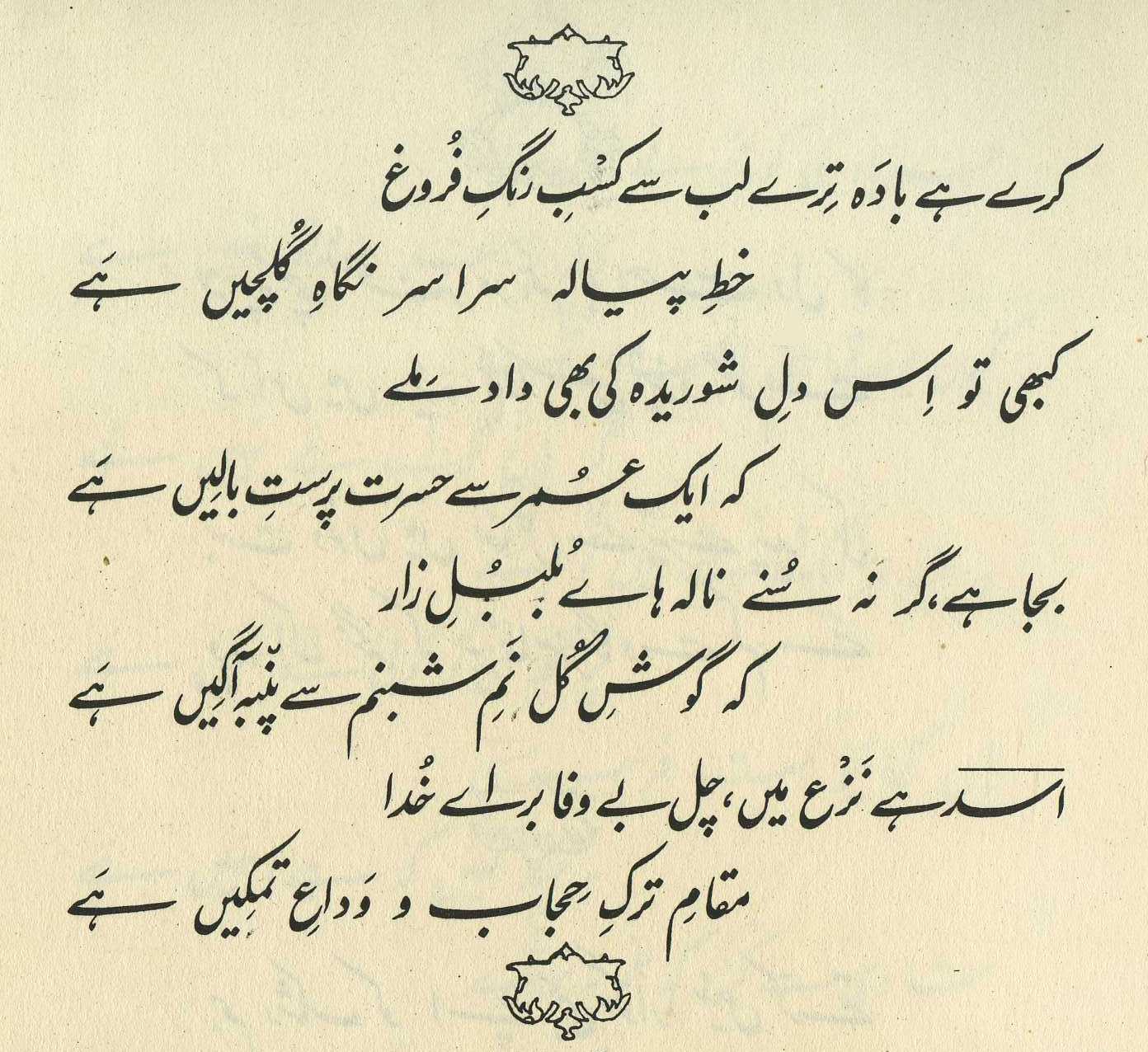
'For a whole lifetime it has been a longing-worshipper of the pillow' means, for one thing, that for a long time there has been the longing to place the head on a pillow; for another thing, that there's such weakness that the head can't be lifted up from the pillow, and in this situation it wouldn't be strange if the word 'heart' was an error by the scribe, and the author had said 'head' []; but the meaning of the verse is clear in any case. (223)
== Nazm page 223

The rule is that in a state of madness and wildness, sleep doesn't come. He says, 'Sometime my tumultuous/faint heart should receive justice, for it has been absorbed for years in longing for the pillow'. The meaning is that in reality when there's a lessening of the madness of passion, the head will become acquainted with the pillow, and sleep too will come. (281)
Sometime our wild heart should receive its due, since for a whole lifetime it's longed to put its head on the pillow and sleep-- that is, we have a longing to put our head in your lap and sleep....
[Agreeing with Nazm's theory of scribal error:] Undoubtedly, that seems to be the case. (391)
If the heart deserves 'its due', or satisfaction of some kind of just claim, what does that mean, and how does the heart come to deserve it? Here are some possible explanations:
=Because the heart is so dejected, so burnt-out with passion, it longs to rest; the lover's wild behavior has never yet permitted it to do so, but surely one day its time will come, and its yearning for the pillow will be satisfied.
=Because the heart is so weak, dejected, and faint, it cannot sustain the lover in anything except the role of an invalid; after a lifetime of being confined to bed and thus symbolically 'worshipping' the pillow, surely the heart's patience and endurance deserves some kind of recognition or reward.
=Because the heart is so wild and turbulent with passion, it maintains a kind of secret dedication to a vision of peace and rest-- and death; perhaps one day its self-sacrificial devotion will be rewarded.
It's not a very compelling verse. Still, it's surprising that Nazm is so ready to assume that it incorporates a scribal error that Ghalib presumably never noticed in the course of all the four divan printings that he oversaw; and it's even more surprising that Bekhud Mohani, usually so eager to disagree with him, here warmly supports his view. No doubt 'head' would be a more conventional and obvious choice (in view of 'pillow') than 'heart'-- which is why we shouldn't be surprised that Ghalib avoids it. It's true that in this case Ghalib doesn't seem to make much use of the unconventional 'heart'; but then, substituting 'head' wouldn't do much for the verse either. It's just an early, perfunctory verse; Ghalib at nineteen or so was writing great numbers of such experimentally cerebral verses-- and what were the rest of us doing at nineteen?
graphics/pillow.jpg