Verse 31816ii;Nhai
G9
In this meter the next-to-last long syllable may be replaced by two shorts.
1
it's proper if she/it would not hear the laments of the plaintive Nightingale
2
for the ear of the rose is cotton-filled with the wetness of the dew
'In place; proper, suitable, fit, becoming; right, just, true'.
'Groaning, lamenting, afflicted; thin, lean, weak'.
'Full (used in comp.)'.
| References | |
|---|---|
| Arshi, Imtiyaz Ali | Ghazal# 162 |
| Raza, Kalidas Gupta | 282-83 |
| Nuskhah-e-Hamidiyah | 236-237 |
| Asi, Abdul Bari | 297 |
| Gyan Chand | 437-438 |
| Hamid Ali Khan | Open Image |
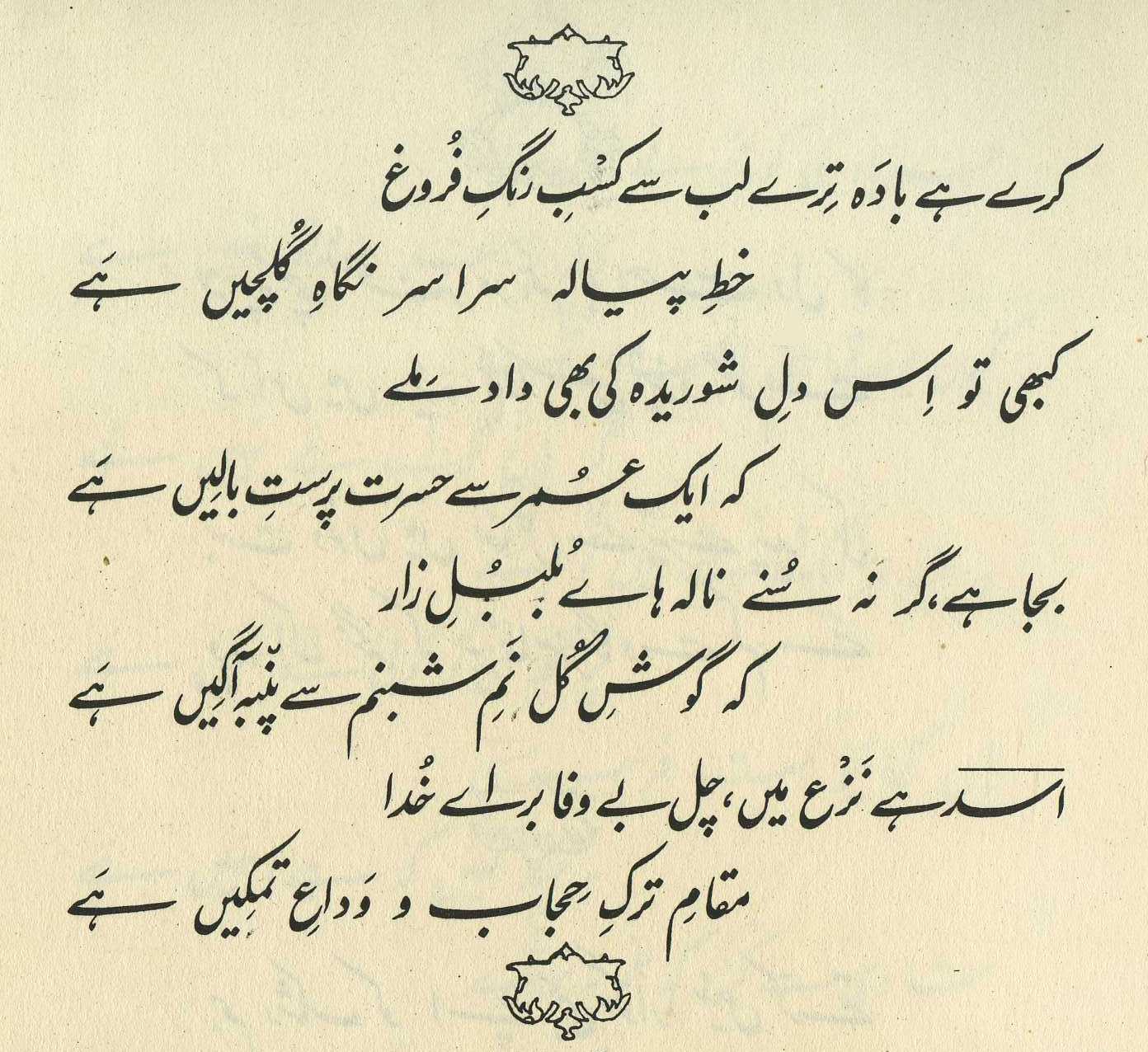
They always give for the rose the simile of an ear, and when dew falls on it, it's as if it has put cotton in its ear. Then, how would it hear the Nightingale's lament? This verse is of the same type as one that has already appeared: 101,7 . And the idea is that in the verse the mention of the rose and the Nightingale and the candle and the Moth , and so on, gives beauty, as long as some aspect of an allegory would emerge clearly from it.... But where the allegory would not emerge clearly from it, and where it would seem that the purpose of the verse is only discussion of the state of the rose and Nightingale, then that verse becomes devoid of pleasure.... And both these verses of the author's too are of exactly this type.... But most of the author's work is free of this unpleasurableness-- as compared to other poets, whose work is usually full of this kind of verses. (223-24)
== Nazm page 223 ; Nazm page 224


He says, 'If the rose can't hear the lamentation of the grieving Nightingale, it's pardonable, because the rose's ear has been closed up with drops of dew as though it had stuffed cotton in its ear; now it can't possibly hear the Nightingale'. (281)
If the rose (that is, the beloved) can't hear the lament of the wretched and suffering Nightingale (the lover), then there's no cause for astonishment; since its ears, because of the tyranny of the dew, are cotton-filled. (392)
Here's a classically piquant mushairah -verse. The first line sets up a provocative assertion: at once we ask, why is it proper? Usually it's not considered proper, it's something the poor Nightingale grieves over, as an additional cause of his solitary suffering. Why won't the beloved listen to the lover, and what's her justifiable reason? Under mushairah performance conditions, we're made to wait a bit for that second line; and even then, not until the last possible moment do we get the punch-word that makes the whole thing suddenly comprehensible.
When we do hear that punch-word, we realize with amusement that the first line has deliberately sent us off down the wrong path in our speculation, so that we can have a sudden burst of explosive 'getting-it' pleasure. Usually the beloved won't 'listen to' [] the lover's laments: it's a choice she makes, for reasons that have to do with her attitude toward the lover. But can also mean 'to hear', with a convenient ambiguity that's hard to capture in modern English. We only now realize that the rose is deaf (she can't hear), rather than heedless (she won't listen) as we had at first assumed.
And she's deaf because of drops of silvery, shining dew that resemble little balls of cotton stuffed into her petal-shaped 'ears'. This would seem to mean that the rose is innocent-- how can she be expected to control the fall of the dew? And yet as we think about it further, the image of the cotton ball exerts its own power as well. Cotton balls never get into people's ears by accident-- they must be put there for some purpose. Might the rose have an earache, or feel a chill? Or might she have contrived to use the drops of dew as earplugs, to spare her the annoying moans and groans of her tedious lover? Needless to say, it's left up to us to decide.
The cotton balls and drops of dew are nicely balanced in other ways as well: dew is wet, while cotton is used to dry things and keep them dry; dew is produced by a universal natural process, while cotton balls are specialized human creations; dew is really colorless, with a temporary silvery glint in the light, while cotton balls have their own essential white. (Usually in the ghazal world wads of cotton have quite a different function; on this see 87,4 .)
There are also some elegant sound effects in the second line: is a wonderful phrase to say, with its forceful initial consonants so enticingly balanced with the metrical stresses. In particular, the repetition of (since dew is literally 'night-wetness') is well arranged: the first one almost vanishes because of its , while the second rebounds with extra vigor. Then in we have an evocation of both the consonants of : the is written, while the sound converts itself, for phonetic reasons, to a in recitation.
graphics/rosedew.jpg