Verse 51821uu;Nvuh bhii
G2
1
don't be so coquettish/proud about the sharpness of the sword of tyranny/cruelty
2
in my sea of restlessness/pallidness, even/also that is a single wave of blood
'Cutting; sharpness'.
'Faintness; agitation, restlessness, uneasiness, impatience; lack of splendour or lustre'.
| References | |
|---|---|
| Arshi, Imtiyaz Ali | Ghazal# 133 |
| Raza, Kalidas Gupta | 342-343 |
| Nuskhah-e-Hamidiyah | 182-183 |
| Asi, Abdul Bari | 217 |
| Gyan Chand | 332-333 |
| Hamid Ali Khan | Open Image |
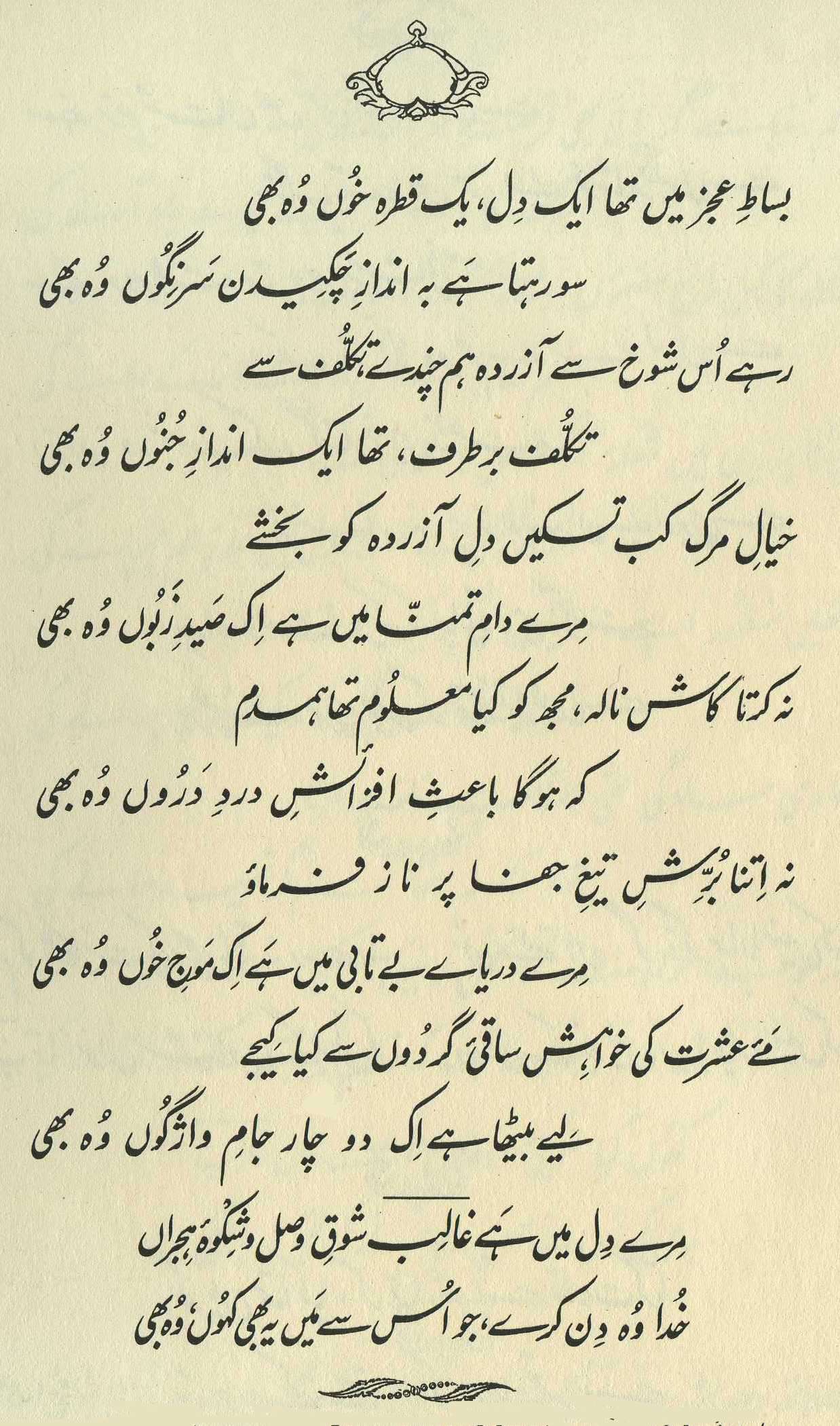
While being slain, and in the state of writhing in pain, these words are spoken. And by the 'sword of tyranny' that sword itself is meant, by which he is being slain and by which tyranny is being practiced. But the simile of a 'wave' for a sword is carelessness/casualness []. By calling it a 'wave of blood of the sea of restlessness' he has created novelty. The gist is, what is your one sword worth? My sea of restlessness is full of waves, and hundreds of such swords are piercing me. (143)
== Nazm page 143

He says, 'Oh my murderer, why are you so proud of the sharpness of the sword of tyranny? I agree that the sword of your tyranny is slaying me. But what is that? In my sea of restlessness, it is one lowly wave of blood.' (198)
Why do you plume yourself on your sword? It too is one wave of blood in my sea of restlessness. In the state of restlessness, every wave of blood that runs in my veins is just as piercing. (264)
Nazm has perceptively indicated the real problem: why is the 'sword of tyranny' to be equated with a 'wave of blood'? The problem is especially acute because the first line itself tells us that the beloved's pride is in the 'sharpness' of the sword, and thus implies that that might be the basis of comparison. A wave of blood can be many things, but 'sharp' is not one that springs readily to mind.
Of course, if we unleash our imaginations, we can come up with possibilities. The sword is a wave of blood because the sword is dripping with (the lover's) blood, and because it swings through the air for its slashes the way a wave of blood would ripple through the sea. The sword is 'a single' wave of blood because it is long and thin like a wave, and and moves along its long axis the way a single wave does. The sword is a wave of blood because it is limited, contingent, short-lived, and superficial, capable of causing only minor effects-- the way a wave of blood would travel only briefly, among hundreds of its equally short-lived and trivial peers, over the surface of the much larger, more powerful, and longer-lasting sea of blood that is the lover's own passion and suffering. What the beloved can do to him is nothing compared to what he is already, and always, doing to himself.
There's also the unstated but hovering wordplay of , which means both 'water' and the 'temper' of a sword; compare 193,2 , in which it becomes explicit. And it's not even entirely unstated: the phrase , or , means 'Brightness, brilliance, lustre, splendour; dignity, grandeur, majesty, glory, pomp' (Platts p.1). Thus not only itself literally contains , but also gives it an idiomatic point of entry.
Still, by Ghalib's standards this kind of thing is not exactly overwhelming. To see how astonishingly much more he can do when he's really on his game, consider the brilliant 16,4 , which also deals with unusual kinds of waves.
graphics/bloodwave.jpg