Verse 31816aa;Nhai
G2
1
from excess/abundance of grief, to such an extent the mood of joy was ruined/wasted!
2
{since / in that} the dawn of Eid to me is {worse than / inferior to} the tearing of the collar
'Perishing; ruin, destruction, loss; profusion, prodigality, waste, consumption, expense; ... , v.n. To perish, to be destroyed or ruined; to be wasted; to meet with a loss, be unfortunate'.
| References | |
|---|---|
| Arshi, Imtiyaz Ali | Ghazal# 154 |
| Raza, Kalidas Gupta | 275 |
| Nuskhah-e-Hamidiyah | 223-224,227 |
| Asi, Abdul Bari | 232 |
| Gyan Chand | 355-356,358-359 |
| Hamid Ali Khan | Open Image |
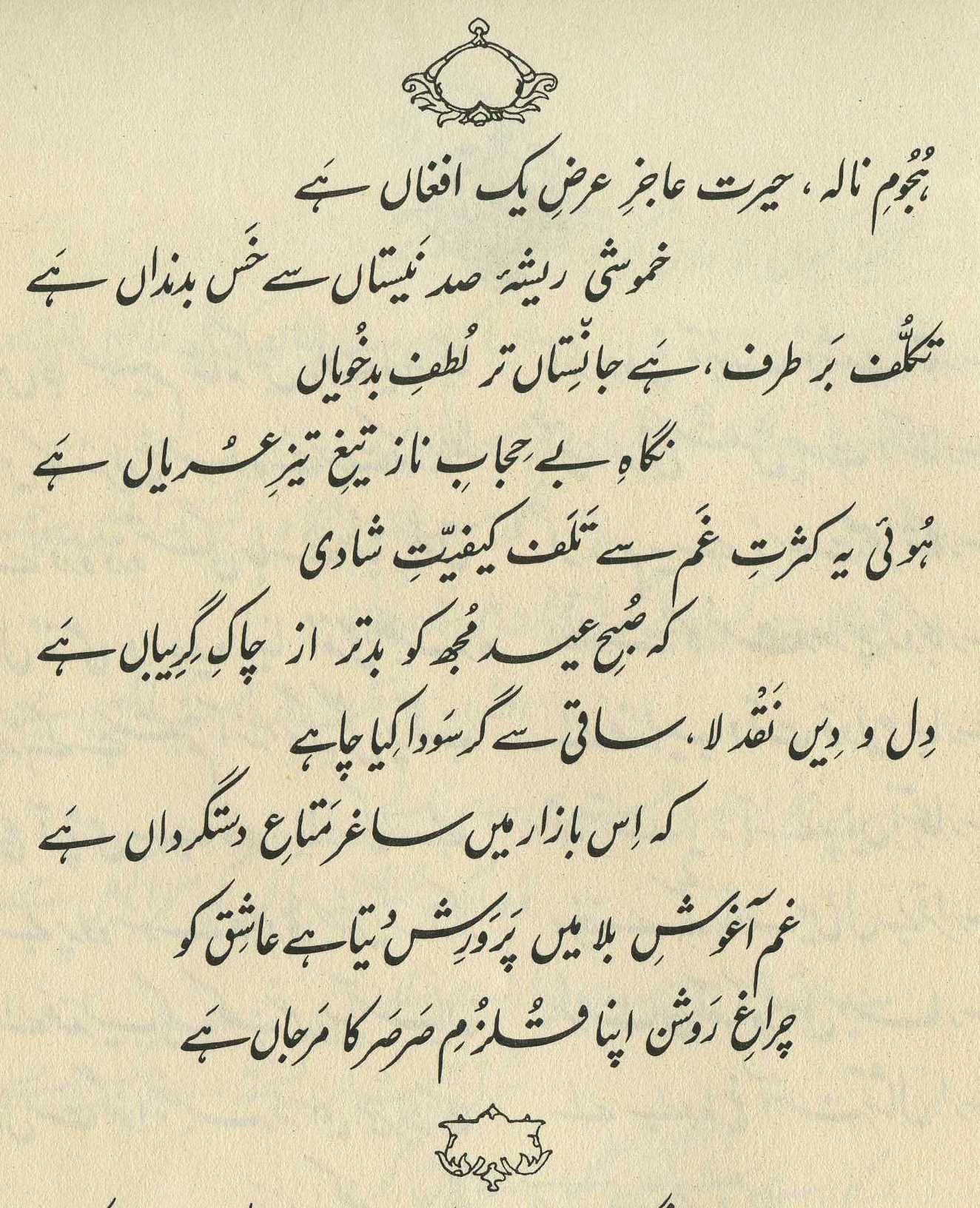
All the poets always versify the word to mean 'to this extent', but it seems that this is worthy of being renounced. (254)
== Nazm page 254

He says, 'From an excess of grief, to such an extent joy has been erased that in my sight the dawn of Eid is worse even than the tearing of the collar'. (311)
[Disagreeing with Nazm:] When all the poets always versify it, and not even any reason for renouncing it is presented, what will we call this [objection] except 'inspiration'? (460)
In Raza's text ( Raza 1995 p. 275 ) this verse appears as the closing-verse of the first of the two ghazals from which Ghalib chose verses for this ghazal in the published divan . The verse's first line in Raza's text is: . Apparently Ghalib modified the line to remove the pen-name when he decided to place the verse in the middle of the newly framed ghazal for his divan. (And in fact he chose to leave the newly framed divan ghazal without a closing-verse.)
The first line provides a particularly subtle and elegant wordplay between as 'excess' or 'glut', and the meaning of as 'profusion' or 'waste' (see the definitions above). The fact that is so remote from the that establishes it as part of a verb construction, encourages us to initially take it as a noun, and thus to activate this wordplay.
Why is the dawn of Eid compared to the tearing of the lover's collar? For more examples, and discussion, of this collar-tearing motif, see 17,9 . The dawn first shows itself as a white line along the horizon, like a narrow bright slash in the darkness; thus its shape resembles the neck-opening of a kurta. On this 'crack of dawn' image, see 67,1 . And after that first white slash appears, dawn then opens itself out and widens into day-- the way the mad lover, in his frenzied grief, rips open the neck of his kurta.
When the time comes to put the two lines together, the little shows its own versatility. One of the meanings it can have is 'consequently' or 'therefore'; in this 'A causes B' reading, the change from joy to melancholy causes the speaker to prefer tearing his collar over celebrating the joyous festival of Eid. But the can also mean merely 'such that' or 'in that', so the second line may only illustrate the situation described in the first one.
Note for grammar fans: What about that obtrusive, oddly-placed ? We really have to go with the consensus of the commentators and read it as 'to such an extent', which certainly makes sense as a common idiomatic usage. For if we don't, the first line in prose order has to read: . There are two problems here: the line then offers no antecedent whatsoever for what the could refer to; and such an antecedent is needed especially because whatever it is is now over, and thus not immediately apparent. In addition, the line would then be seen to separate the almost impossibly far from its real, prose-order position before .
graphics/dawn.jpg