Verse 11816aa;Nhai
G2
1
rush of laments/complaints-- amazement-- incapable of the presentation of a single lamentation-- is
2
silence, through the fiber/vein of a hundred reed-thickets, has a straw between its teeth
'Rushing (upon, or at, ); attacking; crowding, swarming (round, or about, -par);--assault, attack; effort; impetuosity;--crowd, throng, concourse, mob; a swarm'.
'Perturbation and stupor (of mind), astonishment, amazement, consternation'.
'Lacking strength or power, or ability, powerless, impotent, unable (to do), unequal (to); weak, feeble, helpless; brought low, overcome; lowly, humble; exhausted; dejected; in despair, hopeless; baffled, frustrated'.
'Fibre; filament; nerve; vein (of a leaf)'.
| References | |
|---|---|
| Arshi, Imtiyaz Ali | Ghazal# 154 |
| Raza, Kalidas Gupta | 275 |
| Nuskhah-e-Hamidiyah | 223-224,227 |
| Asi, Abdul Bari | 232 |
| Gyan Chand | 355-356,358-359 |
| Hamid Ali Khan | Open Image |
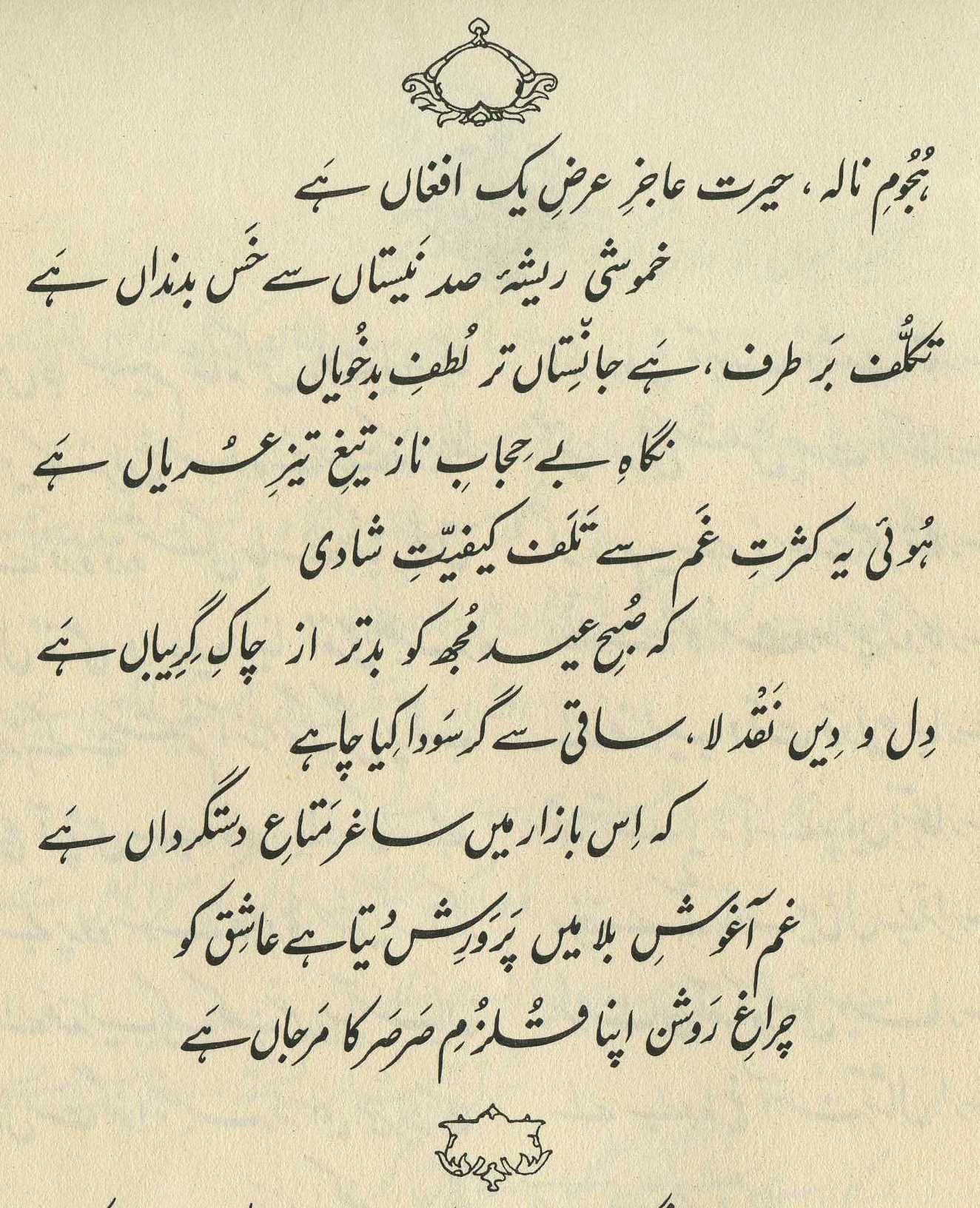
On the battlefield, when some group is defeated, then in order to express their helplessness they take some straw, grass, etc. in their mouth and show it, to say, 'stop the battle'. Here, the crowd of laments has won the day, and amazement is unable to make even one lament; and in order to express that helplessness, there is silence, etc. But in order to take a straw in its teeth-- what is the special quality of the fiber of a reed-bed? It's the root of lament and complaint, for from a fiber a flute is made; and from a flute, lament. And in a state of control, lament is silent, the way lament is hidden in the fiber of a reed-bed. It is in the vocative-- that is, he means 'oh rush of complaints'. Only through having addressed the rush of laments has the author said 'the fiber of a hundred reed-thickets'. (254)
== Nazm page 254

He says, 'Despite the rush of laments, amazement has made me helpless to present lamentation. As if silence has made the reed-thicket, in which hundreds of bamboo flutes are present, take a straw in its teeth.' The meaning is that despite the power of speech, out of respect to secret-keeping I have sewn my lips shut. (311)
The rush of laments is helpless and anxious, since by reason of amazement it cannot weep and wail. The expression of its helplessness is taking place through its silence. By the taking of a straw between the teeth helplessness is also intended. Here the poet's intention is that the way a rush of laments, because of stupefaction, is silent, in the same way so is the fiber of the reed-thicket, whose similitude is to grass-- and from which hundreds of reed-flutes can be made. (459)
Compare 10,3 . (182, 268)
The grammar of the first line is really hopelessly ambiguous. There's a 'rush of complaints', an 'amazement', and something 'incapable' which could also be a noun (an 'incapable one'). In order to show the difficulties, I've provided a 'translation' that really looks awful in English and hardly makes sense-- and it accurately reflects the semi-incoherent grammatical openness of the Urdu. Perhaps we could also argue that the confusion of the grammar mirrors the confused, 'amazed' state (on the stupefying nature of see 51,9x ) that's being depicted, the way the grammar of 223,1 can be said to reflect the coming of a flood. (That kind of 'mimicry' argument is a slippery slope, however-- before you know it you open the door to people who write boring novels and claim they're actually novels about boredom.)
Nazm thinks the 'rush of laments' is being addressed, and Bekhud Mohani thinks that the 'rush of laments' is what is 'incapable'. Could we also invent 'amazement-incapable' [] as some kind of compound that would mean 'rendered incapable by amazement'? If we could, that would offer another possibility. In any case, our choices are limited. All the constructions in the line are metrically compulsory, and no others are metrically possible.
This means that we urgently need help from that second line, and we have to make serious use of the 'A,B' possibilities. Since parallelism would be the most informative relationship between the two lines, we are well entitled to try that one first. The second line depicts a personified 'Silence' that has 'a straw between its teeth' in token of submission-- but the straw is a 'fiber' or reed from a reed-thicket, and thus has latent in it the makings of hundreds of reed-flutes. So the image seems to be of an entity that is now quiet, motionless, passive-- but with an inner life likely to produce great noise and turmoil at some later point.
If we read the first line as parallel to the second, we're led to imagine a personified 'Amazement' that is powerless and stupefied, frozen in place, unable to give voice to a single lament. What stupefies it may well be the 'rush' or 'assault' of laments that it is perhaps experiencing (though the grammar doesn't permit us to be sure of this). 'Amazement' wants to give vent to so many laments that they block each other's path and none of them actually get out; instead, their 'assault' knocks Amazement off balance and renders it powerless and silent. Thus the connection with the second line: 'Silence' and 'Amazement' would then be in similar situations. Or else, of course, the two lines could be two ways to envision the same situation: the lover's inability to express his suffering.
Even so, we still have to decide how to link 'rush of laments' to 'Amazement', and the line gives us no help at all. We can always decide, with Nazm, that it is a vocative ('oh rush of laments, you should realize that...'), so that the speaker is explaining to the semi-personified 'rush of laments' why it is that 'Amazement' is so unresponsive. But the arbitrariness is irritating. We have to do a lot of work, and the results still don't fit together with a nice precise click. And if we try to set up other relationships between the two lines, our task becomes much more difficult, since then we have much less guidance to help us frame the unresolvably ambiguous grammar of the first line.
In short, the powerful second line is undercut by the awkward grammar of the first line. It just doesn't feel very satisfactory. But what's really a cause for 'amazement' is how few such unsatisfactory verses there are in the divan , , and how many brilliant ones.
The obvious verse for comparison, as Arshi points out, is 10,3 ; but 155,3 too is a good 'straw in the teeth' example.
graphics/reedthicket.jpg