Verse 2after 1847aakiye
G3
1
it's only/emphatically a heart-- it feared the authority/punishment of the Doorkeeper
2
I-- and [that I] would go from your door without {calling out / making a sound}!
'Rule, government, governance, administration; jurisdiction, legal authority; --correction, punishment, chastisement; torture, pain, pang, agony; severity, rigor'.
'Echo; sound, noise; voice, tone, cry, call'.
| References | |
|---|---|
| Arshi, Imtiyaz Ali | Ghazal# 221 |
| Raza, Kalidas Gupta | 406 |
| Hamid Ali Khan | Open Image |
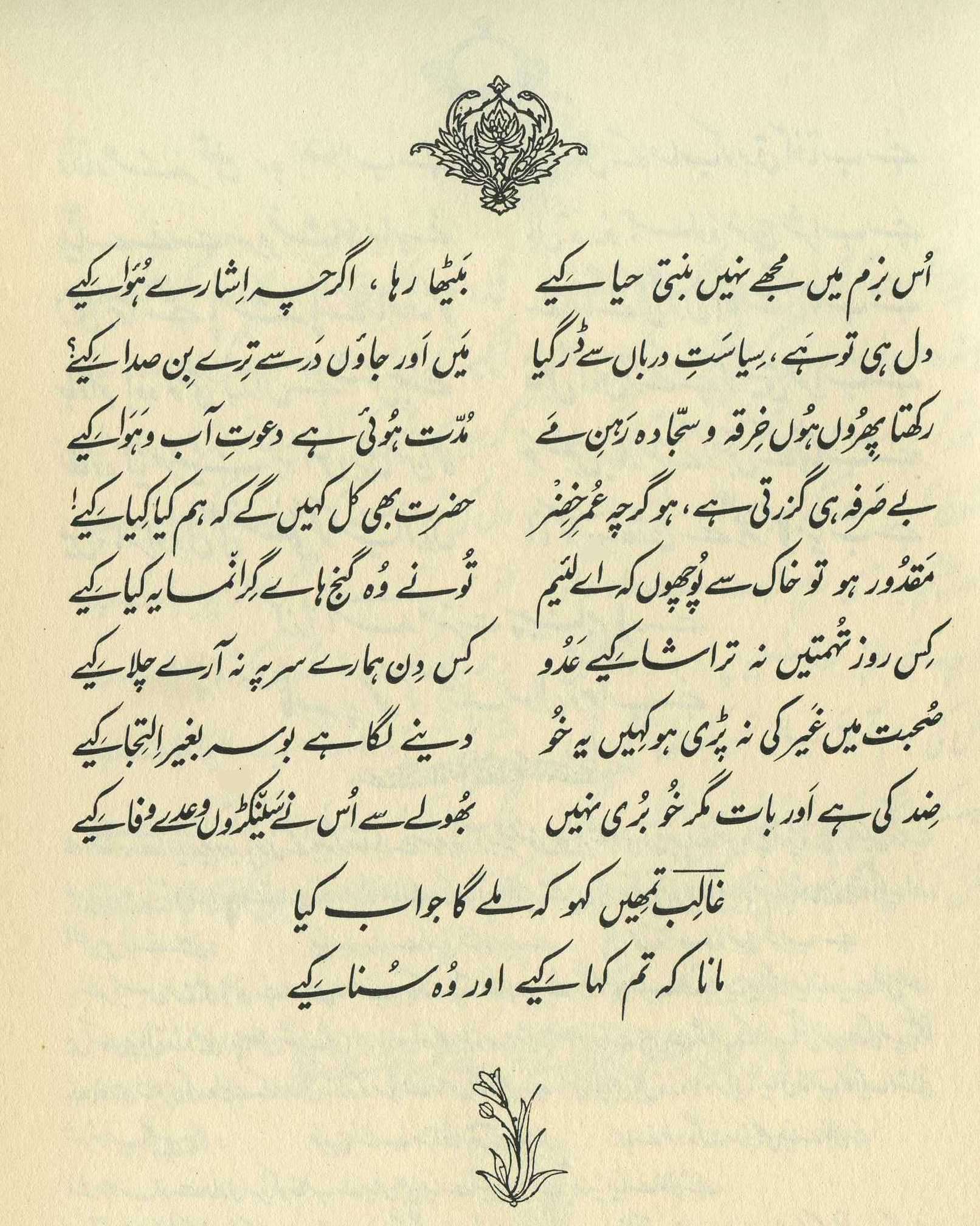
The word , people now have rejected, in poetry and prose. And that has created such an effect that even in conversation it is gradually being rejected. But as yet it still doesn't sound ugly to the ear, and its rejection too is without reason. and are Indian [] words, and is a Persian word. The Indian word has been dropped, and the Persian one has entered into its place. (161-62)
== Nazm page 161 ; Nazm page 162


That is, the situation of the heart is that sometimes it becomes strong, and sometimes feeble. At that time the condition was such that a mere small intervening challenge caused it to fear; otherwise, I am not such that I would have gone away from your door without calling out. (217)
The reply to the beloved's suspicion or complaint is: 'That I would come to your door, and not call out the way faqir s do-- this act was impossible for me. But a person has a heart-- it feared the Doorkeeper.' is now rejected; in its place they say . (290)
[See his comments on Mir's M 605,1 .]
This is a verse of nuance-- a network of subtle suggestions and enjoyable implication s. In the first line, the lover seems to be excusing himself for his seeming cowardice: it wasn't by any means he himself who feared the authority/punishment of the Doorkeeper ! Oh no, not at all! In fact it was his heart-- and after all, the beloved knows how hearts are! The all-purpose does a wonderfully colloquial job of getting the point across, with a shrug and a rueful smile. For another use of the same phrase in the same position, see 115,1 .
Aside from the fact that that's an amusingly implausible excuse, the fear itself is (in real-world terms) implausible and inappropriate. After all, the lover is a person of a higher social class; he has his own Doorkeeper (even if that person's only job may now be grass-cutting, as in 10,7 ). For him to fear a lowly servant like the beloved's Doorkeeper is a sign both of his abject humility before the beloved, and of his awareness that she will not welcome him. Thus the only way he could ever hope to get past her Doorkeeper would be by flattering and conciliating him (as in 43,4 and 111,12 ). Since even this might not work, how terrifying the prospect of sealing one's fate by actually incurring the Doorkeeper's anger! No wonder the poor heart quails!
The Dooskeeper's anger would be incurred, it seems, by the lover's 'calling out' [] at the beloved's door. As Bekhud Mohani observes, this is exactly what wandering faqir s, or religious mendicants, do: they come to the door and call out, announcing their presence. If the householders want to give alms, they do so, and receive the faqir's blessing; if the faqir gets no response, he passes on. He doesn't expect to be invited into the house and entertained as a guest. The lover apparently places himself in this category. It's no duty of the faqir to call out as he passes by; but the lover is so abjectly devoted that he apparently feels guilty for even such a minor negligence. Or else he feels appalled at his behavior ('I-- and to do that!') for some other reason-- one that is, of course, carefully left to our imagination.
The sound effects of , then , then also create enjoyable echoes.
graphics/door.jpg