Verse 9after 1847aakiye
G3
1 a
Ghalib, you yourself say-- will you get an answer?
1 b
Ghalib, you yourself say-- what answer will you get?
1 c
Ghalib, you yourself say-- what an answer you'll get!
1 d
Ghalib, you yourself say-- as if you'll get an answer!
2
granted/assuming that you would [continually] speak-- and she would [continually] listen
'Respected, regarded, heeded; accepted; supposed; granted, &c.'.
| References | |
|---|---|
| Arshi, Imtiyaz Ali | Ghazal# 221 |
| Raza, Kalidas Gupta | 406 |
| Hamid Ali Khan | Open Image |
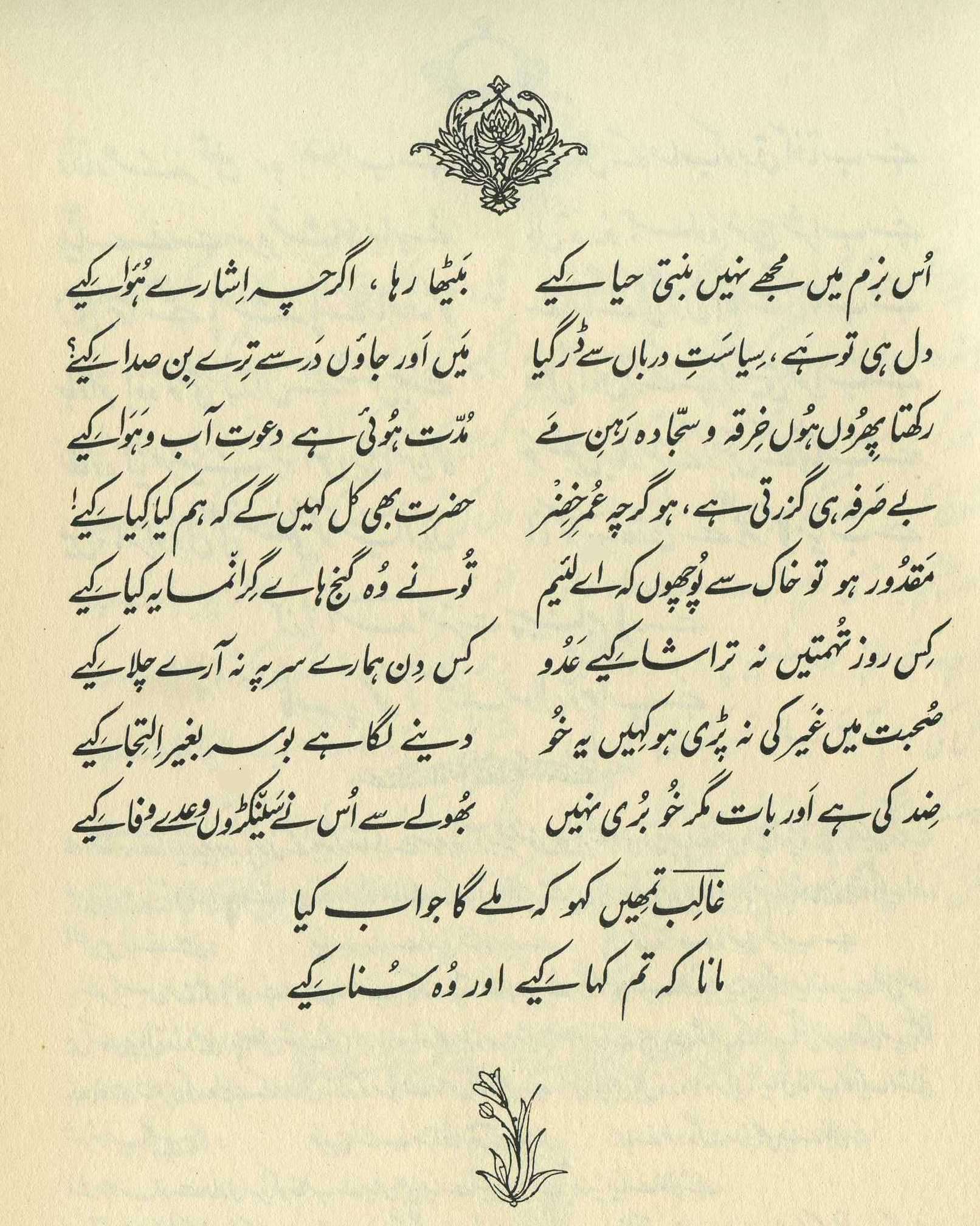
In the second line there is sarcasm-- that is, all right, granted that you spoke and she listened, but think about this: what answer will you get? The persuader is convinced that Ghalib has gone mad, that he's gone there to express his passion; in that place even access is impossible, much less that anyone would listen to his whole utterance. For this reason, he has said 'granted'. (163)
== Nazm page 163

He says, oh Ghalib, you yourself think, and answer this question: what answer will you get from there? You've assumed that you would keep expressing your desire to her, and she too would keep listening, but what prospect will there be of your desire's being fulfilled? How will you be able to reach there, and then how will the imposingness of beauty give permission for the expression of longing? Where are you, and where is she? Just think it over for yourself. (218)
The persuader says, first of all, she won't listen to your words; and even if she would listen, then you yourself think, what answer will she give? That is, her temperament, her pomp, her rank, make it impossible that she would agree to your words; so what is the behefit of this foolishness? (293)
This is another one of those remarkable and delightful verses that does so much with such (apparently) simple means. In the first line, Ghalib is asked to answer a question about his chances of getting a question answered. The inquirer could be some concerned friend, trying to help him get a grip; or the question could be part of the lover's own wrestling with himself.
The verse takes maximum advantage of the enjoyable ambiguities of the 'kya effect'; in this case it generates four distinct possibilities. Assuming that you talk and she listens (which is not guaranteed), the speaker says,
=Will you get an answer? (Perhaps not.)
=What answer will you get? (It's uncertain.)
=What an answer you'll get! (She'll be brutal!)
=As if you'll get an answer! (She'll simply have you thrown out!)
The usefulness of is that it can be applied variously, to mean either 'I now assume for the purposes of argument (though not necessarily in the real world) that X might happen', or 'I grant you that X will probably happen'. This second reading may not seem very likely in the present verse, but it's not impossible (perhaps the beloved would have her own reasons for listening to Ghalib's plea). For another clever exploitation of the possibilities of , see 152,6 .
For an even more extravagant exercise along the same general 'dialogue' lines, see 46,7 .
Note for grammar fans: On , see 215,1 .
graphics/speaking.jpg
graphics/listening.jpg