Verse 3after 1847aakiye
G3
1
I go around carrying and pawning my khirqah and prayer-carpet, as a pledge for wine
2
it's been a long time since I made a feast of/for/about the atmosphere/'water-and-air'
is an archaic form of .
'A ragged, patched garment; dress of a devotee or religious mendicant'.
'Air, climate'.
| References | |
|---|---|
| Arshi, Imtiyaz Ali | Ghazal# 221 |
| Raza, Kalidas Gupta | 406 |
| Hamid Ali Khan | Open Image |
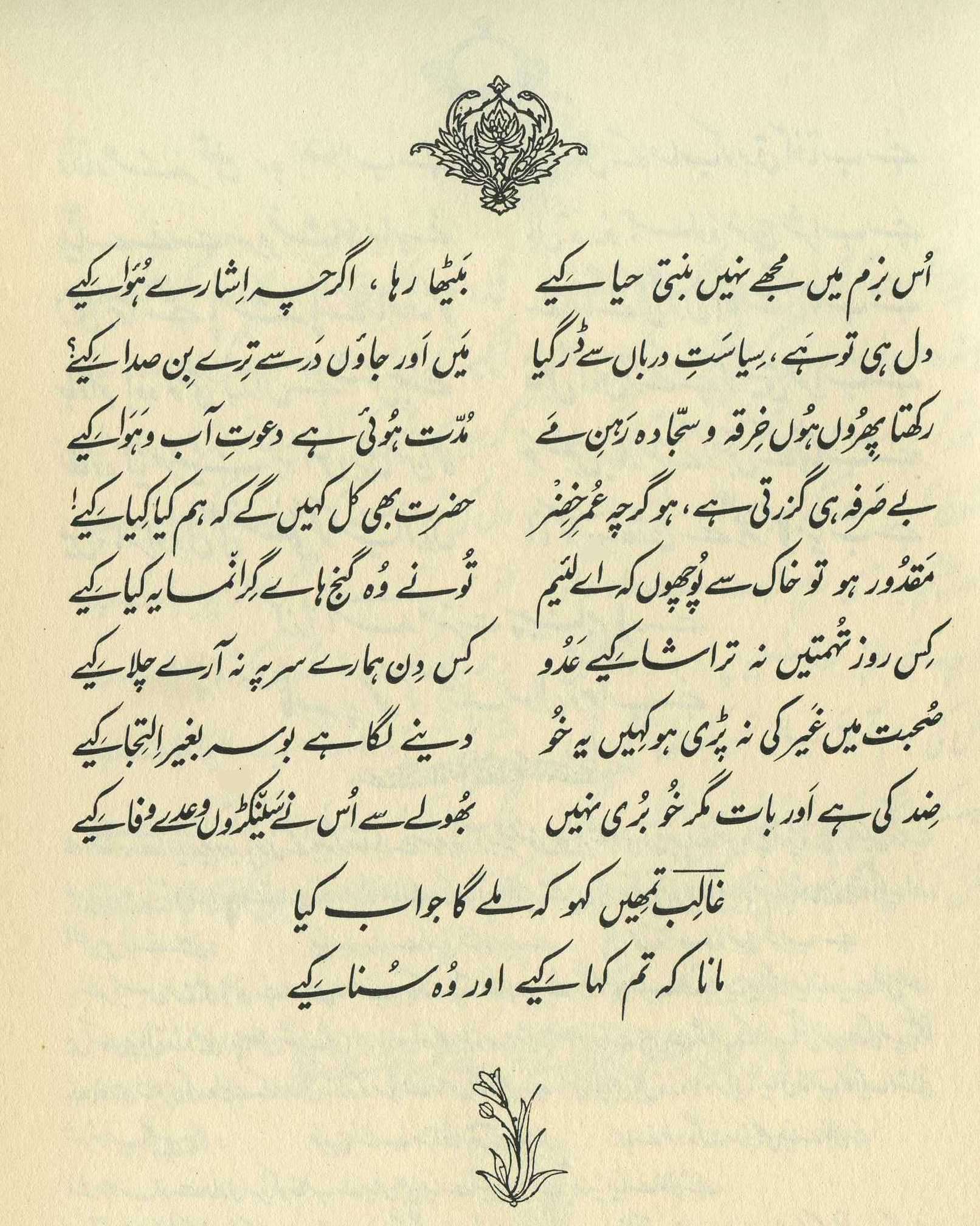
That is, it's a feast for the spring season. (162)
== Nazm page 162

After a whole year, the spring season has come. The rain is falling, and a cool breeze is blowing. It's proper that at this time a feast for the spring season would be given, and wine would circulate. And having put both things together, he pawns them. And he's made the mischievousness [] of the verse to be that one of the things was not sufficient for the price of the wine. (217)
From there emerge two meanings. One is that my ardor is such that if one wine-seller doesn't accept my pledge, then I go to another. And the second meaning is that nobody speaks up to accept the deal. From 'khirqah and prayer-carpet' there emerges the interpretation that in the eyes of the wine-sellers these are so valueless that nobody speaks up to accept them.
The second line tells us that this is no new thing; we have done the same thing previously. Time after time we become pious or rakish. The heart blames us; we repent. Ardor wells up; again we tear up our repentance. From the pawning of khirqah and prayer-rug it's also clear that in his opinion, among all the things in his house, these are the most useless. Or else that as his wine-drinking continues, nothing remains in his house at all. In the pawning there are also two aspects: one is, why would the wine-sellers take the things and sell them to anyone? Thus he doesn't confide them to anyone else's hands, because he knows his temperament: that he will certainly again repent, and will need them again. (291)
Bekhud Mohani does a fine job unpacking the possibilities of the first line, with all the implications of the wandering, the pawning, and so on. Since this is an 'A,B' verse, we're left to decide for ourselves whether the pawning is a preparation for the proposed feast, or a substitute for it, or simply an alternative activity that occupies the speaker's attention.
And what kind of a feast is it, anyway? Thanks to the ambiguities of the construction, there are several possibilities:
=A feast 'about', or celebrating, the atmosphere, climate, etc.; the commentators interpret this as a celebration of springtime, but of course the verse goes out of its way not to confirm any such idea. It might be celebrating the vitality and indispensability of wine itself. (Think of the whole 'wave of wine' ghazal, 49 .)
=A feast 'for' 'water and air', in which they are the honored guests. And with what could they more appropriately be regaled, than with wine? Wine, after all, is a superior cousin of water, and creates its own 'air' or 'atmosphere' of intoxication. (The lover is a thoughtful host: when he gives a feast for 'eyelashes', he serves them bits of liver: 233,2 .)
=A feast consisting 'of' 'water and air', in the sense that the supreme gifts of 'water and air' are provided to the guests-- in the form of wine, of course, that absolute necessity of the lover's life. There are verses in the 'wave of wine' ghazal, 49 , that equate wine with sustenance, growth, and flourishing.
In any case, this is a verse full of 'mischievousness' [], as Bekhud Dihlavi observes. The complex layers of humiliation inflicted on the faqir's robe and the prayer-carpet, in order to provide complex layers of glorification of wine, are presented with such offhand casualness that they're a sheer delight to read. After all, the lover is really concerned chiefly with his social obligations, with the overdue feast (compare 233,1 ); the means for arranging it are presented only by the way.
Compare the similar religious mischievousness of 131,1 .
A gathering of darveshes (Deccan, c.1640)-- in a miniature painting that once belonged to Warren Hastings:
graphics/darveshdeccan1640.jpg