Verse 1after 1847aakiye
G3
1
in that gathering, I get nowhere by showing/'having shown' shame/modesty!
2
I remained seated-- although signs/gestures/hints always occurred
'Shame, sense of shame, modesty; pudency; shyness, bashfulness'.
'Sign, signal; beck, nod, wink, nudge, gesticulation; pointing to, indication, trace, mark, allusion, hint, clue; insinuation, innuendo; love-glances, ogling'.
| References | |
|---|---|
| Arshi, Imtiyaz Ali | Ghazal# 221 |
| Raza, Kalidas Gupta | 406 |
| Hamid Ali Khan | Open Image |
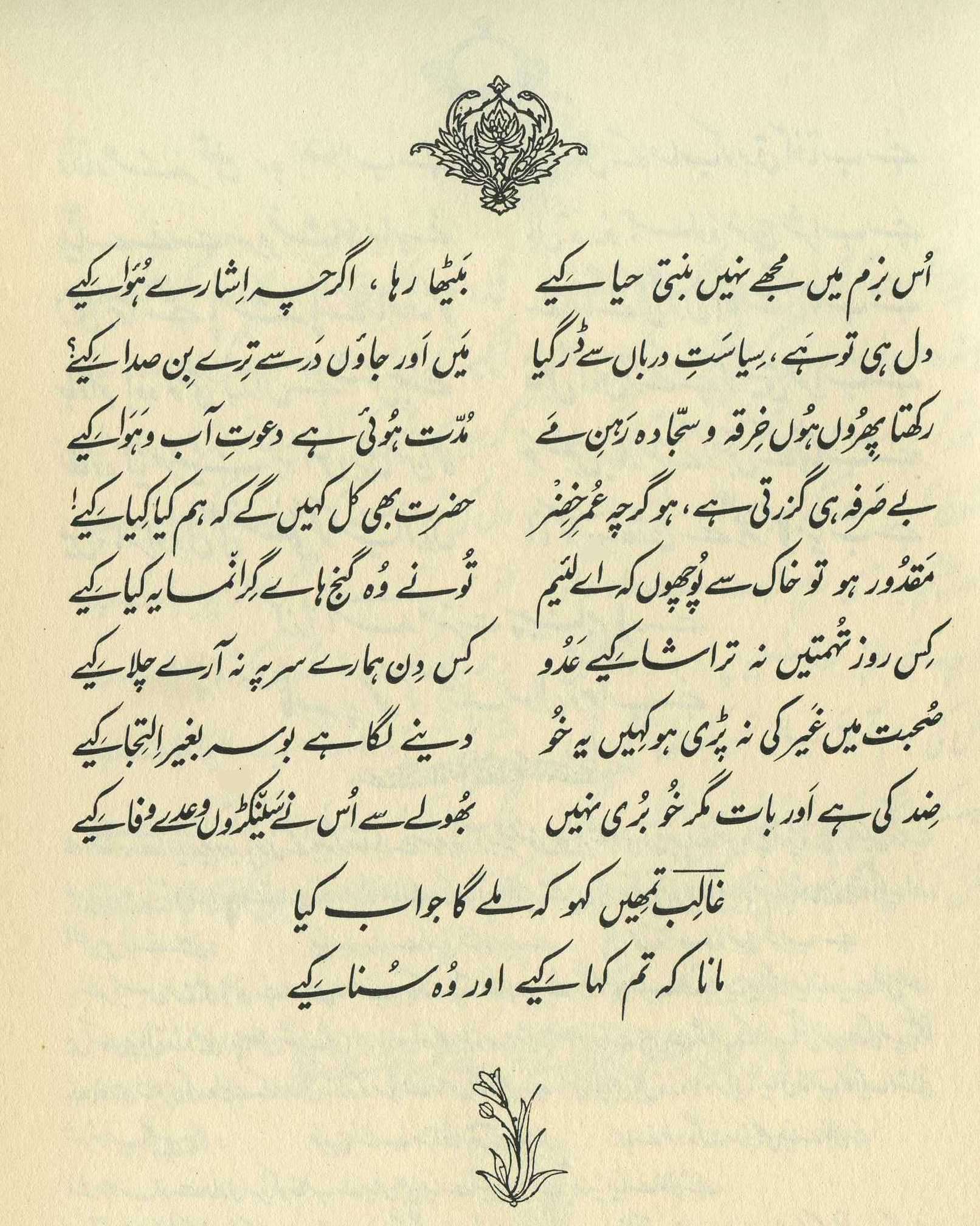
[1861, concluding a letterto Ala'i:] For singing, seven verses are usually enough. I send two Persian ghazals, two Urdu ones, relying on my memory, as an offering to Bhai Sahib: {151, verses 1,8,7,3,6,9}. [For a fuller discussion, see 62,1 .]
==Urdu text: Khaliq Anjum vol. 1, pp. 372-73, 375
==Another trans.: Daud Rahbar , pp. 21-22
They also use to mean [honour, jealousy, envy, shame, spirit, bashfulness (Platts p.774)]. That is, I remained seated without 'honor' in her gathering, no matter how people kept making gestures and whispering. (161)
== Nazm page 161

In this verse Mirza Sahib has used with the meaning of 'honor' []. He says, in her gathering of coquetry, I get nothing accomplished by showing 'honor'. I remained seated, despite her signs/gestures toward the Other . (216-17)
Although jests and taunts kept being exchanged among the beloved, the Rival s, and their near and dear ones, we remained seated.... In such a situation one ought not to have remained seated. But he remained seated, and it's also clear that the feeling still remains with him. But the heart is uncontrollable-- nothing can be done []. (290)
The first line has an energetic idiomatic punch; 'I get nowhere!' is my attempt to approximate it in English. Literally, it's that the speaker's , his 'project/task/idea' doesn't 'occur/happen'. The expression is so common and colloquial that people often omit the , although its presence can be seen in the feminine singular of . (For more on this, see 59,2 .) This particular form of the expression, involving the perfect participle of a transitive verb plus (having done X, the doesn't ), can be seen in Bekhud Mohani's commentary above, and in 191,1 .
Then in the second line, as so often, Ghalib has carefully maintained ambiguities. He has framed the grammar in such a way that it pointedly doesn't give us any idea who's making signs to whom, of what kind, or for what purpose. As usual, the commentators with one voice (not just the few commentators I've quoted here, but all the ones I've looked at) pick out one or two possibilities and magisterially affirm them. In this case, their possibilities are:
=The beloved and the others in the gathering are making gestures that mock or taunt the lover.
=The beloved is making encouraging or flirtatious signs to other lovers in the gathering.
I don't deny these possibilities. But as usual, I want to add another perfectly good possibility:
=The beloved is making (at least possibly) encouraging or flirtatious signs of some kind to the lover himself.
I would even argue that my possibility is more amusing than theirs, and best accords with the vexed, letting-off-steam tone of the first line. The lover seems to be exasperated with the results of his own behavior. Maybe what he's exasperated with is not the signs, but the fact that despite them, he kept on just modestly sitting there. Maybe the beloved doesn't appreciate his modesty, humility, reverence, and is inviting him to try a more flirtatious kind of behavior? Instead of just sitting there bashfully as he did this time, maybe next time he might respond in some way-- at least maybe wink at her, or try a romantic smile, or make some such small gesture? Or is he disgusted by her shallowness-- would his own deep passion make that kind of thing quite impossible? The verse leads us into enjoyable kinds of speculation, as we attempt to fathom his thought processes.
Nazm and (following him) Bekhud Dihlavi (re)define the relatively straightforward as the more multivalent , which has meanings that include jealousy, envy, shame, honour, spirit, and bashfulness (Platts p.774). Then they base their readings on rather than . My reading has the advantage of not requiring such an extension.
Note for grammar fans: On , see 215,1 .
graphics/gestures.jpg