Verse 11852aa))enah bane
G5
In this meter the first long syllable may be replaced by a short; and the next-to-last long syllable may be replaced by two shorts.
1
she's a nit-picker; the grief of the heart wouldn't be able to be told to her
2
how would a thing succeed, where a thing having been contrived/fabricated wouldn't {succeed / come into existence}?
'Hypercritical; captious; —a captious critic, a caviller, carper'.
'To be successful, prove a success, answer well; to gain credit or honour, to prosper, flourish'.
'To talk much; to make up a story; to invent excuses, to concoct, fabricate; to talk grandly, to boast'.
| References | |
|---|---|
| Arshi, Imtiyaz Ali | Ghazal# 226 |
| Raza, Kalidas Gupta | 429-30 |
| Hamid Ali Khan | Open Image |
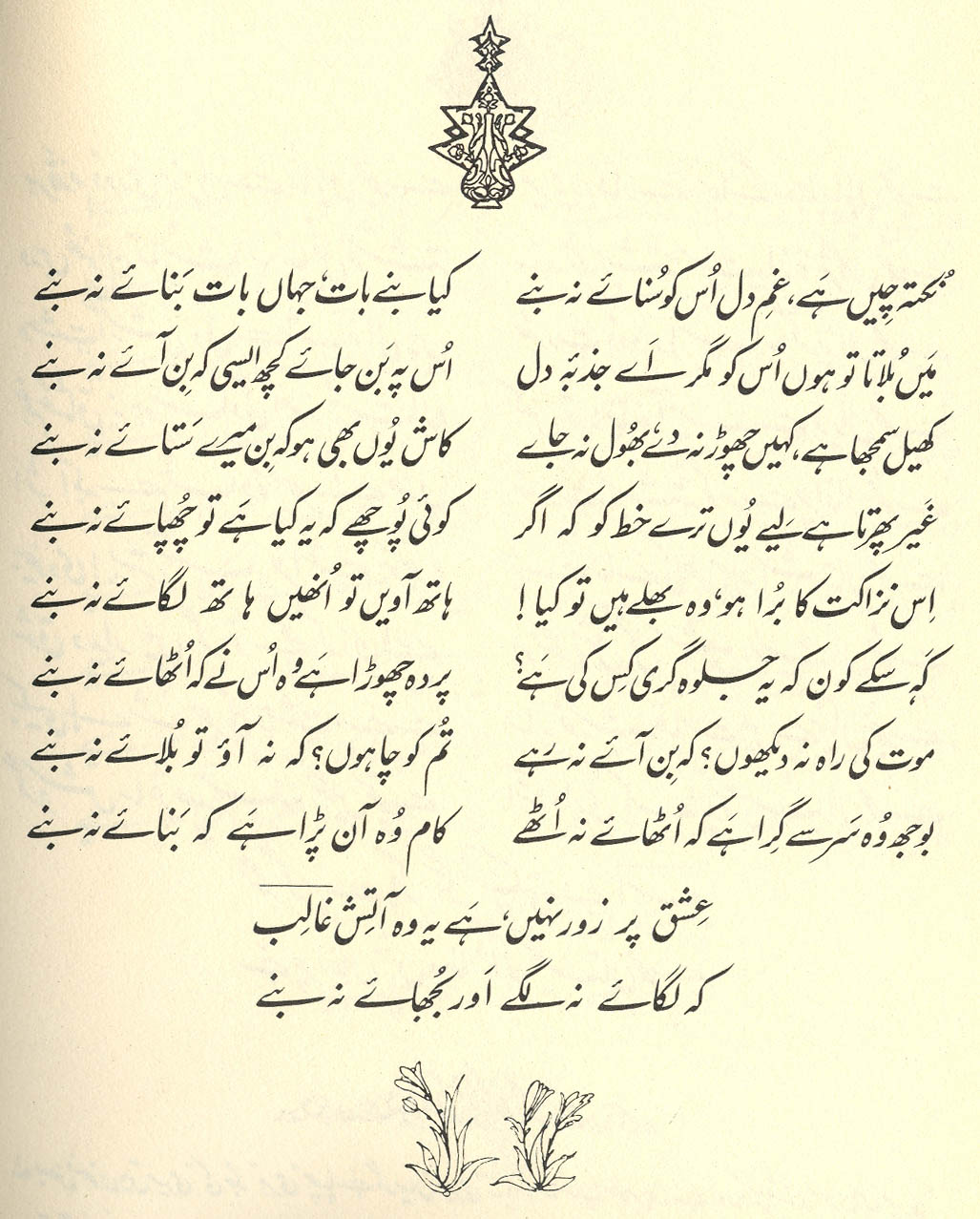
[1862, to Ala'i:] [In a letter, Ghalib quotes {191:1, 2, 5, 8, 4, 9}. For the letter, see 161,1 .]
and are in the sense of 'for devices/strategems to succeed'; and is in the sense of 'twisting and turning a matter in order to cause one's purpose to succeed'. He says, she's such a nit-picker that I would want a hundred thousand times to contrive to recount to her the sorrow of my heart-- she realizes this, and cuts me off. (214)
== Nazm page 214

He says, that mischievous one is a nit-picker. To narrate to her the grief of the heart-- it just doesn't happen. That is, she will seize on every single word, and then add an objection.... means 'to tell a lie'. The meaning is, because of ner nit-picking our lie will become apparent to her, and the thing will be spoiled. (273)
= for a desire to be accomplished. = to express one's purpose. The beloved is a nit-picker-- she objects to every single word. To narrate to her the grief of the heart is not an easy task, nor does it yield any result. In such a place, where even expressing one's purpose would not cause a desire to be accomplished, what hope can there be? (374)
Here's a well-known and very popular ghazal. Because of its refrain , the whole ghazal is greatly shaped by idiomatic expressions involving , often with the colloquially omitted (for another example of the same idiom, see 70,3 . The present verse also features the especially suitable (see the definition above), made from the transitive form of the same verb. In addition, the second line of the verse cleverly integrates into another common idiomatic pattern displayed in ; for discussion of this structure, see 191,8 .
The result is a classic second line with almost tongue-twisting sound effects, a wonderfully circular feeling when you recite it, and a kind of radical untranslatability. The framing structure [how would a thing succeed, where a thing wouldn't succeed?] can hardly fail to be present in our ear and mind, interrupted only by , which itself works, in terms of both sound and idiomatic meaning, as a kind of embellishment of the theme.
What exactly is the problem being expressed in this second line? Basically, that the beloved is a nit-picker , so the speaker can't get anywhere when he talks to her and tries to tell her the 'grief of the heart'. But the precise involvement of falsehood versus truth remains undecideable. Here are some possibilities:
=She's a nit-picker-- thus she detects and unravels the grandiose falsehoods with which the speaker tries to impress her, so that his situation is hopeless.
=She's a nit-picker to such a degree that not even carefully framed fancy falsehoods would impress her, so what hope is there for a helplessly truthful, inarticulate, suffering lover like the speaker?
=She's a nit-picker about style, and only enjoys fancy rhetoric and floridly embellished verbiage-- and even that doesn't ultimately succeed with her, so what hope can any lover have?
Ajit Sanzgiri has suggested that the 'nit-picker' can be the 'grief of the heart' itself-- it is strict and scrupulous, and refuses to be embellished or rhetorically dressed up in any way, even to please the beloved. I think this is possible, but not as persuasive as the primary reading, since personifying the 'grief of the heart' is not very common in itself-- much less envisioning it as a 'nit-picker' (which is the obvious and perfect behavior for the beloved). But who can say that this reading too doesn't hover at the edges of the main meaning, especially in view of the positioning and grammar of the first half of the first line?
This one is really a verse of convoluted idiomatic wordplay, and its great charm is the astonishing second line. The following verse, 191,2 , has a similar structure.
graphics/nitpicking.jpg
graphics/nitpicking2.jpg