Verse 61852aa))enah bane
G5
In this meter the first long syllable may be replaced by a short; and the next-to-last long syllable may be replaced by two shorts.
1
who would be able to say, whose is this {glory/appearance}-doing?
2
he/she/it has loosed/lowered a veil/curtain, [such] that having been lifted it would not become [lifted]
'Manifestation, publicity, conspicuousness; splendour, lustre, effulgence'.
'Acting, doing; practice; trade, office (used as last member of compounds)'.
'Clearness, conspicuousness; splendour; affectation, blandishments'.
| References | |
|---|---|
| Arshi, Imtiyaz Ali | Ghazal# 226 |
| Raza, Kalidas Gupta | 429-30 |
| Hamid Ali Khan | Open Image |
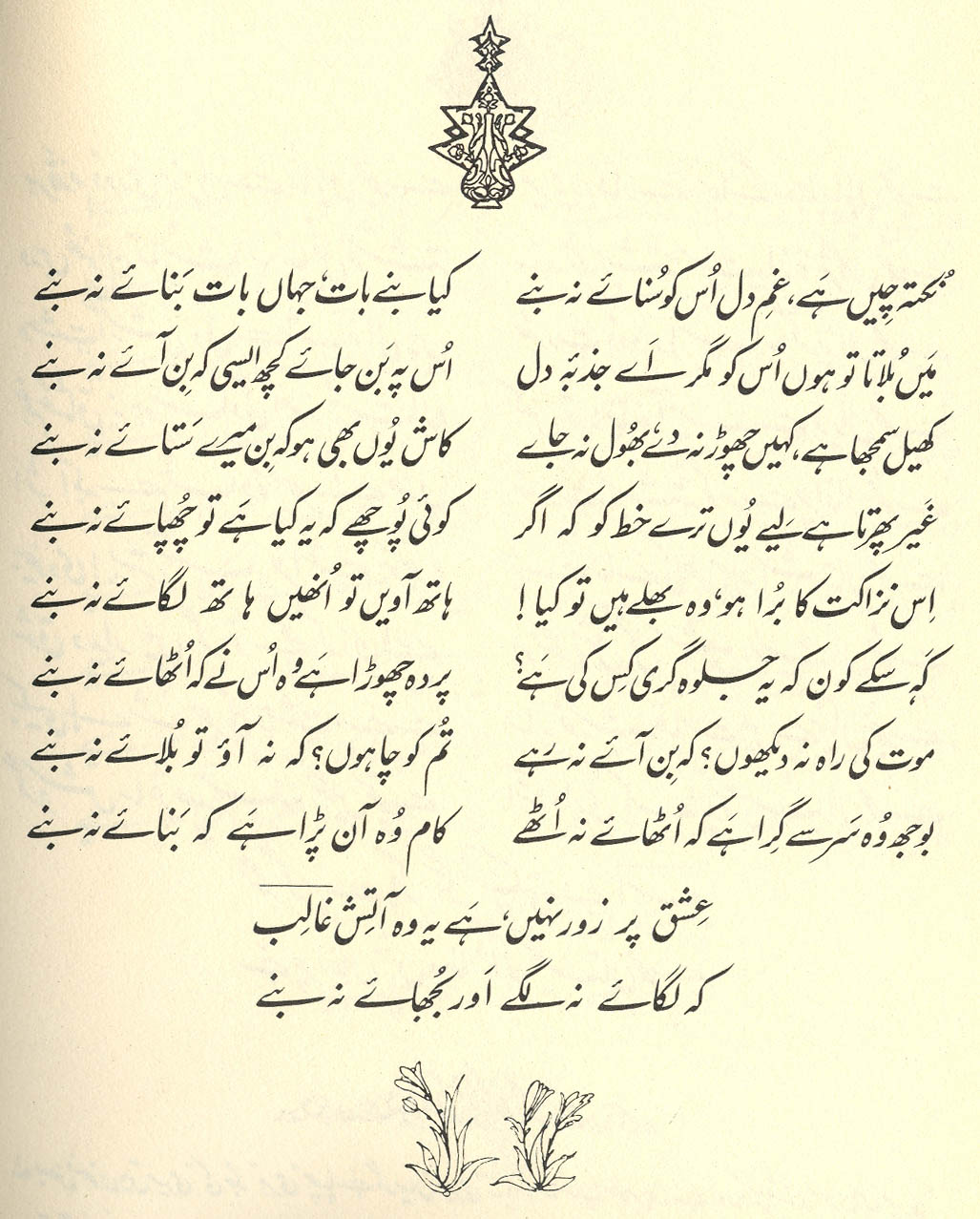
To lower a veil is a metaphor for the world of contingency, and this very metaphor has given glory [] to the theme of the verse. (215)
== Nazm page 215

He says, 'Who can tell whose this is. Having created the world of contingency, he has placed such a curtain that this pardah can't be lifted up through anyone's lifting it [].' (274)
The same thing that in the first line he's called , in the second line he calls a curtain/veil. That is, that very same beauty of the world is the curtain/veil that has kept the supernatural appearance [] of the True Beloved hidden. (376)
On the idiomatic grammar of expressions, see 191,8 .
It's a meditative and lyrical verse, with an alluring, deceptive simplicity. The first, line asks one question (whose is the , who owns or controls it?) within another question (who would be able to say whose it is?). We are poised in suspense, looking forward to at least some kind of answer in the second line-- after, of course, the suitable mushairah delay. Instead, the second line slams the curtain down on us once and for all.
Then once we have time to reflect, we realize that we can't really even tell exactly what kind of answer is being given in the second line. Above all, we can't tell who is the 'that one', and what relationship s/he has to the rest of the verse. There would seem to be three candidates for the curtain-dropper: it could be (1) the itself (the thing we're looking at); or (2) the owner of the (the one we're asking about); or (3) the one who can tell us who the owner is (the one 'who can say'). Thus the reason we can't learn about the owner might be:
=Because 'that one' (that is, the one who might have been able to tell us who the owner is) has deliberately denied us the information by slamming a curtain down to block all our inquiries.
=Because the owner himself/herself has decided to drop a curtain and deny us such knowledge.
=Because the very working of the itself might constitute the dropping of an unliftable curtain, no matter who the owner or operator might be; compare the abstract role of the , 'card-shuffling', in 81,2 .
The commentators generally insist on reading this verse mystically, and it's not hard to see why. But since one of the meanings of is 'affectation, blandishments' (see the definition above), it's also quite possible to see the dropping of the unliftable veil as the coquettish device of the beautiful beloved-- and when she's chosen to be veiled, the lover can't dare to even imagine lifting her veil.
There's also the excellent wordplay and meaning-play between the 'appearance, manifestation' in the first line and the 'curtain/veil' in the second line.
graphics/veil.jpg