Verse 91852aa))enah bane
G5
In this meter the first long syllable may be replaced by a short; and the next-to-last long syllable may be replaced by two shorts.
1
there's no power/control over passion-- this is that fire, Ghalib
2
that having been lit, would not catch fire; and having been extinguished, would not become [successfully extinguished]
'Strength, power, vigour, virtue; force, strong effort, exertion, strain; stress; weight; violence; coercion'.
| References | |
|---|---|
| Arshi, Imtiyaz Ali | Ghazal# 226 |
| Raza, Kalidas Gupta | 429-30 |
| Hamid Ali Khan | Open Image |
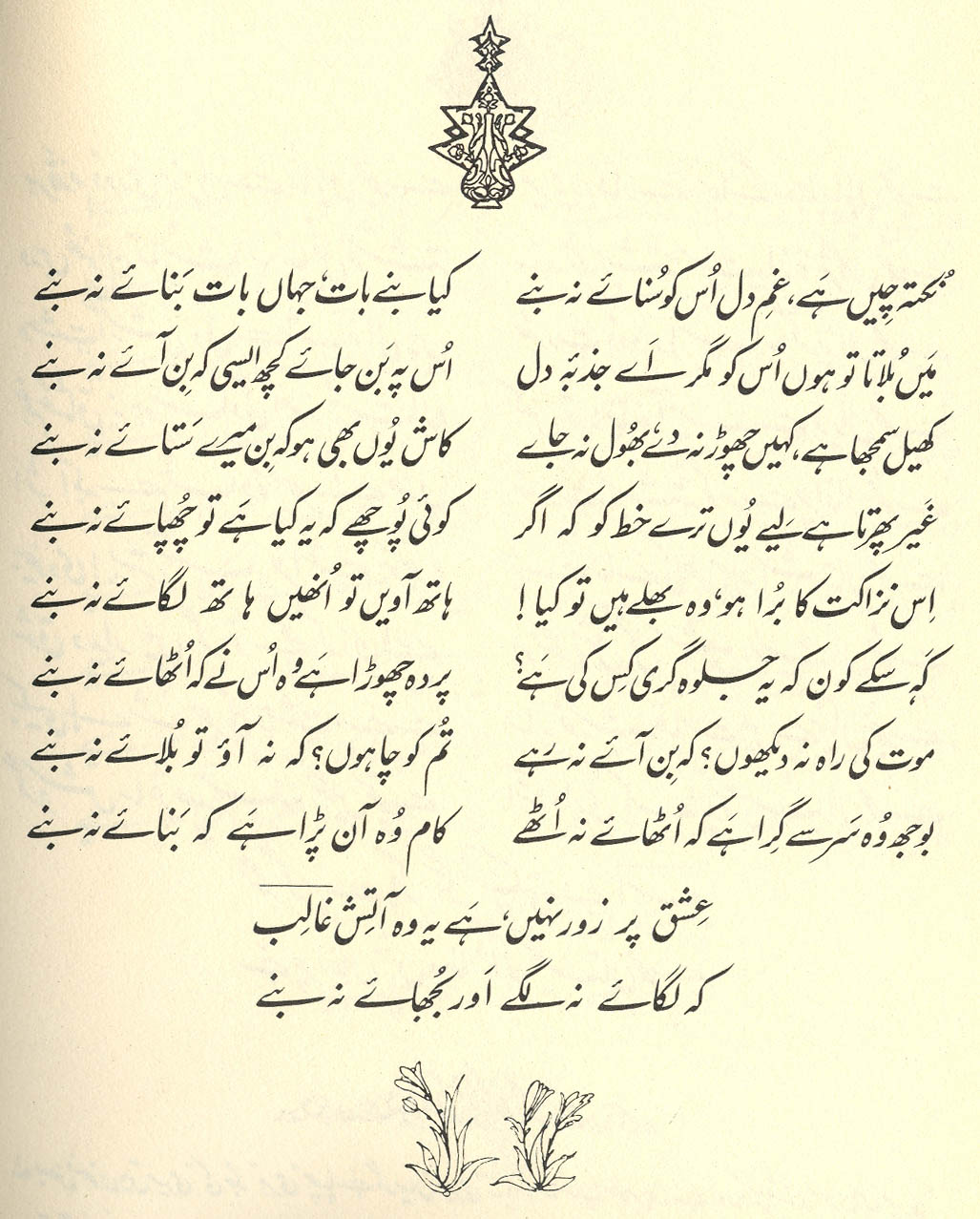
That is, if you wish that passion would also be kindled in the beloved's heart, then no power controls this; and if you wish to extinguish your own kindled fire, then this too doesn't happen. He has composed a whole adorned [] ghazal, and this is the color/mood of ghazal-recitation []. (215)
== Nazm page 215

That is, if we would wish that in the beloved's heart too we would cause the fire of passion to spring up, then this is not possible; and if we would wish to extinguish our own kindled fire, then this too doesn't manage to happen. (275)
Passion is a fire over which no one has control. That is, neither is it within a man's power to light that fire, nor is it possible to extinguish it once lit. The gist is that being lighted it doesn't get lit []; nor being put out does it go out []. It is a divinely bestowed gift, the creation and elimination of which is in the power of the Lord. Atish says:
[this wealth belongs only to one in whose destiny it would be
the wine of love is neither in a cask, nor in a glass, nor in a flagon] (377)
As Nazm observes, this whole ghazal is a terrific one for recitation, and this is surely its most memorable and recitable verse. It's elegantly balanced between two extremes: it is as lucid, semantically clear, and instantly comprehensible as 191,4 , while avoiding that verse's sense of prosiness and triviality. And it has an enjoyable layer of idiomatic wordplay in the second line (for discussion of expressions, see 191,8 ), though this isn't pushed as far as in, say, 191,1 .
The verse is both saying something coherent and paraphrasable (which always delights the commentators), and saying something arresting and thought-provoking (which delights all of us); it's also saying that something elegantly (with an enjoyable but not overpowering degree of wordplay), and with a rhythm and energy that nobody could resist.
Nazm and Bekhud Dihlavi want to specify a context ('Alas, I can't make her love me, nor can I stop loving her'); Bekhud Mohani favors a more abstract and universal reading. As usual, every reader can (and of course must) make his or her own choice(s). For the verse itself is as abstract as it can possibly be, and gives no warrant for even claiming it's about the lover's personal situation at all. It speaks-- ruefully? sadly? detachedly? with wry amusement?-- not of this one's passion or that one's passion, but of the nature of passion itself.
graphics/fire.jpg