Verse 4after 1847aakiye
G3
1
it passes only/emphatically unprofitably, although it might be the lifetime of Khizr
2
even/also Hazrat [Khizr] will say tomorrow, 'What deed have we accomplished?!'
'Expending, expense, expenditure; economy; utility, profit; addition, surplus, excess, redundance, profusion'.
'Action, deed; doings'.
| References | |
|---|---|
| Arshi, Imtiyaz Ali | Ghazal# 221 |
| Raza, Kalidas Gupta | 406 |
| Hamid Ali Khan | Open Image |
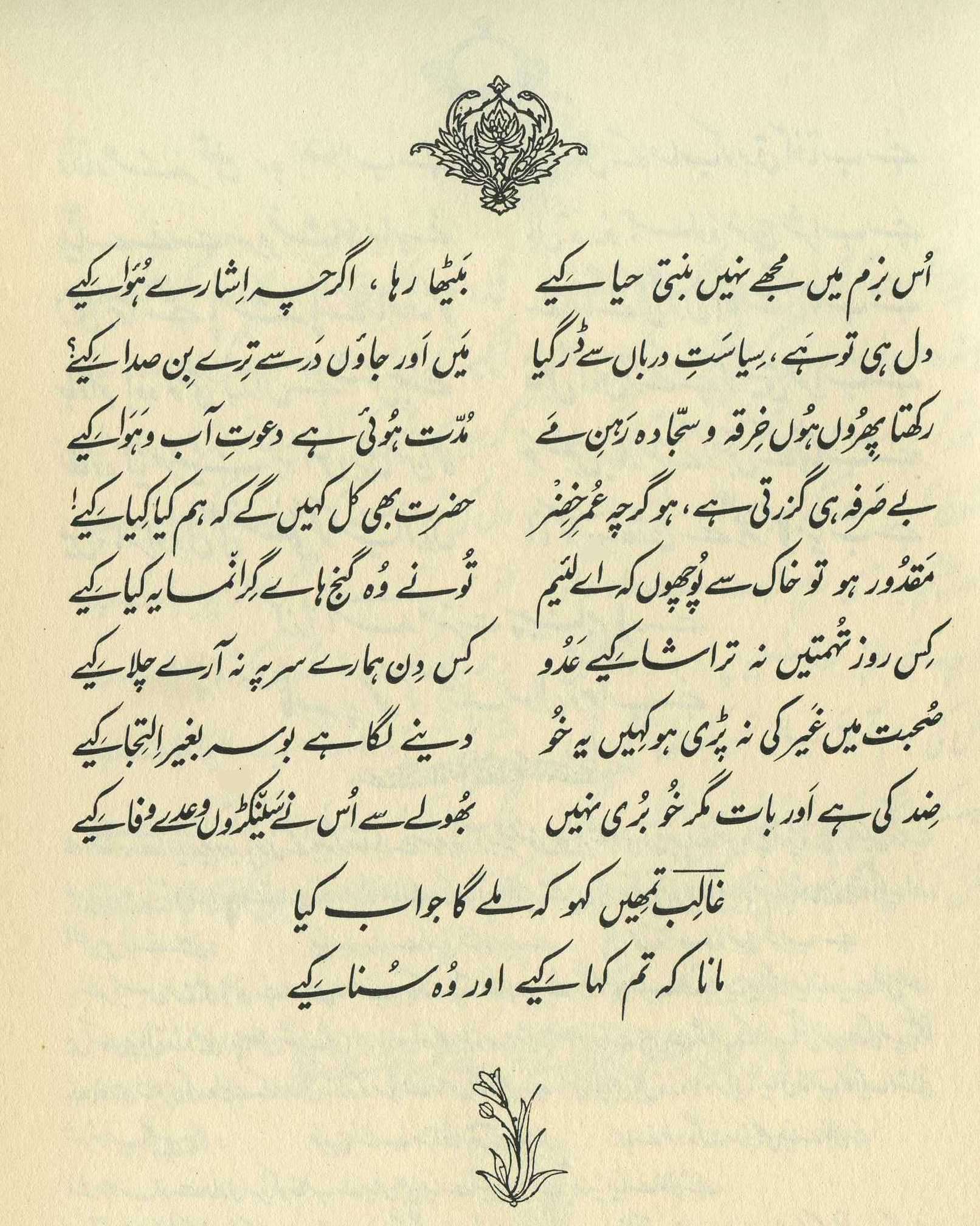
The meaning is that no matter how long a lifetime there may be, the chatterings/voices of the world don't give a person the chance to make preparations for tomorrow. (162)
== Nazm page 162

He says, where is there escape from the chatterings/voices of the world, that the lifetime would be spent in divine worship! Even if the lifetime would be as long as Khizr's, it will certainly pass uselessly. Even/also Hazrat Khizr will say tomorrow, 'We don't know what we kept doing'. (217)
Even if there would be a lifetime like Hazrat Khizr's, it becomes wasted. Although Hazrat Khizr is a guide to all creatures, even this, in comparison to the lofty rank of life, is no admirable task. (291)
This one always reminds me of Zauq 's famous verse:
[even if there would be the lifetime of Khizr, we will say at the time of death
'We hardly remained here!-- just now we came, just now we left!']
The general meaning of is 'unprofitably', but the range of meanings of itself adds enjoyable overtones. Are our lives lived 'without expenditure', without a chance to use up everything we have in us? Are they lived 'without economy', so that we're compelled to see our time wasted? Are they lived 'without utility or profit', so that we gain nothing from them? Are they lived 'without excess or profusion', so that our lifetime never yields any interest on our investment? (Or, of course, all of the above; our lives are restless and dissatisfied in so many ways.)
Moreover, the little word 'tomorrow' creates wonderful implications of its own. Even Hazrat Khizr, who will live till Judgment Day, has a lifespan so short that it will be merely 'tomorrow' when he will look back on it with regret.
In addition, the sound effects of are truly a delight.
Note for grammar fans: the should be interpreted as an adverbial past participle with the colloquially omitted: , 'we are in the state of having done what deed?'.
graphics/hourglass.jpg