Verse 3after 1847aaniiaur hai
G14
1
a number of times her indignations/grievances {I've seen / have been seen}
2
but this time the weightiness/vexation/grief is somewhat-- other/more
'Grief, &c. (=); indignation, offence; unpleasantness, coolness.
'Weight, burden; heaviness; gravity; importance; ... —heaviness of spirit; depression; grief, vexation;'
| References | |
|---|---|
| Arshi, Imtiyaz Ali | Ghazal# 213 |
| Raza, Kalidas Gupta | 400 |
| Hamid Ali Khan | Open Image |
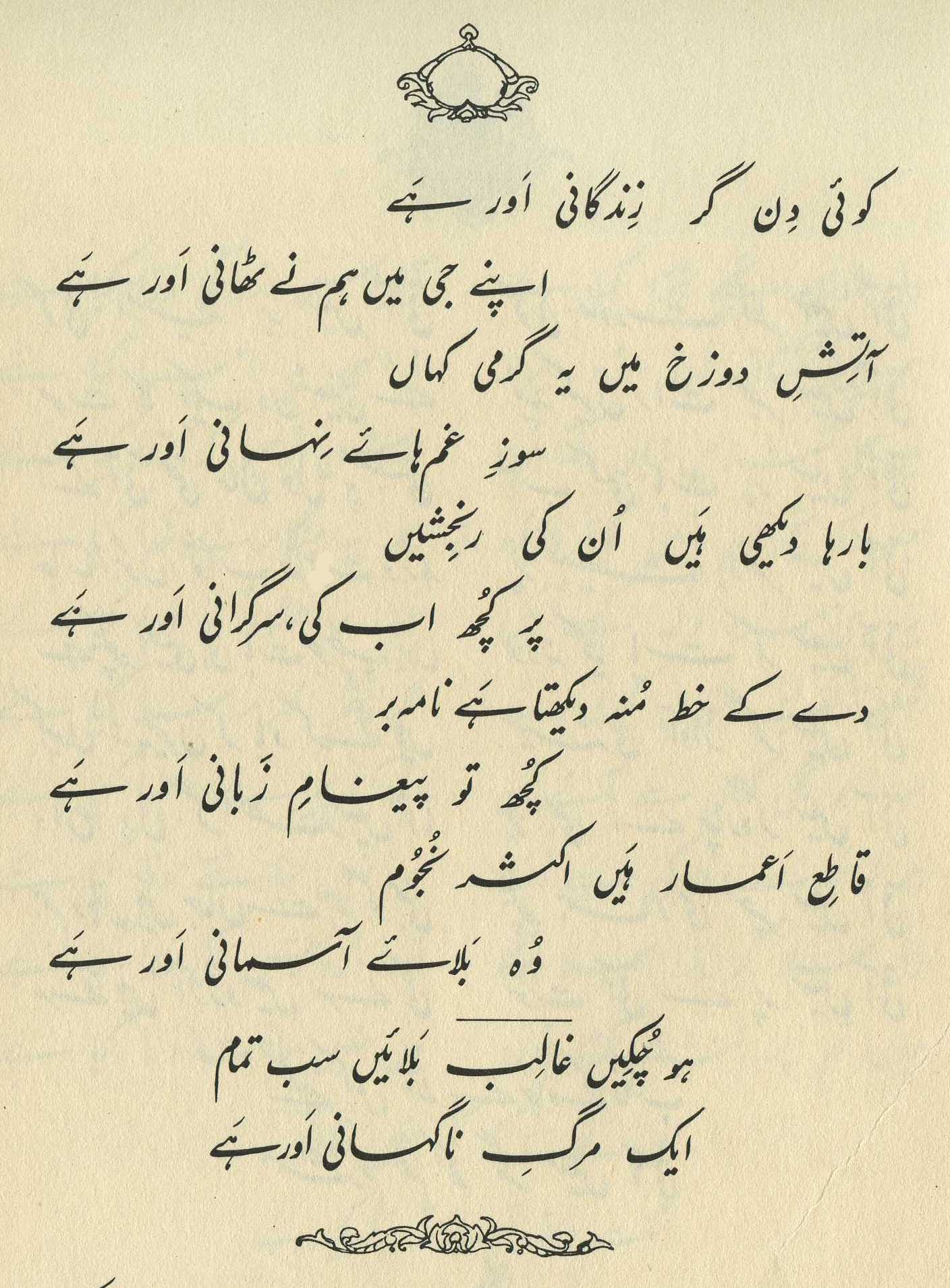
From the claims of an excess of love, the illusion has come about that the anger of the present time is greater than that of all other times. (172)
== Nazm page 172

He says, 'The suspicion of the excess of love is a frightful thing. Although a number of times a quarrel with her has taken place, and then mutual reconciliation has occurred, this time I believe that now there will be no reunion with her.' (229)
The lover is speaking to his heart, that she often becomes angry, but this time there's such anger that there's no hope of reunion again. (It's possible that the indignation itself would be such, or that it would be merely an illusion.) (307)
There's some manuscript variation in this verse; some editions (including Hamid) have instead of . Both are grammatical: the former is presumably a truncated form of , the latter of (for more on such colloquial omissions, see 59,2 ). As always, I follow Arshi.
How darkly ominous a verse-- and also, how shrewdly ambiguous. The best horror, after all, is invoked indirectly, by hints, and ominous Noises Off. What is the beloved angry about? How does the lover recognize that this time is different? Is this time in fact different, or is her anger always so apocalyptic that this time is really no worse than usual? (As the commentators point out, the lover's tunnel vision and paranoia might be at work.)
The tone of judiciousness is part of the ominousness; the tone seems to be simply, flatly, recognizing some irrevocable disaster. It's already too late to avert the calamity of her wrath, if indeed it could at all have been averted. The colloquialness of the complements the 'inexpressibility trope' of the -- no words can be found for what's going on now, it's simply something greater than, and/or different from, what's ever happened before. In English we have similar idiomatic forms ('The scene she created was really something else!').
There's also the enjoyable versatility of the (see the definition above). It could refer to any of three things: (1) the beloved's vexation or anger, as reported in the first line; (2) the lover's grief or depression, which is now greater than it has been in the past; or (3) the weightiness or importance of their quarrel, which this time is of a different (and more dangerous?) order.
Note for grammar fans: can be read either as a present perfect, with the subject colloquially omitted, or else as an adjectival perfect participle, short for ('her indignations are in a state of having been seen'). In this verse, it doesn't seem to make much difference.
graphics/sargirani.jpg