Verse 5after 1847aaniiaur hai
G14
1
cutters-off of lives, are a great many stars
2
that celestial disaster is-- more/other
is the plural of .
is the plural of .
'Most; many; much; a great many, very many; —s.m. The greater number, the majority; —adv. Generally, for the most part, mostly, chiefly, often, frequently, commonly, usually'.
'Trial, affliction, misfortune, calamity, evil, ill; a person or thing accounted a trial, affliction, &c.; evil genius, evil spirit, devil, fiend; a wonderful or extraordinary person or thing; an awful or terrible person or thing'.
| References | |
|---|---|
| Arshi, Imtiyaz Ali | Ghazal# 213 |
| Raza, Kalidas Gupta | 400 |
| Hamid Ali Khan | Open Image |
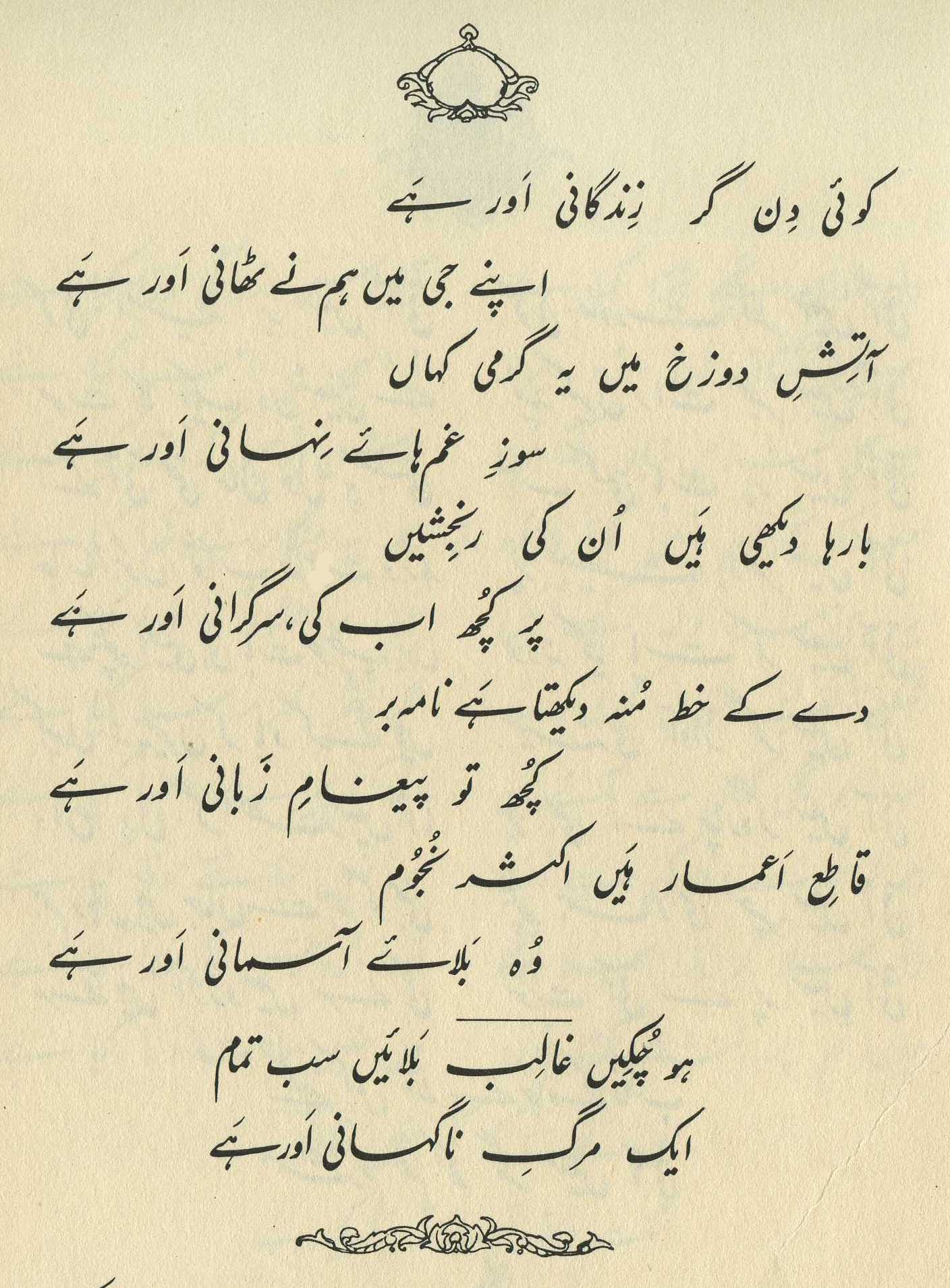
That is, from the wandering of the stars time is marked off []; and from the time being marked off, lifetimes keep being marked off. But this effect is very weak. Here, the celestial disaster that I've become involved with-- she/he/it is forceful fate itself. (173)
== Nazm page 173

He says, 'A number of stars are such that lifetimes become cut off through them, but here that celestial disaster with whom I've become involved-- in comparison to those inauspicious stars, she/he/it wields the power of forceful fate'. (230)
From the movements of the stars, too, lifetimes are cut off. But that celestial disaster with whom I've taken up-- she/he/it is forceful fate. That is, feeling a passion for her, to remain alive is impossible. He has called the beloved a sky-disaster because he considers her some sort of lofty creature like the Houri s of Paradise. (308)
The idea that the heavens have a role to play in our lives is as old as astrology ; evil stars or dangerous planetary conjunctions are poetically thought to threaten all sorts of dire happenings. In that astrological sense, evil stars and planets may 'send down' troubles upon us. Thus disasters are commonly imagined in the ghazal world as descending from the sky. See for example 14,8 , which seems to make the stars observers of some kind (though it's not clear whether they exercise any control) as the streams of disasters come pouring down. (And of course, blaming the sky, and the stars, and fate, is more theologically acceptable than blaming God.)
The lover certainly seems to be calling the beloved a , literally a disaster that is 'sky-related'. This might mean a disaster that descends from the sky; but it could also mean a disaster that pertains to the sky because it dwells or remains there; think for example of 27,8 , in which the sight of the sky reminds the lover of the infinitely powerful, and infinitely remote, beloved. And comparing the stars invidiously to the beloved suggests that her rank, grandeur, radiance, cold glitter, inaccessibility, etc. far surpass theirs.
It's also a bit chilling to see how easily the lover dismisses the mere 'cutting-off of lives' that stars generally do. How incomparably much more deadly and cruel and tyrannical that beloved must be, who can be described only as 'more' or 'other' (or as 'something else'). Once again Ghalib harnesses the power of implication , and forces our own imagination to do much of the poetic work of the verse.
graphics/skybala.jpg