Verse 6after 1847aaniiaur hai
G14
1
all the disasters, Ghalib, have already become completed
2 a
there is a single/particular/unique sudden-misfortune death more
2 b
a single/particular/unique sudden-misfortune death is different/other
'A sudden misfortune'.
'Sudden death'.
| References | |
|---|---|
| Arshi, Imtiyaz Ali | Ghazal# 213 |
| Raza, Kalidas Gupta | 400 |
| Hamid Ali Khan | Open Image |
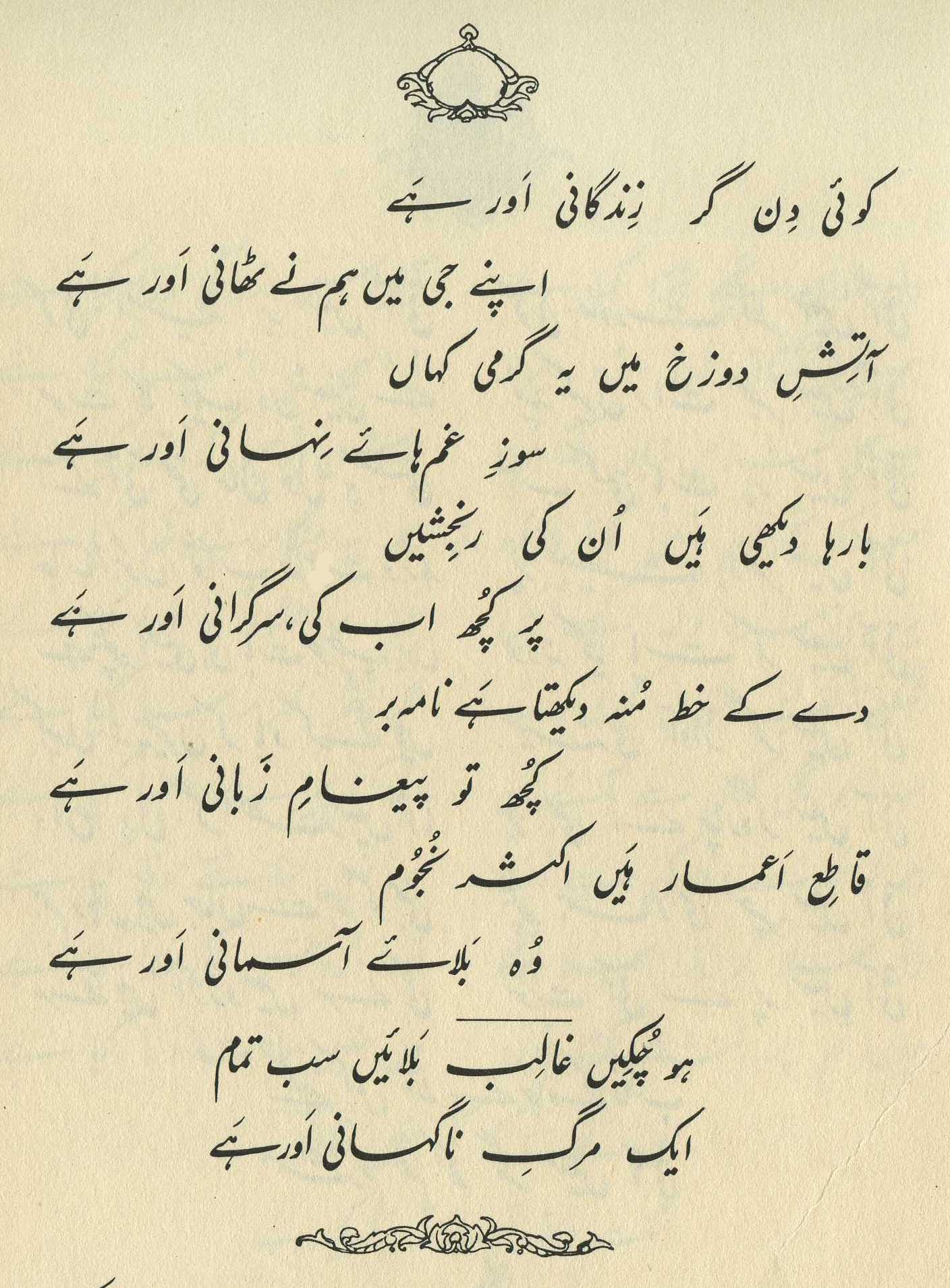
[1861, to Majruh:] Why even ask about the epidemic? In the quiver of the skilful archer Fate, there was only this one arrow left. The slaughter was so general, the looting so severe, famine so major-- why wouldn't there be an epidemic [too]? The Tongue of the Unseen [i.e., Ghalib himself] said ten years ago: {160,6}. My friend, the matter of the year 1277 A.H. [or 1860/1, which Ghalib had predicted as the year of his own death] was not wrong, but I didn't consider it worthy of me to die in a common epidemic. Really, it would have diminished my glory. After this turmoil is over, we'll see about it. (Arshi 313-14)
==Urdu text: Khaliq Anjum vol. 2, pp. 529-30
==another trans.: Russell and Islam , p. 258
[c.1867, to Mina:] Due to events of the time and diseases of the body, I'm only half-alive. In this transitory sarai I'm a guest of only a few days: {160,6}. ==Urdu text: Khaliq Anjum vol. 2, p. 828
[c.1867, to Mina:] Due to events of the time and diseases of the body, I'm only half-alive. In this transitory sarai I'm a guest of only a few days: {160,6}. ==Urdu text: Khaliq Anjum vol. 2, p. 828
Here by is meant not 'sudden death', but rather that when death comes, it is unexpected-- after all, from saying 'death' it doesn't just come. (173)
== Nazm page 173

He says, 'Oh Ghalib, all the difficulties you had to confront in life have worked themselves out and are finished. Now there's remained only one more sudden-misfortune death.' Death doesn't come just from saying 'death'. There's no telling when it would come. It will certainly come, and will attack without prior warning; I am always waiting for it. (230)
[In response to Nazm's commentary:] The Lord knows why a 'sudden-misfortune' death would not be meant. It's also not true [to say that death comes unexpectedly], because many diseases and conditions are such that the sick person knows beforehand not the day or date, but that now he would die. (308)
A ghazal with a refrain of is a natural place to exploit the ambiguities of , and this verse follows 160,1 and 160,4 in taking advantage of the built-in opportunity.
Thus if we take to mean 'more, additional', as in (2a), then the speaker is simply adding up the list of disasters that has constituted his life: this one is over, that one has done its worst, and so on-- oh, come to think of it, there's one more coming, death, and then that really will be the end. The word 'one' thus contributes to the arithmetical sense of adding them all up.
And if we take to mean 'different, other', as in (2b), then the speaker is making a category distinction. All the disasters are already over. This means that death is either a disaster of such utter magnitude that it requires a whole new word or concept to capture it; or else not a disaster at all, but something else-- maybe even a blessing, or a welcome release, or a sufistic union with the beloved, or something else that 'doesn't count' in the tally of disasters. On this reading, the emphasizes the singularity and unique status of the that's yet to come.
graphics/flatline.jpg