Verse 51853arhai kyaa kahiye
G9
In this meter the next-to-last long syllable may be replaced by two shorts.
1
deliberately she asks about his situation, in the bazaar, in such a way
2
that he would say this: that 'It is the roadside-- what can one say?!'
| References | |
|---|---|
| Arshi, Imtiyaz Ali | Ghazal# 227 |
| Raza, Kalidas Gupta | 440-41 |
| Hamid Ali Khan | Open Image |
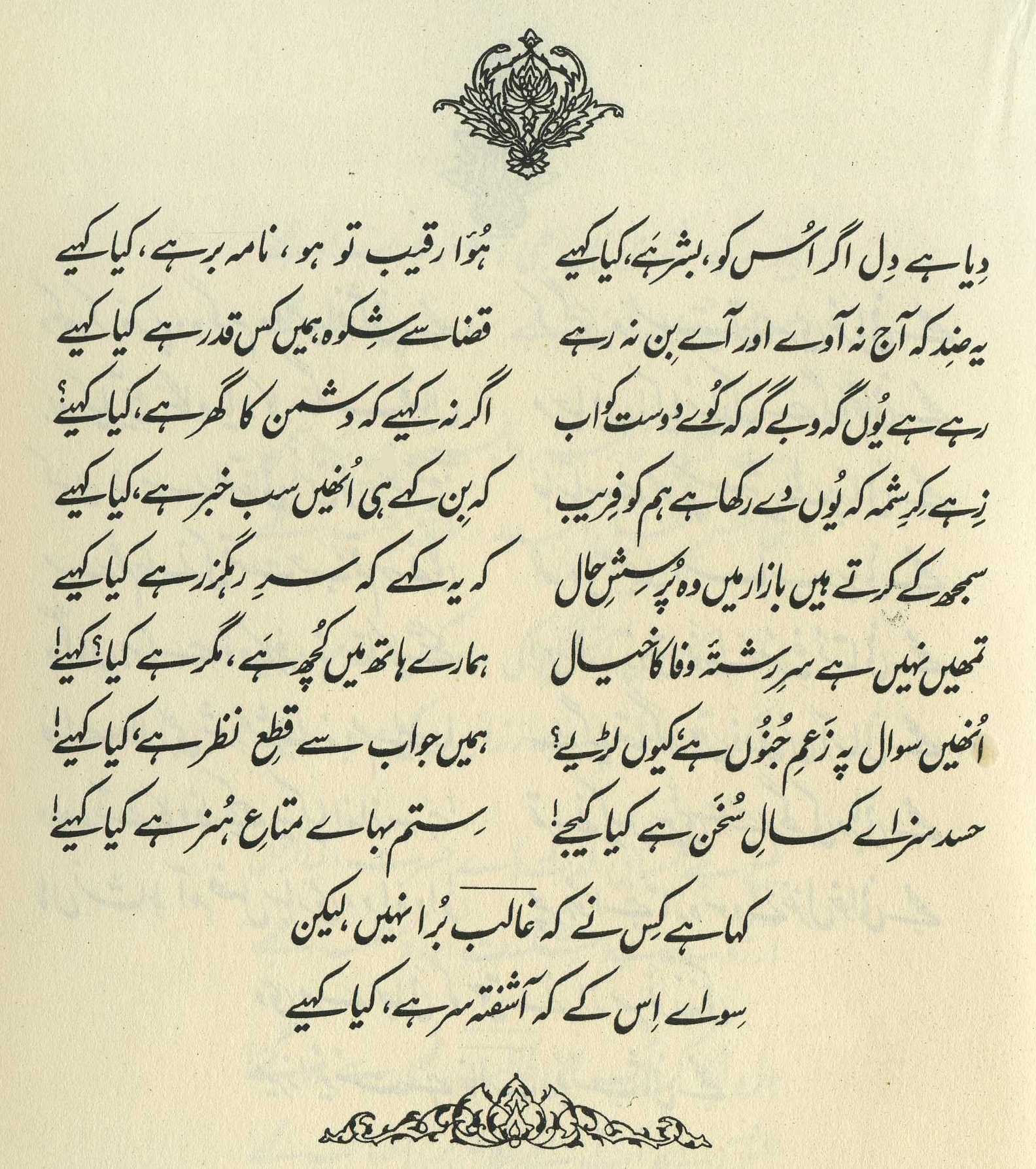
The excellence of this verse is that it bears witness to the beloved's being tricky/devious [] and mischievous in her temperament. (225)
== Nazm page 225

He says, that coquettish one considers that 'Mirza Sahib, because of his dignity [], will be embarrassed to speak to me on the street, and in reply will say that this is not the occasion for conversation.' (283)
In his heart he is telling to some confidant, the state of the beloved's trickery/deceit []. (394)
This is a good chance to continue our discussion of the complexities of . In the previous verse, 201,4 , one of its uses was as a very flexible form of quote-marker (as in the second instance here). But in the present verse the first instance of has to mean something like 'so that, in order that'. (This is a logical reversal of the 'since, because' sense in the previous verse.) How do we know which way goes in any one case? Sometimes through grammar: in the present verse, the subjunctive is a good clue, while in the previous verse the indicative is another. But in other cases, the meaning could genuinely go either way, and has to be puzzled out through sheer semantic context; which makes it a great tool for a brilliantly sadistic word-gamer like Ghalib.
Here the beloved torments the lover with a show of sympathy-- but a cleverly impossible one. She makes him an offer he can't accept. Right in public, in the marketplace, she asks how he is. She knows perfectly well he'll have to say, 'We're out here in the street, how can I tell you anything?!'. Here works as a rhetorical part of his expostulation.
Or perhaps she makes her inquiry not even from the lover himself, but from the usual gossipy crowd in the bazaar. On this reading, perhaps the bazaar gossipers have some sense of sympathy and/or decorum, so that they don't want to humiliate the lover in public, and they decline to provide her with information. Or else they genuinely don't know anything about him, and claim with a shrug of the shoulders that too many strangers pass by for them to keep track of any particular one.
Such a beloved, with her calculated use of publicity, deserves a lover like the Other in 191,4 .
There's also a nice balance of similarity and contrast between 'that' [] in the first line and 'this' [] in the second. The colloquial flavor of in the first line is hard to translate-- when she 'does that situation-inquiry', the 'that' really, idiomatically, means 'such a', and calls attention to a description that is to be offered. The position of the makes this reading very attractive. Alternatively, the could be the subject, 'she does situation-inquiry'), so that we wouldn't need to postulate a colloquially omitted subject. This reading would normally be the more compelling, except for the piquant positioning of the .
Similarly, the in the second line can either be the subject ('this one would say') or-- if we assume an omitted subject-- the object ('he would say this').
On as 'to consider', see 90,3 .
graphics/wilson1841.jpg