Verse 61853arhai kyaa kahiye
G9
In this meter the next-to-last long syllable may be replaced by two shorts.
1
you have no thought/care for the end/origin of the thread/connection of faithfulness
2
there's something in our hand, perhaps/but-- what is it? --please say!
'Head, top, pinnacle, tip, end, point; front, face; origin, beginning; head, chief; intention, end, aim; inclination, will, desire, love'.
'Thread, string, line; series; connexion, relationship... ; alliance, affinity'.
| References | |
|---|---|
| Arshi, Imtiyaz Ali | Ghazal# 227 |
| Raza, Kalidas Gupta | 440-41 |
| Hamid Ali Khan | Open Image |
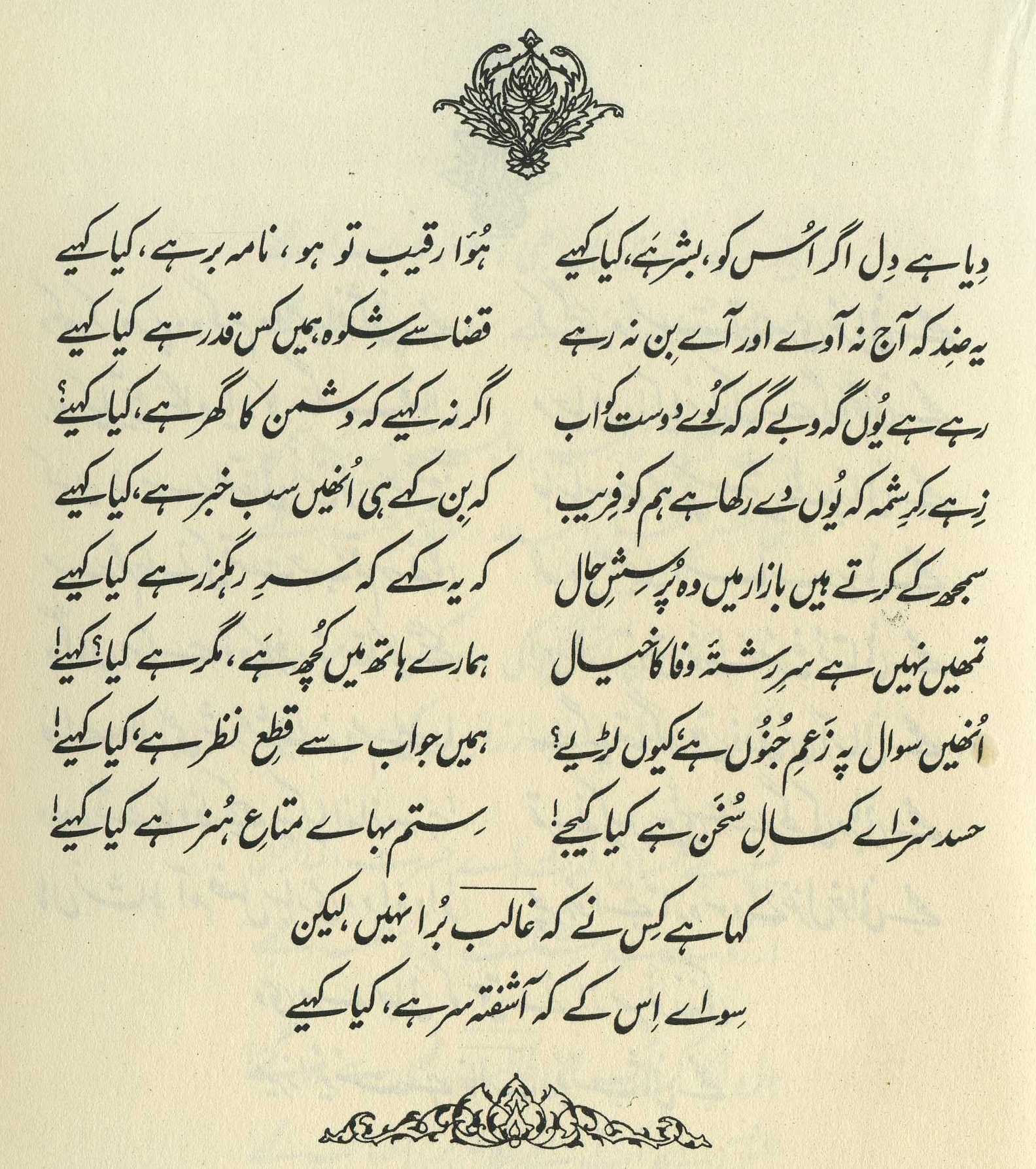
This verse's style of construction is new, and its theme too is fresh. The freshness of its theme is that is assumed to be a physical thing: he asks the beloved, 'Tell us what is in our fist'; and the inventiveness of the construction is that he's asked what's in the fist, but has also named the thing that's in the fist-- that is, 'There's something in our hand, but what is it? Tell us, since you have no thought for the '. (225)
== Nazm page 225

He says, 'You have absolutely no thought for the , you've entirely forgotten its mystery/secret. So for heaven's sake [] tell me what's in my fist!' Such a supreme height of expression and such stylishness of thought have been made present in this verse that he has established the non-physical as physical. And the crest-jewel of it is that he has earlier even named it, and despite having given the name he says, 'there's something in our hand, but you tell us what it is, you have no thought for the '. (283)
In this verse, besides the beloved's being pitiless and ill-tempered, there's a subtle allusion to her simplicity as well. That is, even having been told, she is unaware of the reality that the lover is forcefully gripping the . But the beloved hasn't the smallest sense of it. (395)
The commentators treat the verse as a kind of parody of a classic children's game-- 'Guess what's in my hand!'. As they point out, the idea is that even when already prompted in the first line, the beloved is so radically indifferent to the that she still can't guess the answer.
That works, but I think there's more going on as well. Though it's more complex than the average mushairah -verse, this verse too has a deceptive, misleading first line that the listener must then radically reinterpret when-- in oral performance, after a suitably suspenseful delay-- the second line is finally vouchsafed.
The first line invites us to abstractness and conventionality. The word has such a variety of abstract meanings (see the definition above) that we really hardly know where to go with it. Then the same is true of the word , which in normal usage more often means 'relationship' than 'string'. When we come to , we easily move to an abstract meaning, because the beloved's heedlessness of a 'relationship of faithfulness' is so much more plausible than her heedlessness of a 'string of faithfulness'. We can now see that the lover is berating the beloved for her faithlessness, and we're prepared for some further elaboration of the usual complaints or laments in the second line.
Thus the first part of the second line comes as a kind of abrupt shock of incomprehensibility. Have we blundered into a different verse entirely, and is this a children's game? Not until the very end of the second line, and even perhaps for a few moments afterwards while our minds race to put it all together, do we 'get' what's going on. Now suddenly we have the unfolding enjoyment of all the layers: it's a child's game, it's a taunt, and it's a complaint.
In addition, it also has the sneakily clever quality noted by the commentators, that the beloved has already been told the answer-- though, like us, she probably misunderstood it as abstract (something about a 'relationship') rather than concrete (something about a 'string'). Or of course she might not have been paying attention at all, which is always a major risk when the lover is reproaching the beloved. So has he 'got' her, with his wit and his cute but sharp-edged childish taunt? Or has she 'got' him, since she's so indifferent she hasn't even bothered to listen to all that barbed wit?
There's one further enjoyable feature of this spectacular verse. Different verses in this ghazal play with the refrain , turning on and off its idiomatic and literal meanings at will. This verse provides a new wrinkle: while 201,3 turns the whole refrain into a single phrase of completely unidiomatic semantic 'normalcy', this verse turns the refrain into two separate bits of such 'normalcy': the becomes part of the phrase , or 'what is it?' (with the 'it' colloquially omitted), while the is left alone to mean 'please say'.
graphics/string.jpg