Verse 81853arhai kyaa kahiye
G9
In this meter the next-to-last long syllable may be replaced by two shorts.
1
envy/jealousy is the punishment for accomplishment in speech/poetry-- what can be done?
2
tyranny is the price of the wealth of skill/craft-- 'what can you say?!'
'Envy, malice; — emulation, ambition'.
is an archaic form of ( GRAMMAR )
'Price, value;... -- , s.m. Blood-money'.
| References | |
|---|---|
| Arshi, Imtiyaz Ali | Ghazal# 227 |
| Raza, Kalidas Gupta | 440-41 |
| Hamid Ali Khan | Open Image |
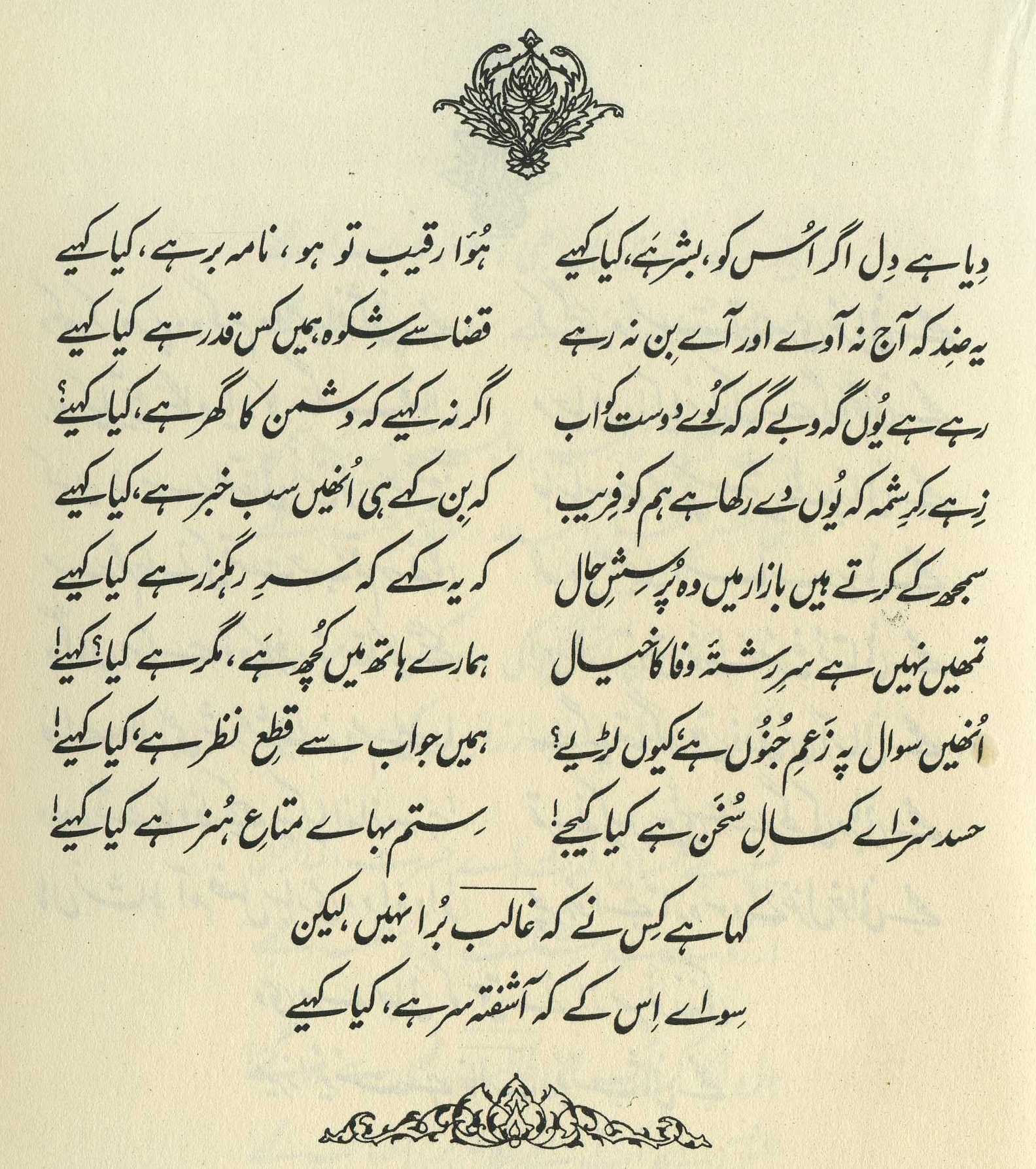
In this verse too the beauty is only because of the similarity of the construction and ornamentation [of the two lines]. They say and on an occasion of feeling weakness. (225)
== Nazm page 225

This verse too is of the same excellence [as 201,7 ]. He says, 'For the accomplishment of speech, the birth of envy is inescapable-- it is duress, what can be done? And the value of the wealth of skill/craft is daily tyranny, what complaint can be made? Both verses are the high point of the ghazal . (283)
It's great duress, it's a great Doomsday, that nowadays in return for being an accomplished poet people begin to feel envy, and if they see some skilled person, then instead of kindness they show him tyranny. That is, nowadays they envy people of skill, and give them sorrow-- and what kind of respect?! (395)
Nazm rightly emphasizes both the parallelism, and the enjoyably exclamatory use of idioms, that give this verse its oomph. As Bekhud Dihlavi notes, the verse seems to follow naturally from its predecessor, 201,7 ; he also singles out these two verses as, collectively, the high point of the ghazal .
And of course the idioms are not just generally appropriate in mood-- able to express ruefulness, vexation, frustration, a shrug of the shoulders, wry amusement, or whatever other tone you want to read them in-- but are also specifically appropriate to the semantic content of each line. The first line decrees an action, a 'punishment', and its idiomatic ending resigns itself in terms of another action, expressed in an archaic form of the passive-- 'what can be done?'. The second line seems to evoke a mercantile transaction: there is a 'price' for a kind of 'wealth' or 'property', so that 'what can you say?' is appropriate to a situation of bargaining or negotiation. And of course the 'wealth' is that of poetry, literally 'speech', itself, so 'what can you say?' acquires a whole extra dimension of relevance.
Bekhud Mohani insists that the verse is a complaint against the way the world in general treats poets 'nowadays'; needless to say, there's no such indication of temporality in the verse itself. Moreover, 'envy/jealousy' is often felt by rival lovers, not just by rival poets; and 'tyranny' is particularly appropriate to the beloved's behavior. So the verse might also ruefully refer to the way the lover's reward for his poetic skill is jealousy from his rivals, along with cruelty (which can often be a sign of favor, acceptance, and attention) from the beloved herself.
graphics/handwriting1.jpg