Verse 51821aa;Nsamjhaa
G5
In this meter the first long syllable may be replaced by a short; and the next-to-last long syllable may be replaced by two shorts.
1 a
through my own weakness [I] realized/knew this: that she will be ill-tempered
1 b
because of my own weakness [I] believed this: that she would [presumably] be ill-tempered
2
from the pulse of the straw [I] understood the heat of the burning flame
'Powerlessness, impotence, weakness, helplessness, submission, wretchedness'.
| References | |
|---|---|
| Arshi, Imtiyaz Ali | Ghazal# 13 |
| Raza, Kalidas Gupta | 325 |
| Nuskhah-e-Hamidiyah | 56-57 |
| Gyan Chand | 91 |
| Hamid Ali Khan | Open Image |
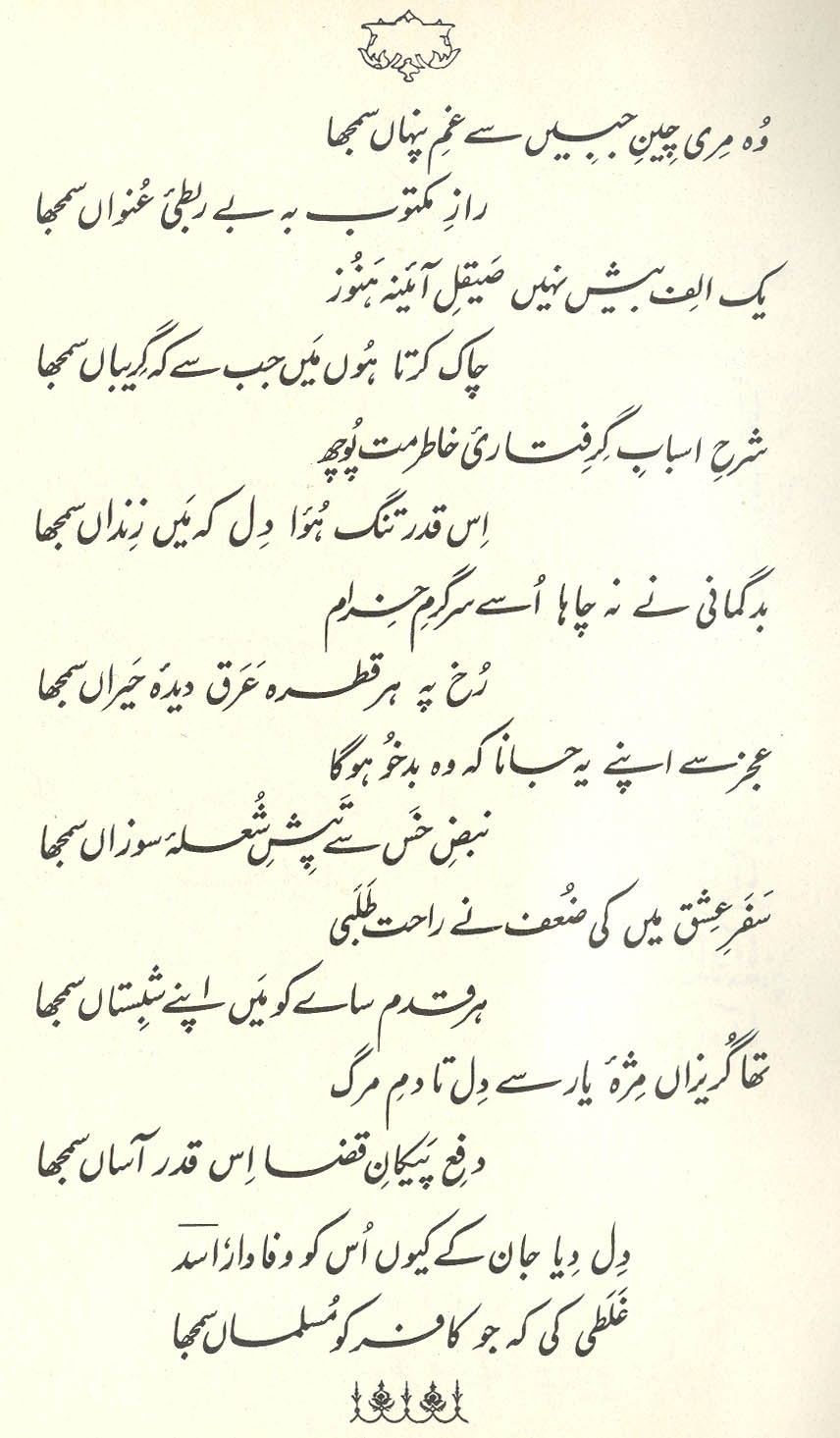
He has envisioned weakness as straw, and ill-temper as flame, and used for straw the simile of a vein with a pulse.... This verse should be read in a tone of sarcasm and reproach. The poet blames himself: 'Due to my weakness and incapacity, I considered that she must be ill-natured and bad-tempered. I should avoid this. As if the heat of the flame can be learned from the pulse of the straw!' (33)
== Nazm page 33

Urdu text: Vajid 1902 {34}
From my weakness and her ill-nature I understood that the way burning flame burns grass and straw, her wrath will be the cause of my destruction and murder. (66)
The effects of my burning in the fire of passion had already come into being. From my own abjectness I considered that the beloved must be an effigy of fire. (81)
This verse is one of Ghalib's most difficult but extremely meaning-creating [] ones. The word 'weakness' is the key to it. It refers to being weak in the ability to make the beloved happy. (357)
As so often, we must decide without help from the verse itself how to connect the two lines. Does line two merely provide a metaphorical illustration for line one, so that they describe the same situation? Or do the two lines operate independently, linked only as two examples of what the lover did? The verse shows a certain parallelism of structure (on this see 22,5 ), though not the maximum possible amount.
If line two is taken as simply elaborating on line one, then the complexities of line one become significant. Is the speaker's knowledge accurate, so that his weakness is a reliable indicator of the beloved's ill-temper (1a)? Or is it the cowardice and hesitation induced by his weakness that causes the speaker to fearfully impute to her bad temper what are really his own deficiencies (1b)? The verb , although it's usually translated 'to know', can also be used for erroneous beliefs; see 34,8 for an example.
Nazm's reading of (1b) causes him to read line two as an equally erroneous statement-- the speaker is foolish enough to make a wild misjudgement, which is revealed as folly by the absurdity of the metaphorical parallel offered for it: 'As if the heat of the flame can be learned from the pulse of the straw!'
But it's also worth noting the elegance of (1a). This reading implies that the beloved is at the core of the speaker's being: he is able to know about the beloved's temperament through his own physical state, just the way he is able to know about his own heart through his physical state (since of course the beloved is in his heart, controls his heart, owns his heart, etc.) Why should such information necessarily be erroneous? (See 25,3 for another case in which the beloved seems to have penetrated deeply into the lover's psyche.) On the same grounds, perhaps the pulse of the straw as it quivers and begins to crackle is indeed an accurate measure of the heat of the flame, since the fire is at its heart. After all, in many medical traditions, including Indic and Islamic ones, the examination of the patient's pulse has been treated as a significant diagnostic tool.
Note for grammar fans: The form of makes it either a future tense, so that the beloved's behavior at some future time is being forecast (1a); or else a presumptive, so that the beloved's present behavior is being guessed at or estimated from a distance (1b).
graphics/strawburning.jpg