Verse 21833iikii sharm
G3
1
those circles of curls are in ambush, oh Lord --
2
may the honor/shame of my claim of liberation be upheld!
is a third-person future imperative of ( GRAMMAR )
'Liberation, deliverance, salvation; --humility'.
'Shame, bashfulness, modesty'.
| References | |
|---|---|
| Arshi, Imtiyaz Ali | Ghazal# 83 |
| Raza, Kalidas Gupta | 381 |
| Hamid Ali Khan | Open Image |
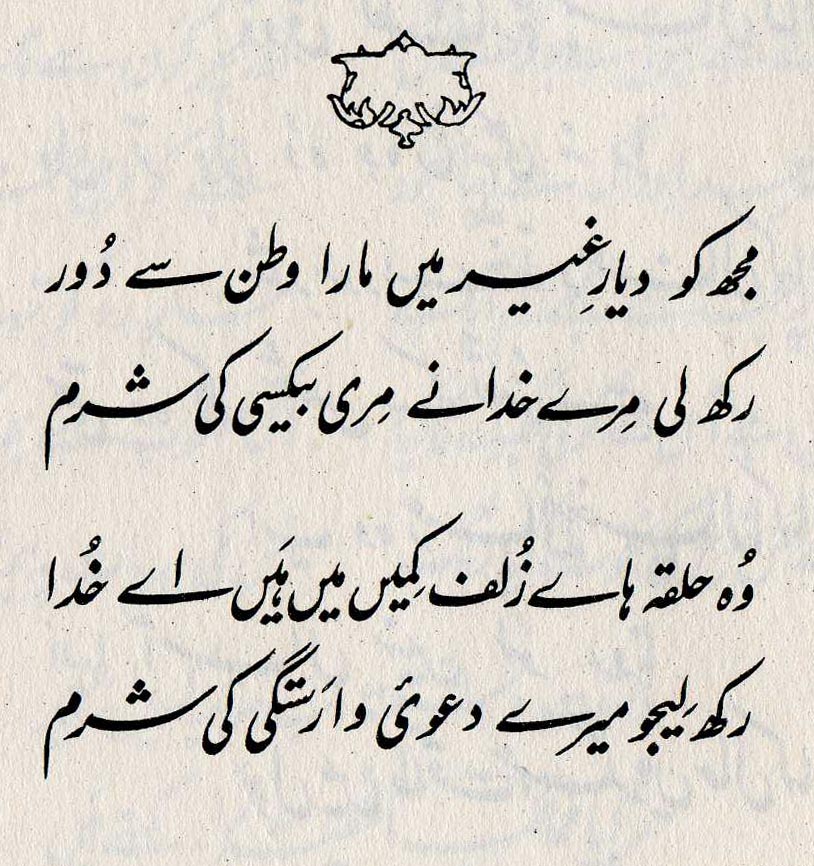
That is, if I become a prisoner of the curls, then my claim of freedom and liberation will no longer remain. (83)
== Nazm page 83

He says, 'Her veiled curls are lying in wait for me. Oh Lord, now the honor/shame of my claim of liberation is in your hands. Preserve my honor/shame!' The meaning is that if I become a prisoner of the curls, then my claim of freedom and deliverance will prove false. (132)
I pride myself on not having come into the snare of any beautiful one. 'Oh Provider, maintain the honor/shame [] of my claim! The circles of the beloved's curls are in ambush for me.' From this prayer, we learn that there is such heart-deception in those curls that the foot can be seen to falter and he says that to escape them is impossible without support from the Unseen. (171)
On the complexities of the word , with its meaning of 'honor/shame', see the previous verse, 83,1 .
The first line is a panicky exclamation, the second a cry for help, making the verse another of the countless examples of Ghalib's love of speech. As the commentators explain, the lover begs God to help him avoid the terrible allure of the beloved. Her curly tresses are like the meshes of a net or snare, and they lie in ambush, waiting to capture their prey.
This is a verse in which those who maintain that the beloved can always be taken as God find the going somewhat awkward. Clearly the lover is asking God for help with the beloved; it's hard to make sense of the verse in any other way. (It would really be an extraordinary casuistry that could make the lover ask God to help the lover escape His own curly tresses.) For more examples of such verses, see 20,3 .
Why should God help the lover? The word has religious as well as worldly dimensions (see the definition above). It can mean 'liberation' from many things, including the world-- and certainly including the snare of passion. The lover may be proposing a cleverly transactional deal here: 'Oh Lord, if you help me maintain my 'liberation' from passion, I can devote my full attention to You-- but if those curls get me, it's all over!'
As Bekhud Mohani points out, the lover's needing to call on God for help is clear proof in itself of the irresistibleness of the beloved's power. The lover's desperate cri de coeur sounds as if it's already too late for any rescue to reach him.
graphics/nettrap.jpg