Verse 11816uusthaa
G1
1
last night when/since/while she was a gathering-illuminator of the seclusion of honor/dignity
2
the wick of every candle was a thorn in the clothing of the glass-shade
'Loneliness, solitude; seclusion, retirement, privacy; a vacant place, a private place or apartment, a closet, &c. (to which one retires for privacy); a cell (for religious retirement) ;—private conference'.
'Reputation, fame, renown; esteem, honour, grace, dignity'.
'Reputation, fame, renown, esteem, honour; dignity; law; divine decrees or judgments; disgrace, reproach, shame; bashfulness, modesty, chastity'. (Steingass p. 1380)
'Dress, apparel, robe, habit; appearance; (met.) figure, form; manner'.
'A pharos, lighthouse; a lantern; (in Urdu) a glass shade (of a candlestick, &c.)'.
'A pharos, a light-house; a whisperer, a tale-bearer'. (Steingass p.905)
| References | |
|---|---|
| Arshi, Imtiyaz Ali | Ghazal# 31 |
| Raza, Kalidas Gupta | 160 |
| Nuskhah-e-Hamidiyah | 83-84 |
| Asi, Abdul Bari | 71-72 |
| Gyan Chand | 116 |
| Hamid Ali Khan | Open Image |
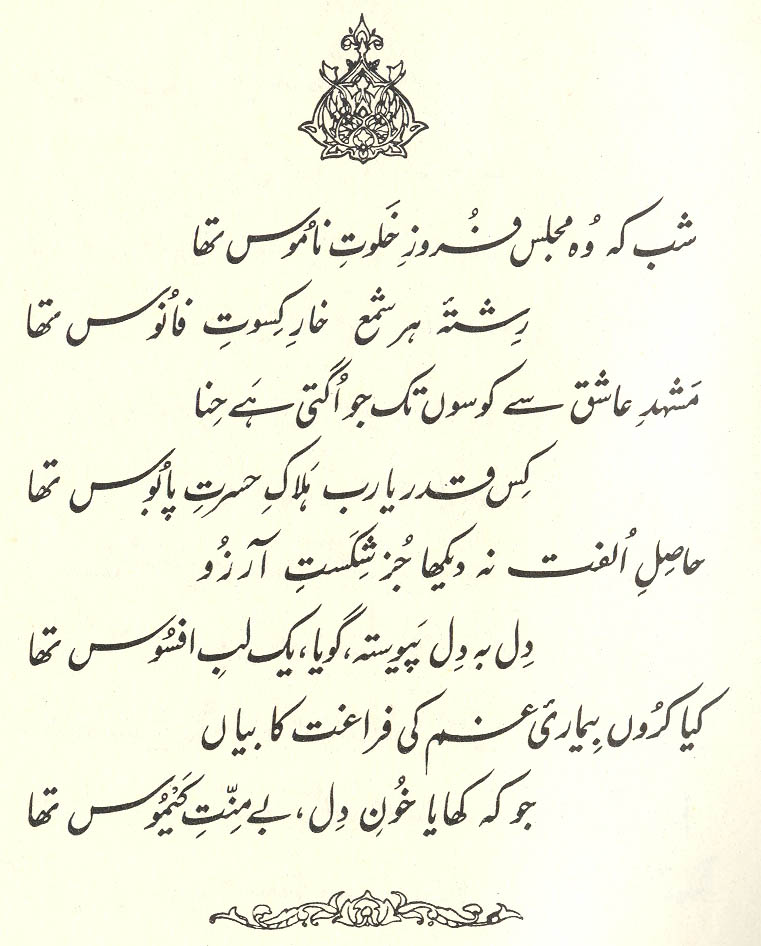
In short, before her the candle kept growing restless, as if there were a thorn in its clothing. (37-38)
== Nazm page 37

Urdu text: Vajid 1902 {39}
The meaning is that in the beloved's modest seclusion, where no one was admitted, even the candle had come to be in an extraordinary state of infatuation. (39)
'To have a thorn in one's robe' [] is a Persian idiom. Mirza Sahib has put it into an Urdu verse. A lantern-frame is usually made out of iron wires over which they put a light fabric. The meaning of the verse is that last night, in the privacy of the gathering of shame and modesty, the beloved was illuminating the assembly. Before her the candle was melting with shame, and the candle-wick had become the thorn in the candle's robe. (74)
The lantern wanted to somehow remove the candle from its embrace, and place the beloved in its heart. (91)
'Seclusion' and 'gathering' are two different things. There's no telling why he described 'seclusion' as 'illumining the gathering'. Perhaps he considered beauty and its requisites to be the members of the gathering. (180)
The light of the candle shines out from the glass-shade, and makes the glass-shade reddish. From the heat of the candle, the glass-shade becomes hot and dry. Redness and heat and dryness are signs of restlessness. The glass-shade in which redness and heat are violently glowing, is in this state because of the candle-wick. Thus, it's been proved that the candle-wick is prickling like a thorn in the robe of the glass-shade. And since the glass-shade is the robe of the candle, we have learned that the candle 'has a thorn in its robe' (that is, is restless).
The real reason for the candle's restlessness is contained in the first line, in . (1) The beloved was a 'gathering-illuminator'. 'Gathering-illumination' is also a quality of the candle's. Having seen its gleam eclipsed and its gathering-illumination diminished, the candle was burning with envy. Thus it was restless.
(2) The clothing on its body was pricking the way thorns prick; the candle wanted to remove it and cast it aside, in order to make itself unclothed and naked before the beloved, so that the beauty of the unveiled beloved and the unshaded candle could be compared face to face.
(3) Between the beloved's radiance and the candle was the glass-shade. For the glass-shade to obstruct in this way was not pleasing to the candle. The candle was restless, wanting to remove the glass-shade and fling it aside so as to adore/worship the radiance of the beloved without hindrance.
In the light of this commentary, every claim made by the verse is seen to be firmly proved, and all its images are established as tightly interlocked....
If we reflect, then the word is not so useless, either. In the [dictionary] one of its meanings is given as 'possessor of a secret'. Into the beloved's seclusion only those people come who in one or another sense are her confidants. Another aspect is that women who live in seclusion are also called , and this meaning is not so unsuitable either.
==(1989: 54-55) 2006: 70-72
Faruqi does much to elucidate this verse; among other contributions, he grounds its imagery in actual physical qualities, which is always a help, and explicates some of its wordplay. We need to read the in , clothing 'of' the glass-shade, as meaning not 'clothing worn by the glass-shade', but rather 'clothing [worn by the candle] that is the glass-shade'. This reading is perfectly possible. But still, the wick is the literal heart of the candle itself, so how can it also be construed as a thorn in the candle's clothing? The verse remains structurally awkward. Perhaps the source of it was the Persian idiom invoked by Bekhud Dihlavi, and Ghalib simply failed to develop it sufficiently.
Shadan's plaintive remarks highlight one enjoyable aspect of the verse: the contrast between the 'gathering' and the 'seclusion'. Wherever the beloved appears, everything around her is compelled to adoration, even the candles in their glass shades, so that even when in 'seclusion' she is always surrounded by a 'gathering' of ardent admirers.
Moreover, she herself always 'illumines' this gathering, and does such a brilliant job of it that naturally the candle is ashamed at being outshone. Thus there are indeed several (literal and metaphorical) reasons for every candle to 'have a thorn in its robe'. And the multivalence of always enables the candle both to burn, and to 'burn with envy'.
ABOUT : The word seems to have a general meaning of a source of light that is surrounded by glass (see the definitions above), presumably to protect it from wind; in Urdu, it is also specifically used for 'a glass shade (of a candlestick, &c.)'. What would it have looked like? Perhaps something like this:
graphics/fanus.jpg
Another possibility, more elegant but probably harder to keep clean, would be this . But who can say? We don't even know whether Ghalib himself had any real acquaintance with such an item; he might well have simply picked up the image from the Persian ghazal tradition (as he did with the 'paper robes' in 1,1 , and in many other cases). Other verses: 188,3x ; 296x,3 ; 298x,2 ; 299x,3 ; 388x,4 . Some Mir ian examples: M 1646,1 ; M 1757,2 .
graphics/candlewick.jpg
