Verse 3x1816aanahchaahiye
G3
1
the lover, [as] a veil of the glory/appearance of the beloved, is needed
2
for a glass-shade of the candle, a wing of the Moth is needed
'A glass shade (of a candlestick, &c.)'.
| References | |
|---|---|
| Arshi, Imtiyaz Ali | Ghazal# 155 |
| Raza, Kalidas Gupta | 283-84 |
| Nuskhah-e-Hamidiyah | 224-225 |
| Asi, Abdul Bari | 233-234 |
| Gyan Chand | 359-360 |
| Hamid Ali Khan | Open Image |
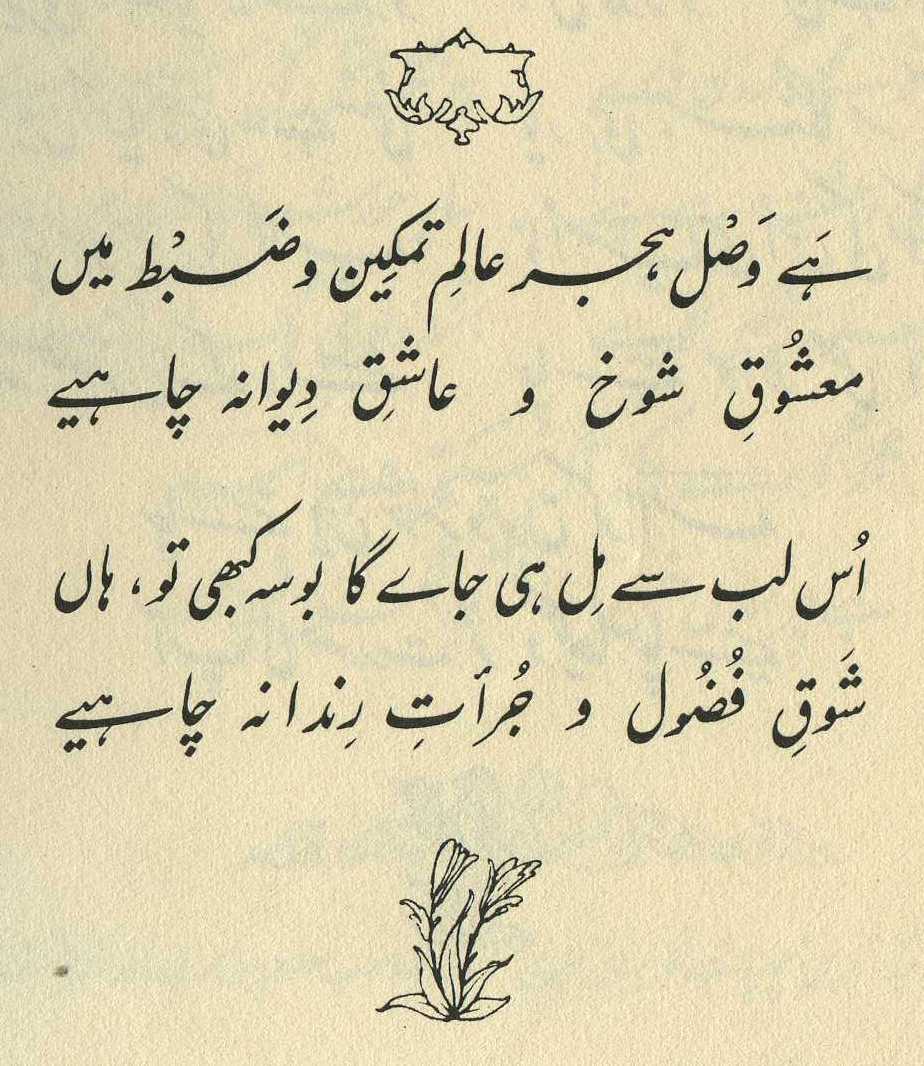
The lover ought to be a veil for the glory/appearance of the beloved, and the radiant glory/appearance of his beloved ought to spread the way in which where there would be a candle, it is more proper for a glass-shade to be made from the wings of Moths.
== Asi, p. 233
The lover would be a veil of the glory/appearance of the beloved. From this two meanings can emerge. One is that the lover would conceal his passion.... But this theme has no connection with the second line. Therefore, consider that the beloved has no need to conceal her face in a veil; rather, she ought to make the lover's heart into her veil. That is, in the lover's heart she shows her glory/appearance. The second line is allegorical: that is, the way the Moth's wing is the proper glass-shade for a candle, in the same way the lover's heart is the proper veiledness for beauty.
== Zamin, p. 352
Over the candle there ought not to be a glass-shade, but rather a 'glass-shade' of the wing of the Moth. The lover ought to become the veil of the glory/appearance of the beloved.
== Gyan Chand, pp. 359-360
For background see S. R. Faruqi's choices . For more on Ghalib's unpublished verses, see the discussion in 4,8x .
On the nature of a , see 39,1 .
The glass-shade of a candle both protects the candle (from wind, and from any too-close approach) and permits the candle's light to be visibly radiated (that is, the glass-shade is not opaque but transparent). The wing of a Moth can be a glass-shade only in a generalized metaphorical way-- but then, the same is true of the lover's heart. The operative quality seems in both cases to be the sense of both sheltering and diffusing the beloved's radiant beauty, at the cost of the lover's life.
The juxtaposed repetitions of almost give an effect of fluttering. Compare 166,3 , with its different unorthodox use of the wing of the Moth.
Note for grammar fans: Obviously there are dodgy things going on with the grammar of . The second line looks straightforward: X Y , X needs Y. But of course that doesn't work very well semantically: it's not the candle-shade that needs the Moth's wing, but the candle. So we need to read as if it were , which is a permissible alternative and solves the problem. The first line offers X Y . In isolation, that would be best read as 'X and Y are needed'. But that too doesn't work, in semantic terms. The most satisfactory way out of the problem is to take X and Y in apposition: 'an X which is a Y is needed'.
graphics/candleglassshade.jpg