Verse 51838anke paa;Nv
G3
1
oh God , the taste/relish of/for desert-wandering! --that after death
2
they move/stir by themselves within the shroud, my feet
| References | |
|---|---|
| Arshi, Imtiyaz Ali | Ghazal# 122 |
| Raza, Kalidas Gupta | 386-87 |
| Hamid Ali Khan | Open Image |
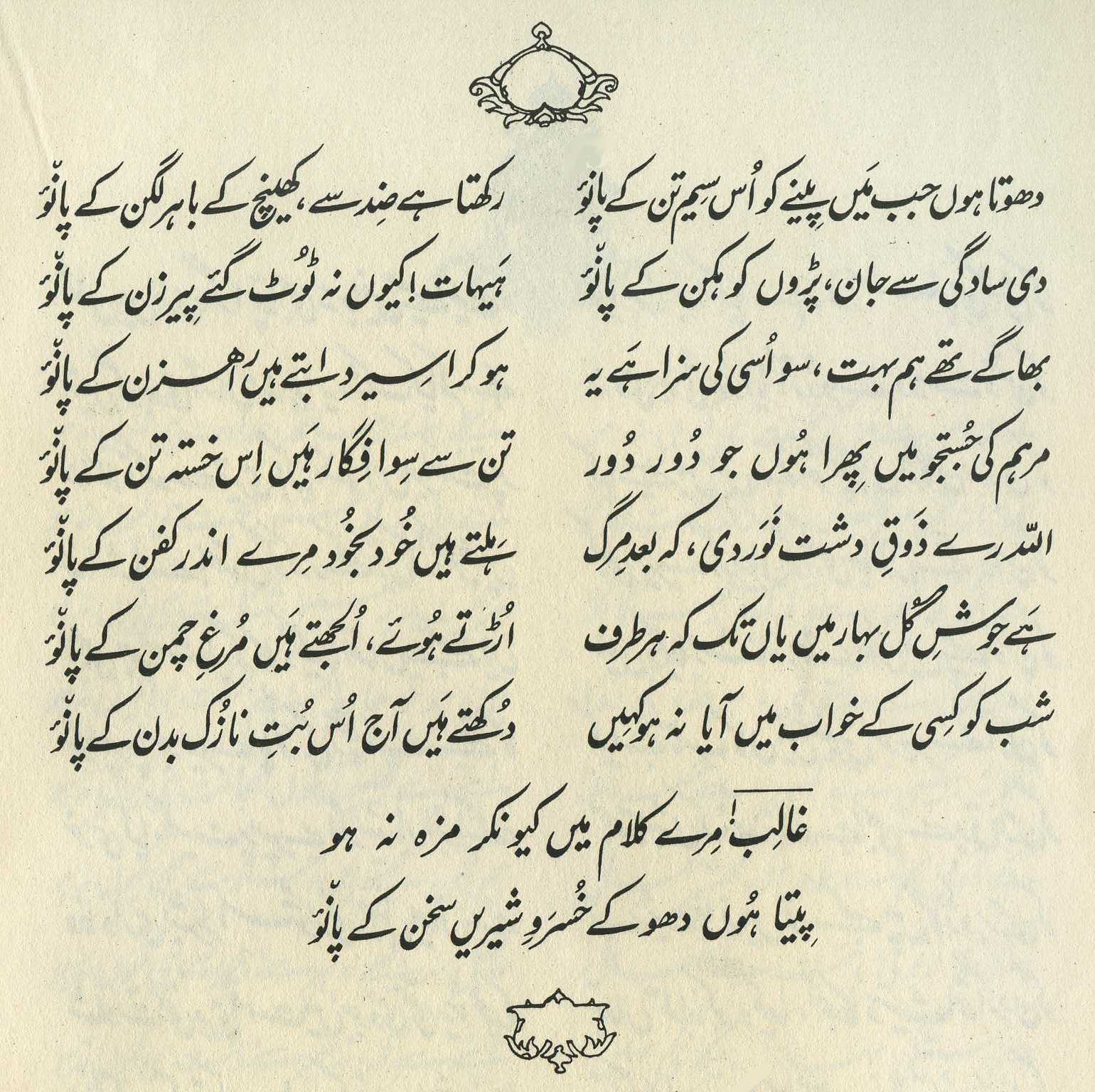
For the feet to move by themselves in a state of relish and ardor is a common and natural thing, and the author was the first to versify it. (130)
== Nazm page 130

He says, 'Even after dying, the ardor for desert-wandering is with me. In life, I wandered around the wildernesses of the world. After death, I am moving through fields of nonexistence.' It's a completely unheard-of thought. (184)
The lover's corpse is saying, in the language of its situation, that there's no limit-- even in the shroud, my feet move by themselves.... This verse is peerless. (246)
This verse is an obvious member of the 'dead lover speaks' set; for others, see 57,1 .
The feet are moving somehow within the shroud, but the range of is wide-- are the feet actually attempting to walk? (This is the obvious first reading, but it's a bit zombie-like and grotesque.) Or are the feet merely quivering with memory or desire? Or might they simply be expressing some more abstract anxiety or restlessness?
In any case, the speaker doesn't necessarily share their relish. The feet are moving spontaneously, not by his will, and perhaps the longing for desert-wandering is theirs alone. Just as the speaker seems to have no choice in the matter now that he's dead, perhaps things were similar when he was alive.
Thus he may be lamenting not the loss of the chance to go desert-wandering, but the aggravating persistence of his feet in still wishing to do so. Consider for example 31,2 or 107,6 , in which the lover laments the incurably vexatious behavior of his heart. Perhaps here he's finding his feet to be equally exasperating. As so often, the simple exclamation itself forces us to choose our own tone in which to read it.
Note for grammar fans: That wide separation in is a bit jarring. It's true that basically we can tell that modifies , because if it were to modify the word order would absolutely have to be (since postpositional phrase boundaries are so powerful). Even so, the effect of 'my, within the shroud, feet' is as annoying in Urdu as it is in English. If you, dear reader, compose a ghazal, don't do that kind of thing. You really have to be Ghalib to get away with it.
graphics/legs.jpg
From a privately printed collection by Kamil Hyderabadi, with thanks to Mansoor Khan