Verse 11838anke paa;Nv
G3
1
when I wash, for drinking, the feet of that silver-bodied one
2
out of contrariness/stubbornness, she draws back her feet and keeps them out of {contact / the brass basin}
'Contrariety, opposition, the spirit of contrariness; persisting, persistence, insistance, perseverance, pertinacity, obstinacy'.
'The being attached (to); the coming in contact (with); attachment, affection, love, friendship; desire, longing'.
'A brazen or copper pan (in which the hands are washed, or in which bread, &c. is baked)'.
| References | |
|---|---|
| Arshi, Imtiyaz Ali | Ghazal# 122 |
| Raza, Kalidas Gupta | 386-87 |
| Hamid Ali Khan | Open Image |
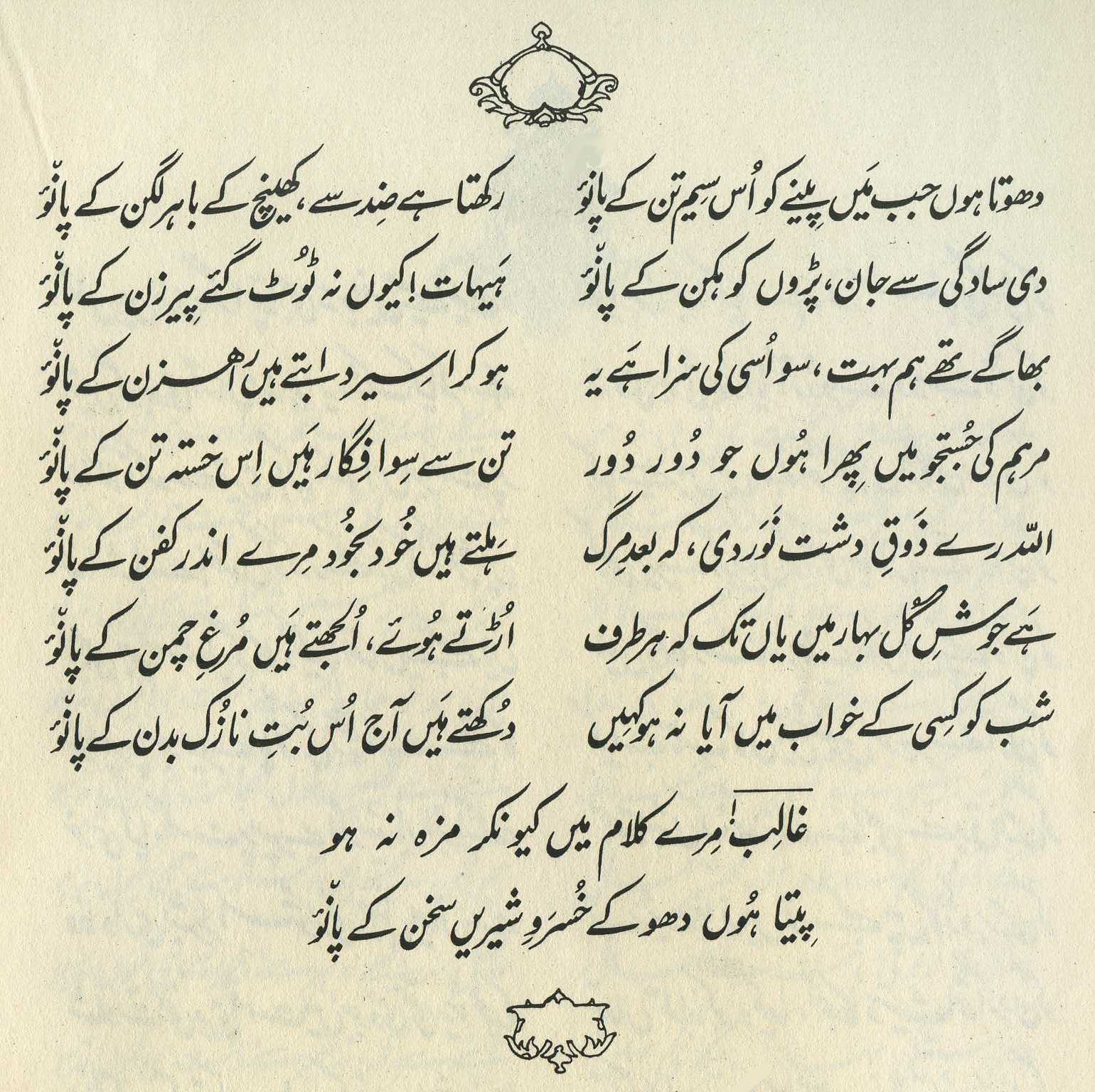
The author has taken this theme from the women's idiom: they say, 'May the Lord grant that your husband again and again wash your feet, and again and again drink the water'-- that is, may he love you very much. Otherwise, in reality to wash the feet and drink the water is no style of love. And the origin of this idiom seems to be that among the Hindus, they worship the feet of Brahmins, and one of the acts of worship is to wash the feet and drink the water. (129-30)
== Nazm page 129 ; Nazm page 130


To wash the feet and drink the water is a metaphor for the ardor of love. The rest of the meaning of the verse is clear. (183)
When it's looked at, this verse seems somewhat strange. But the truth is that even here Mirza has not abandoned his style. From this it emerges that Mirza's love has arrived almost at the limit of worship, so that he longs to drink the ['foot-nectar', as in a Hindu ritual of worship]. The beloved, considering this to be insanity, becomes anxious; and this seems to the lover to be stubbornness. (245)
What a lovely verse of wordplay-- and a classic mushairah verse too. The first line, a relative clause, is tantalizingly incomplete. Under mushairah performance conditions, we are forced to wait in suspense for the second line-- and even then, not until the very end of the line does the ideal, perfect, doubly activated word suddenly explode into our minds with a burst of sheer pleasure, retrospectively bringing the whole verse to several kinds of life:
= means 'contact, touch' (as well as 'affection, attachment'); the beloved, perhaps out of sheer (coquettish?) perversity, seeks to thwart the lover's desire to touch her feet, even if he approaches her in the humblest possible manner.
= refers to a vessel used for washing hands or feet (see the definitions above); in her perversity the beloved draws her feet back from the basin in which the lover seeks to wash them.
As if this perfect pair of meanings weren't enough, there's also an additional layer of wordplay: refers to a vessel made of copper or brass, while the beloved is 'silver-bodied'; she is thus made of a much more precious metal, and perhaps seeks to avoid contact with an inferior one.
Not one single commentary that I've read even mentions this one word that focuses and activates the whole delight of the verse. Go figure!
graphics/footwashing.jpg